Bible Activities That Get Kids Moving: 10 Fun Ways to Reinforce Faith Through Movement
If you've ever tried teaching a Bible lesson to young children, you've probably experienced it...
They're wiggling.
They're fidgeting.
They're rocking in their chairs.
They're looking everywhere except where you hoped.
It's easy to think they aren't paying attention.
But as a school-based occupational therapist, I've learned something incredibly important:
Movement isn't the enemy of learning—it often makes learning possible.
Children learn best when they can actively participate. By combining movement with Bible stories, Scripture, and faith formation, we help children engage more deeply, remember more, and experience God's Word in a meaningful way.
Whether you're a Catholic school teacher, religious education coordinator, Sunday school volunteer, children's ministry leader, or parent, here are ten simple ways to bring faith to life through movement.
Why Movement Helps Children Learn
Children's brains and bodies are designed to move.
Research continues to show that purposeful movement can improve:
Attention
Memory
Executive functioning
Self-regulation
Learning readiness
When movement becomes part of a lesson, children aren't simply burning energy—they're building stronger connections to what they're learning.
Instead of asking children to sit perfectly still for thirty minutes, consider inviting movement into your lesson.
You'll often discover they're more engaged than ever.
1. Walk Through Bible Stories
Instead of simply reading Scripture, invite children to become part of the story.
Can they:
Walk beside Noah?
Jump like frogs during the plagues?
Balance across the Red Sea?
Reach toward Heaven during the Ascension?
When children physically experience a story, they often remember it long after class is over.
2. Create Scripture Movement Stations
Choose several Bible verses and pair each one with a movement.
For example:
📖 "Be strong and courageous."
➡️ Ten giant jumps
📖 "Love one another."
➡️ Give yourself a big hug
📖 "Be still."
➡️ Take three slow breaths
Simple movements make Scripture memorable.
3. Use a Faith-Based Sensory Path
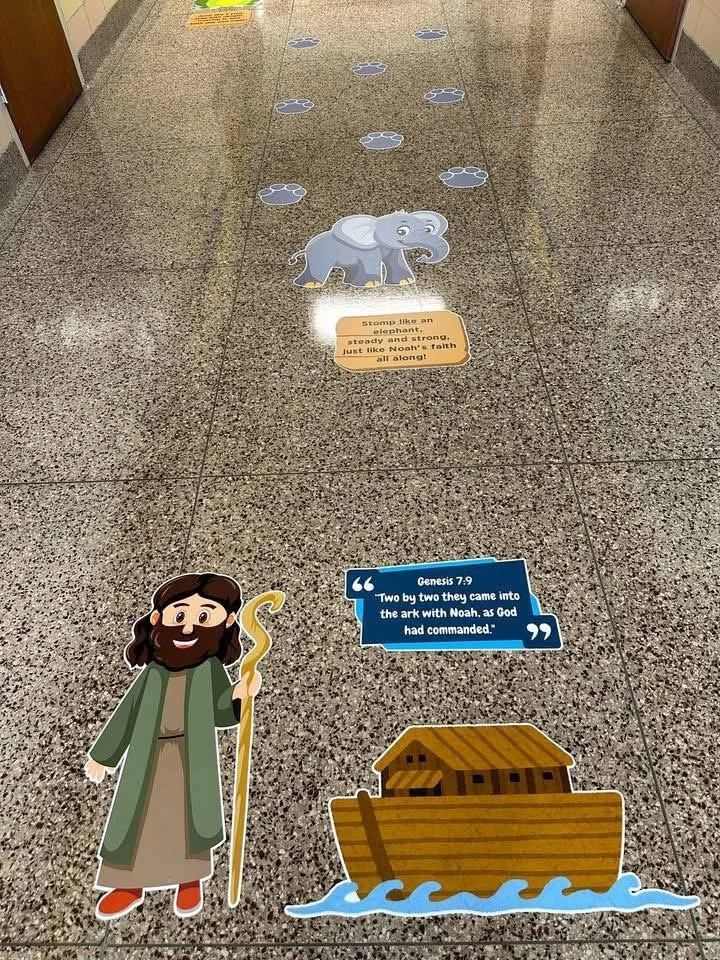
One of my favorite ways to combine movement and faith is through a faith-based sensory pathway.
Sometimes people search for a "holy path for kids," but the idea is the same: a movement experience that reinforces Bible stories, virtues, or Scripture while encouraging children to move.
Faith-based sensory paths can feature:
The Sacraments
The Rosary
Positive affirmations rooted in Scripture
Instead of simply decorating hallways, schools can transform them into places where faith is experienced every single day.
4. Act Out Bible Stories
Children love dramatic play.
Assign simple roles and invite children to:
March around Jericho
Pretend to gather manna
Help build Noah's Ark
Feed the five thousand
Movement turns stories into experiences.
5. Add Motions to Prayer
Simple hand motions help children stay engaged during familiar prayers.
Even older students often enjoy praying with purposeful movement.
Prayer becomes active instead of passive.
6. Bible Verse Relay
Write several Scripture verses on cards.
Students complete a movement activity before finding the next verse.
This combines:
Reading
Movement
Teamwork
Memory
7. Nature Prayer Walk
Take learning outside.
As children walk, encourage them to notice:
God's creation
Birds
Trees
Flowers
Clouds
Ask:
"What does this remind you about God?"
Sometimes the best classroom has no walls.
8. Movement During Religious Education
Transitions happen in every classroom.
Instead of asking children to simply sit and wait...
Use one or two minutes of purposeful movement between activities.
A quick movement break often improves attention for the lesson that follows.
9. Reinforce Virtues Through Movement
Choose one virtue each week.
For example:
❤️ Kindness
💙 Courage
💚 Patience
💛 Gratitude
Create a movement that represents each virtue and practice it throughout the week.
Children begin connecting physical actions with spiritual growth.
10. Create Hallways That Teach
Faith formation shouldn't stop when religion class ends.
Hallways, gathering spaces, libraries, and parish centers all provide opportunities to reinforce God's love throughout the day.
Imagine students walking through a hallway that reminds them:
God loves me.
I am forgiven.
I am brave.
I am never alone.
Sometimes the most powerful classroom isn't a classroom at all.
Why Faith and Movement Belong Together
As an occupational therapist, I've seen how movement helps children organize their bodies, calm their minds, and prepare for learning.
As a person of faith, I've also seen how movement helps children experience Scripture in ways they never forget.
When we combine the two, something beautiful happens.
Faith becomes active.
Learning becomes joyful.
Children become participants instead of spectators.
Frequently Asked Questions
Are movement activities appropriate during religious education?
Absolutely. Purposeful movement often helps children remain engaged and improves attention throughout lessons.
What ages benefit from movement?
Movement supports learners of all ages, from preschool through middle school. Activities can easily be adapted to match developmental levels.
Do I need a large space?
Not at all. Many movement activities work in classrooms, parish halls, hallways, libraries, or outdoor spaces.
What is a "holy path" for kids?
Many educators use the phrase "holy path" to describe a faith-based movement pathway that combines Scripture, Bible stories, virtues, or prayer with purposeful movement. These pathways encourage children to learn while actively engaging their bodies and minds.
Try This Tomorrow
Choose one familiar Bible story and ask yourself:
"How could my students move through this story instead of only hearing it?"
Maybe they'll march.
Maybe they'll jump.
Maybe they'll stretch.
Maybe they'll walk alongside Jesus.
Sometimes a single movement is all it takes to help God's Word come alive.
Want to Learn More?
At Sacred Steps Sensory Paths, every product is designed by a practicing school-based occupational therapist with one goal in mind: helping children move, learn, and grow.
Our faith-based sensory paths combine purposeful movement with Scripture, Bible stories, virtues, and Catholic teaching to create engaging learning experiences throughout schools, churches, and religious education programs.
Whether you're looking for a Noah's Ark sensory path, Days of Creation pathway, Walk with Jesus, Who God Says I Am, Holy Alphabet, or other faith-filled movement activities, we'd love to help you create spaces where faith and movement come together every day.
👉 Explore our collection or contact us for a complimentary hallway mock-up.
About the Author
Trisha Klausing, MOT, OTR/L is the founder of Sacred Steps Sensory Paths and a practicing school-based occupational therapist with more than a decade of experience helping children thrive through purposeful movement. She designs OT-informed, faith-based movement experiences that support self-regulation, executive functioning, learning, and faith formation. Today, Sacred Steps products are used in schools, churches, clinics, and educational settings across 27 states and Canada.