
What Is Executive Functioning —and How Movement Helps Kids Build It
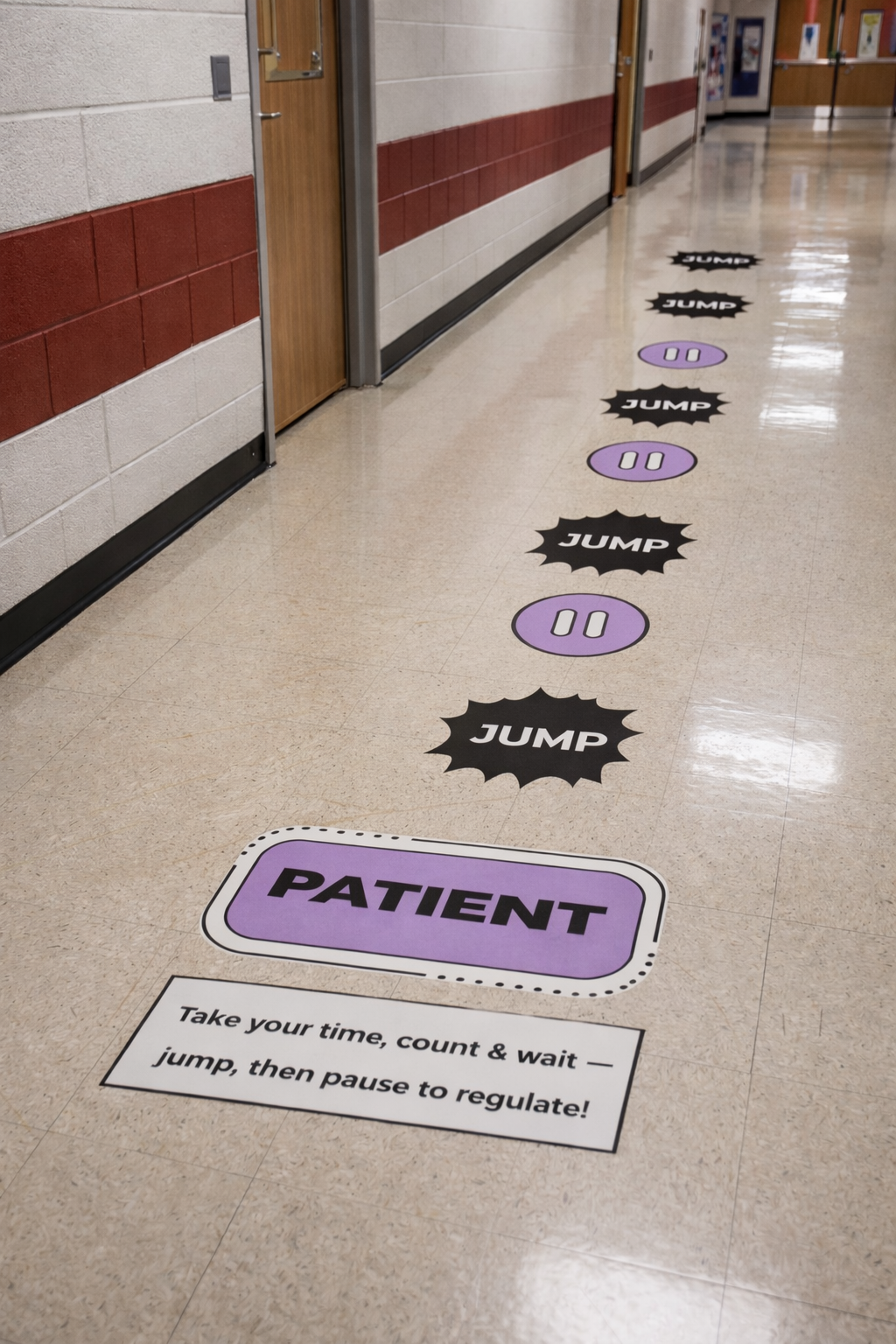
OT-designed sensory path floor decals installed in an elementary school hallway featuring alternating jump and pause markers that guide students through structured movement sequences, building impulse control, self-regulation, and executive functioning skills with every hallway transition.
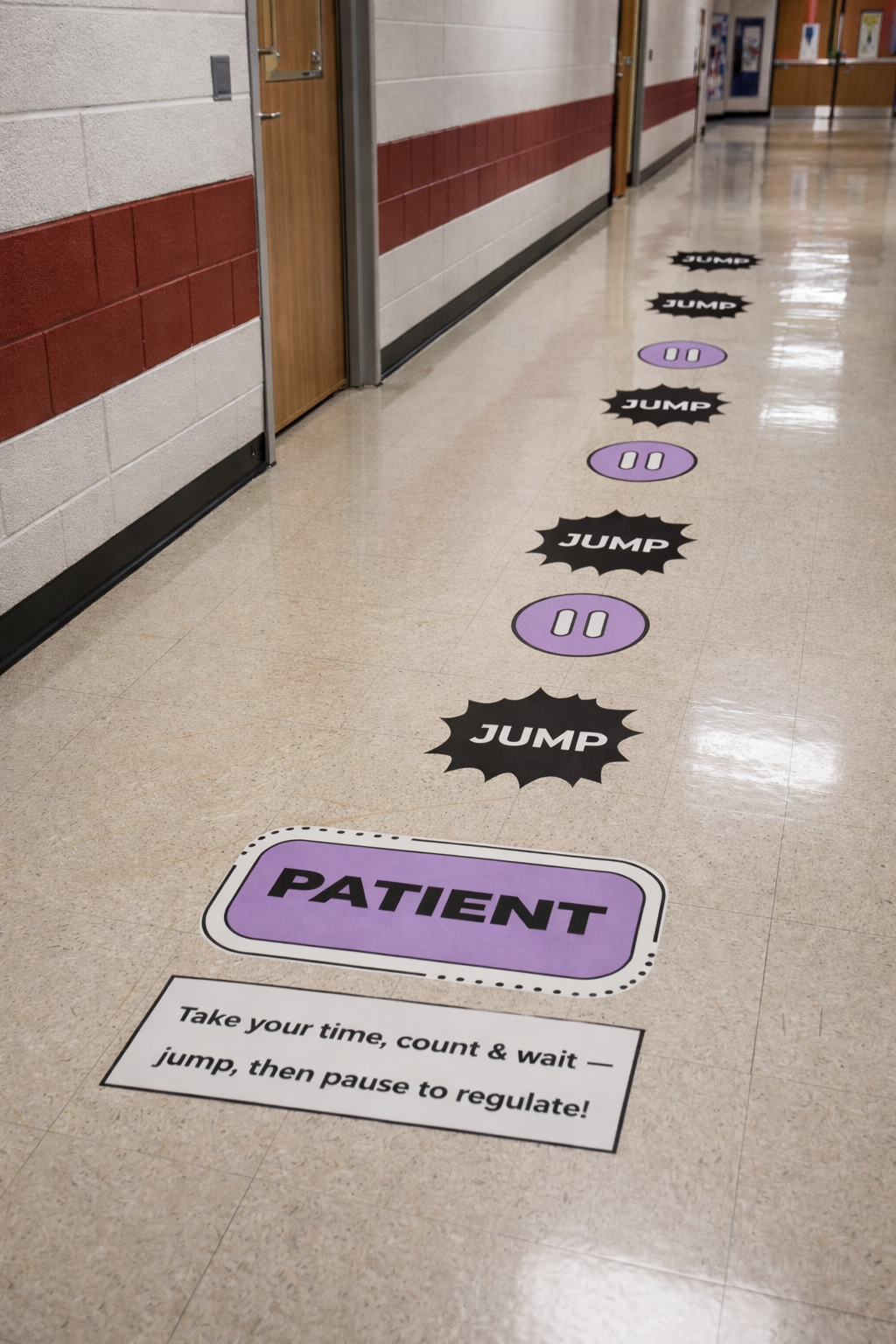
OT-designed floor sensory path installed in a school hallway featuring a purple PATIENT station with the instruction "Take your time, count and jump, then pause to regulate," followed by alternating black star-burst JUMP markers and purple pause symbol circles extending down the hallway, targeting inhibitory control, sequencing, and self-regulation.
If you have ever watched a child melt down because their routine changed, struggle to start a task without reminders, or completely fall apart when asked to wait their turn — you have seen executive functioning challenges in action.
And if you work with kids, you have probably seen it a lot.
Executive functioning is one of the most talked-about topics in education and pediatric therapy right now — and for good reason. These skills shape how children learn, behave, relate to others, and navigate daily life. But here is what most people do not know: movement is one of the most powerful tools we have to build them.
Let me explain.
What Is Executive Functioning?
Executive functioning is the term used to describe a set of mental skills that act like the brain's command center. They help children plan, focus, remember instructions, manage emotions, and adapt when things do not go as expected.
According to Harvard's Center on the Developing Child, the three core components of executive functioning are:
1. Working Memory
This is the ability to hold information in mind while using it. Think of it as the brain's mental sticky note. When a teacher gives three-step directions and a child can remember and follow all three — that is working memory at work. When they can only follow the first one and forget the rest, working memory is struggling.
2. Inhibitory Control
This is the ability to pause, think, and resist the urge to act impulsively. It is what helps a child wait their turn, stop themselves from blurting out an answer, or walk calmly down the hallway instead of running. Inhibitory control is deeply connected to emotional regulation.
3. Cognitive Flexibility
This is the ability to shift thinking, adapt to changes, and see things from a different perspective. It is what helps a child handle a schedule change without falling apart, or switch from one task to another without a meltdown.
These three skills do not work in isolation — they work together constantly, in almost every moment of the school day.
Why Are So Many Kids Struggling With Executive Functioning?
This is the question educators and therapists are asking more than ever — and the answer is complex.
We know that executive functioning develops primarily in the prefrontal cortex, the part of the brain responsible for reasoning, planning, and self-regulation. This area of the brain continues developing all the way into a person's mid-twenties — which means children are quite literally still building the hardware they need.
We also know that children with ADHD, autism, sensory processing disorder, anxiety, trauma histories, and other neurodevelopmental differences often experience significant executive functioning challenges. These are not behavior problems. They are neurological differences that deserve a neurological response.
But here is the piece that often gets missed: executive functioning is not fixed. It can be built, strengthened, and supported — especially in childhood, when the brain is most plastic and responsive to intervention.
And one of the most effective ways to do that? Movement.
How Movement Builds Executive Functioning
Research consistently shows that purposeful, cognitively engaging physical movement improves executive functioning in children. A 2025 meta-analysis published in Frontiers in Human Neuroscience found that exercise interventions — particularly those that combine movement with cognitive demands — significantly improve core executive functions including working memory, inhibitory control, and cognitive flexibility in children and adolescents.
A separate systematic review published in Frontiers in Psychology found that school-based physical activity programs that balance physical intensity with cognitive and emotional engagement are especially effective for building executive function skills.
In other words, it is not just any movement that helps. It is intentional, structured, cognitively rich movement — the kind that asks the brain and body to work together at the same time.
Here is why that works so well:
Movement activates the prefrontal cortex.
The same part of the brain responsible for executive functioning lights up during purposeful physical activity. Movement essentially warms up the command center.
Sequenced movement builds working memory.
When a child follows a series of movement activities in a specific order — hop here, balance there, reach up, push down — they are actively practicing holding a sequence in mind and executing it. That is working memory training in disguise.
Motor planning strengthens cognitive flexibility.
Navigating a movement path requires the brain to plan, adjust, and respond to new information in real time. Every twist, jump, and balance challenge is a mini lesson in flexible thinking.
Proprioceptive and vestibular input regulate the nervous system.
When the sensory system is regulated, the brain has far greater access to its executive functioning resources. A dysregulated nervous system simply cannot plan, focus, or manage impulses effectively. Movement — especially heavy work and balance activities — brings the nervous system into a state where executive functioning is possible.
Routine movement builds inhibitory control.
Following the rules of a movement path — stay on the footprints, do the activity before moving on, wait at each station — is practice in impulse control, every single time a child walks through it.
What This Looks Like in a School Hallway
This is where Sacred Steps Sensory Paths come in.
A well-designed sensory path is not decoration. It is a therapeutic movement tool that targets executive functioning every time a child walks through it.
When a student approaches a Sacred Steps path, they are:
• Reading and processing the activity at each station (working memory)
• Sequencing their movements from station to station in order (motor planning + working memory)
• Regulating their body through proprioceptive and vestibular input (nervous system regulation)
• Following movement rules at each station (inhibitory control)
• Transitioning between different activity types (cognitive flexibility)
• Arriving at their destination calmer, more focused, and more ready to learn
And when faith-based affirmations are woven into those stations — words like "I am brave," "I am loved," "I am God's child" — there is an added layer of identity formation and emotional grounding that supports the whole child.
What Teachers and Staff Can Do Right Now
You do not need a full sensory path to start supporting executive functioning through movement. Here are a few simple strategies:
Build in transition movement.
Use the hallway walk between activities as an intentional opportunity. Give students a movement challenge: walk like a tightrope walker, stomp like an elephant, touch every doorframe with your left hand. These small tasks engage the prefrontal cortex before students sit back down.
Create predictable movement routines.
Predictability builds executive functioning. When students know that every morning starts with three minutes of movement before they sit down, their nervous systems begin to anticipate and prepare. Routine is regulation.
Use movement as a reset, not a reward.
Movement breaks should not be something students earn — they should be something students receive, especially when they are struggling. A two-minute movement break mid-lesson can restore the executive functioning resources that sitting and focusing have depleted.
Add sensory input before demanding tasks.
Heavy work (pushing, pulling, carrying, pressing) before a writing task, a test, or a transition can dramatically improve a child's ability to focus, plan, and self-regulate.
Invest in a permanent movement tool in your hallway.
A sensory path gives every child who walks your hallway access to the therapeutic movement input their brain needs — without pulling a single student from class, without requiring a therapist to be present, and without adding a single thing to your teacher's plate.
The Bottom Line
Executive functioning is not a fixed trait. It is a set of skills — and like all skills, it can be built.
Movement is not a break from learning. It is one of the most evidence-based, neurologically sound ways to prepare a child's brain for the learning that comes next.
When we put intentional, therapeutic movement in a child's path — literally in the hallway they walk every day — we are not just giving them something fun to do. We are giving their brains exactly what they need to focus, regulate, plan, and succeed.
That is what Sacred Steps is all about. 🙏💛
Interested in bringing a Sacred Steps Sensory Path to your school? Browse our full collection at sacredstepssensorypaths.com or reach out at hello@sacredstepssensorypaths.com — we would love to help.