Introducing the Days of Creation Portable Sensory Path — Made Just for K-2 Learners
If you teach or lead a Catholic or Christian preschool, kindergarten, or early elementary classroom, this one's for you.
I'm so excited to introduce our newest product: the Days of Creation Portable Sensory Path — a roll-out movement path designed specifically for our littlest learners, grades K-2.
Why I Designed This Path
As a school-based occupational therapist, I've spent years watching what happens when young children don't get enough movement built into their day. They fidget. They struggle to sit still during circle time. They have a harder time transitioning from recess back into the classroom.
At the same time, I know how much our youngest students love rhythm, rhyme, and repetition — it's how they learn best.
So I designed a sensory path that does both: gives kids the movement their growing bodies need, while reinforcing the story of creation through simple, joyful rhymes they'll remember.
What's Included
The Days of Creation Portable Sensory Path is a 3ft x 10ft rollable mat with 9 stations, taking students through the entire creation story from Genesis 1:1 to Genesis 1:31:
Day 1 — Light & Darkness: Open arms wide to greet the light, drop down low for the quiet night
Day 2 — Sky & Waters: Reach up high, bend down low, sky to sea, and back we go
Day 3 — Land & Plants: Curl up small like a seed in the ground, jump up tall, stretch branches around
Day 4 — Sun, Moon & Stars: Spin around just like the sun, reach up high to the stars
Day 5 — Sea Creatures & Birds: Wiggle and swim like a fish in the sea, flap your wings and fly like you're free
Day 6 — Animals & Humans: Stomp like a bear, growl like a beast, stand up tall — God's masterpiece
Day 7 — Day of Rest: Soft and still, hands on your heart, rest like God did
Each station includes simple, age-appropriate movement directions paired with bold, colorful icons — designed so even our youngest students can follow along independently.
Why It Works for K-2 Specifically
Older students can read longer instructions and more complex movement sequences. But K-2 learners need something different: short rhymes, clear actions, and repetition they can memorize quickly.
That's exactly what this path delivers. By the second or third time through, most kindergartners and first graders will know the rhymes by heart — which means they're not just moving their bodies, they're also reinforcing early literacy skills and memorizing scripture, all without realizing they're "learning."
Where It Fits in Your School
This portable path is perfect for:
Classroom transitions and brain breaks
Hallway movement between activities
Prayer corners and reflection spaces
Parish preschool programs
Religious education classrooms
Because it's portable and rolls up for easy storage, it works just as well in a single classroom as it does moved between multiple rooms throughout the week.
A Joyful Way to Start the School Year
Summer is the perfect time to plan ahead, and this path is an easy, affordable way to bring movement and faith formation into your K-2 classrooms starting on day one of the new school year.
🎉 Launch special: Save $25 through June 30th with code CREATION25.
👉 Shop the Days of Creation Portable Sensory Path
I can't wait to see this little path bring big joy — and a deeper love of God's creation story — to classrooms this fall.
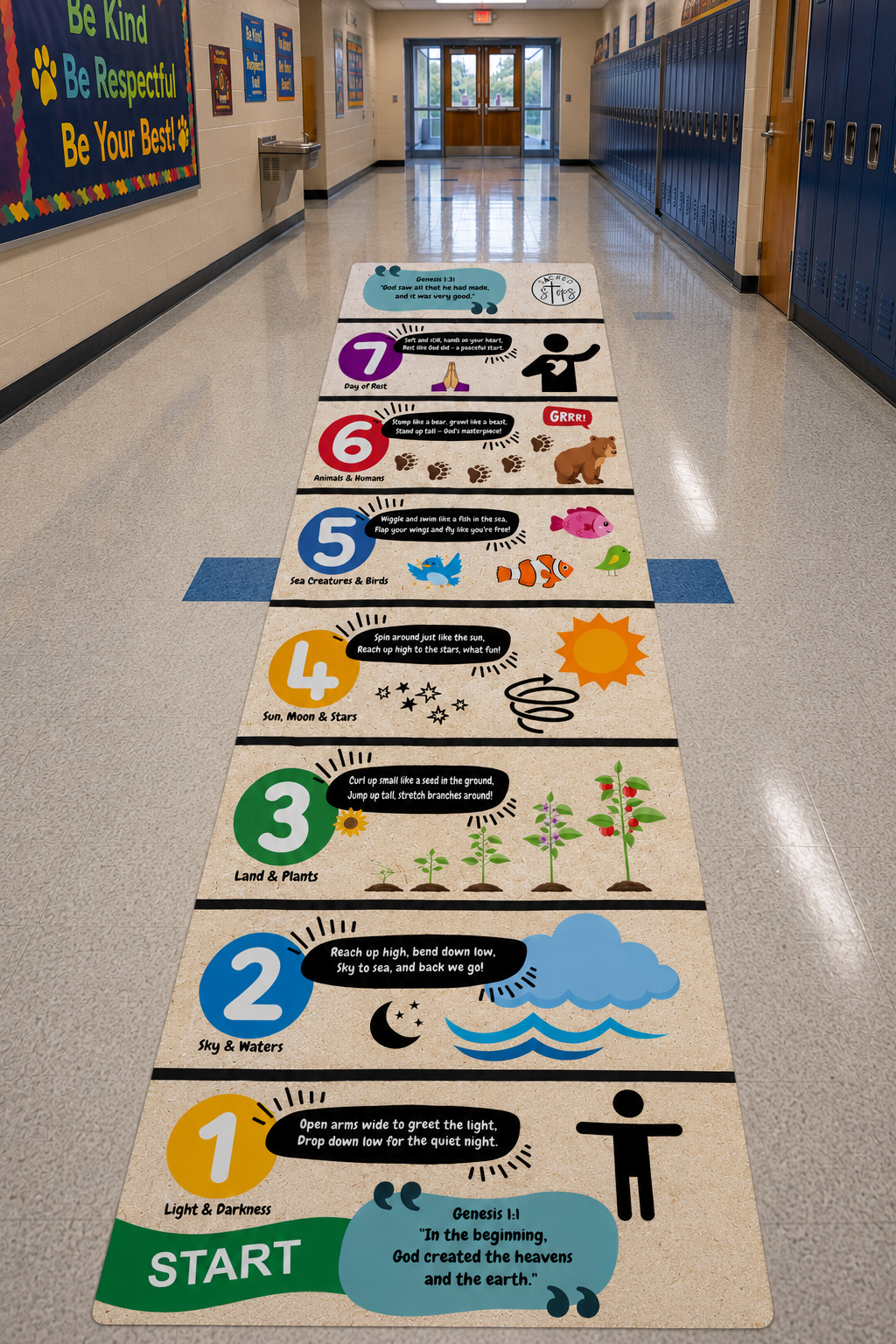
Introducing the Days of Creation Portable Sensory Path — a roll-out movement path made just for K-2 students, featuring rhyming directions and scripture for Catholic and Christian classrooms. (Please note: The above image is an AI-generated mockup and may have small visual quirks. Rest assured the final product is professionally designed and printed — real-life photos coming soon! 💛)
Trisha Klausing, OTR/L, MOT is a pediatric occupational therapist with over 10 years of school-based experience and the founder of Sacred Steps Sensory Paths LLC.