Floor, Wall, or Portable Sensory Path? How to Choose the Right Option for Your School
Floor, wall, or portable—which sensory path is right for your school? Compare the benefits of each format and learn what works best for your students, space, and daily routines.
When schools begin exploring sensory paths, one of the first questions they ask is:
Should we choose a floor path, a wall path, or a portable option?
It is a great question—and there is not one answer that works for every school. The best choice depends on your available space, the ages of your students, how you want the path to be used, and whether you need a permanent or flexible resource.
As a pediatric and school-based occupational therapist, I created Sacred Steps Sensory Paths to give students proactive opportunities to move, regulate, refocus, and return to learning. Each format supports those goals a little differently.
Here is an easy way to determine which sensory path may be the best fit for your school, church, preschool, or therapy space.
Choose a Floor Sensory Path When You Want Movement Built Into the Hallway
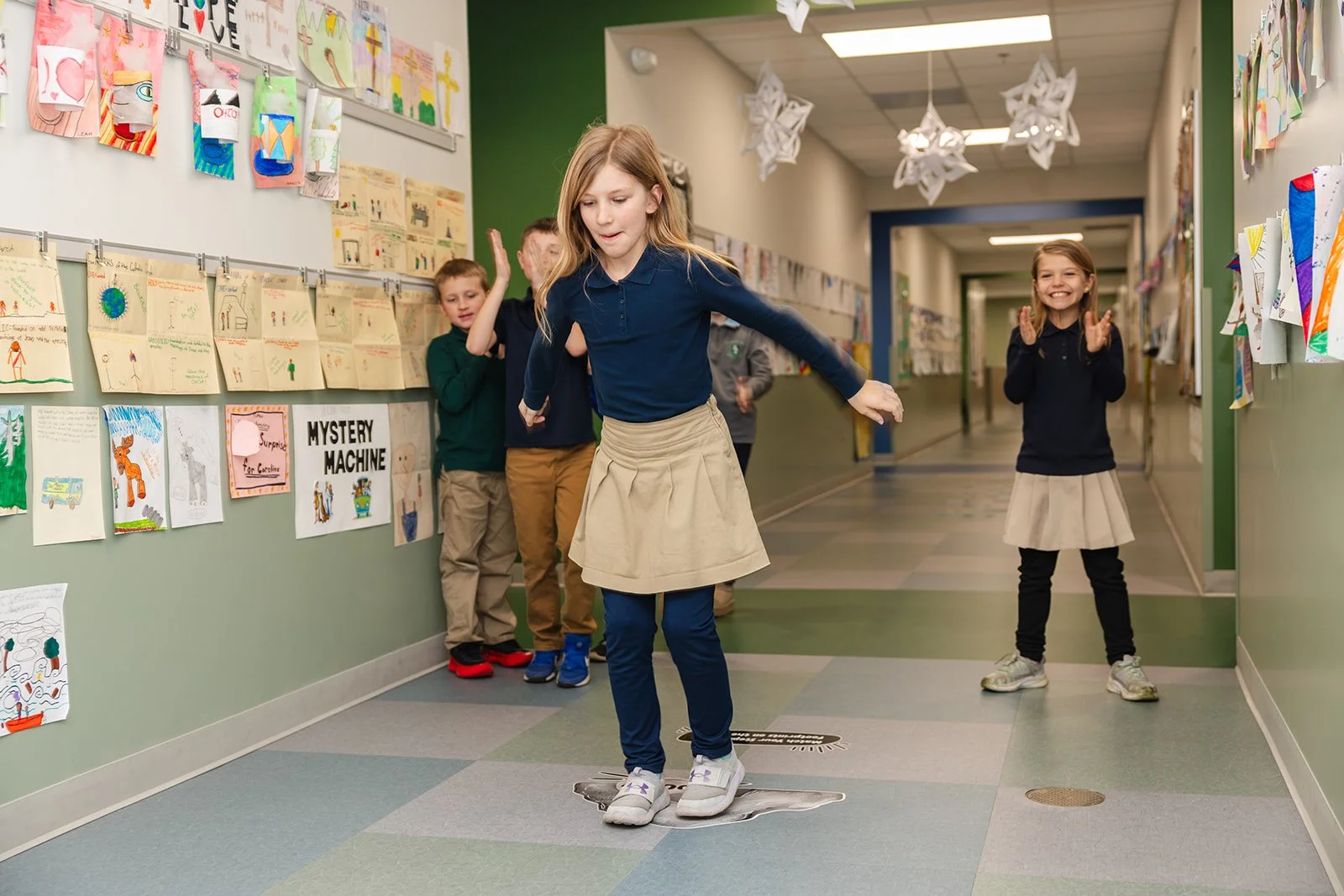
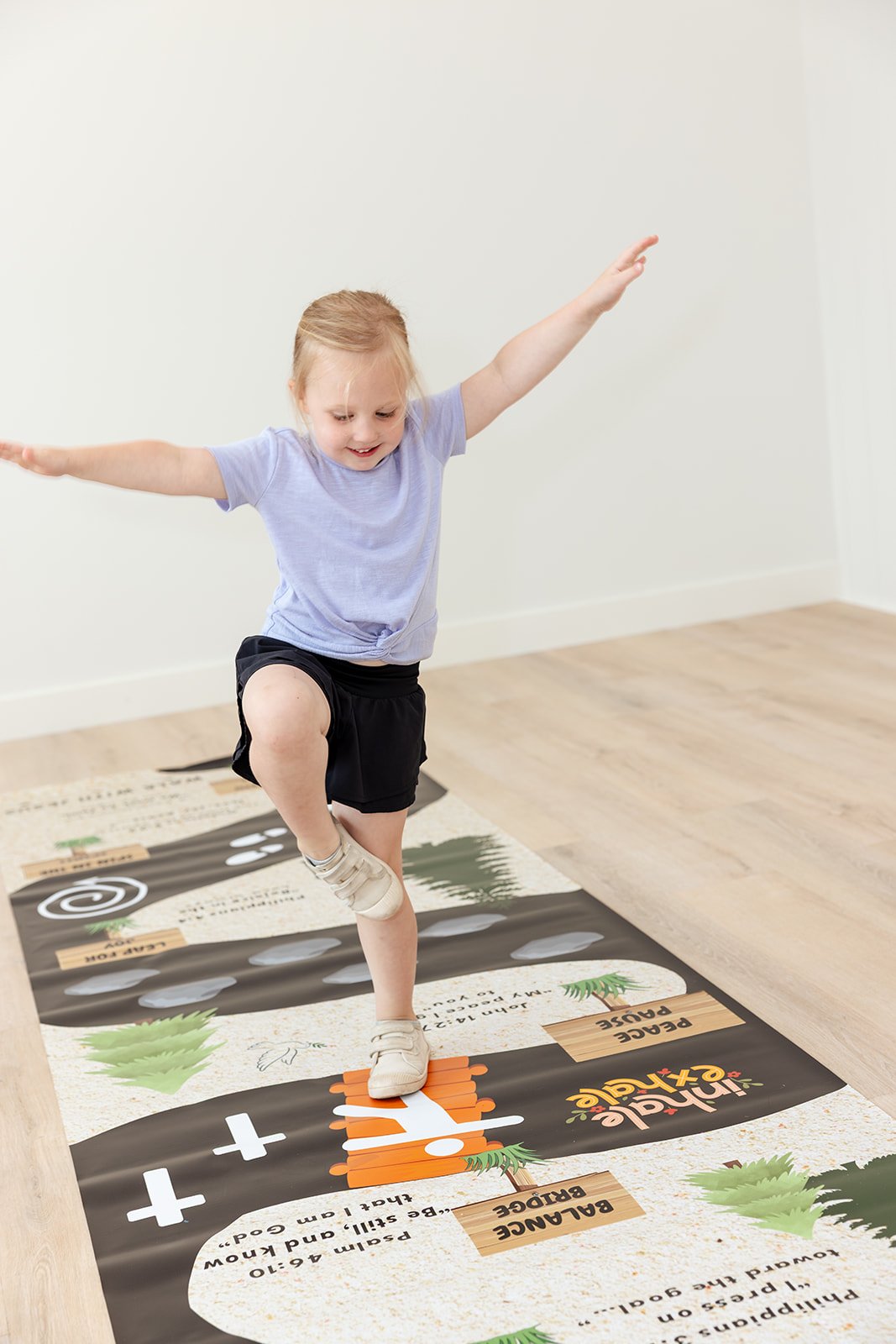
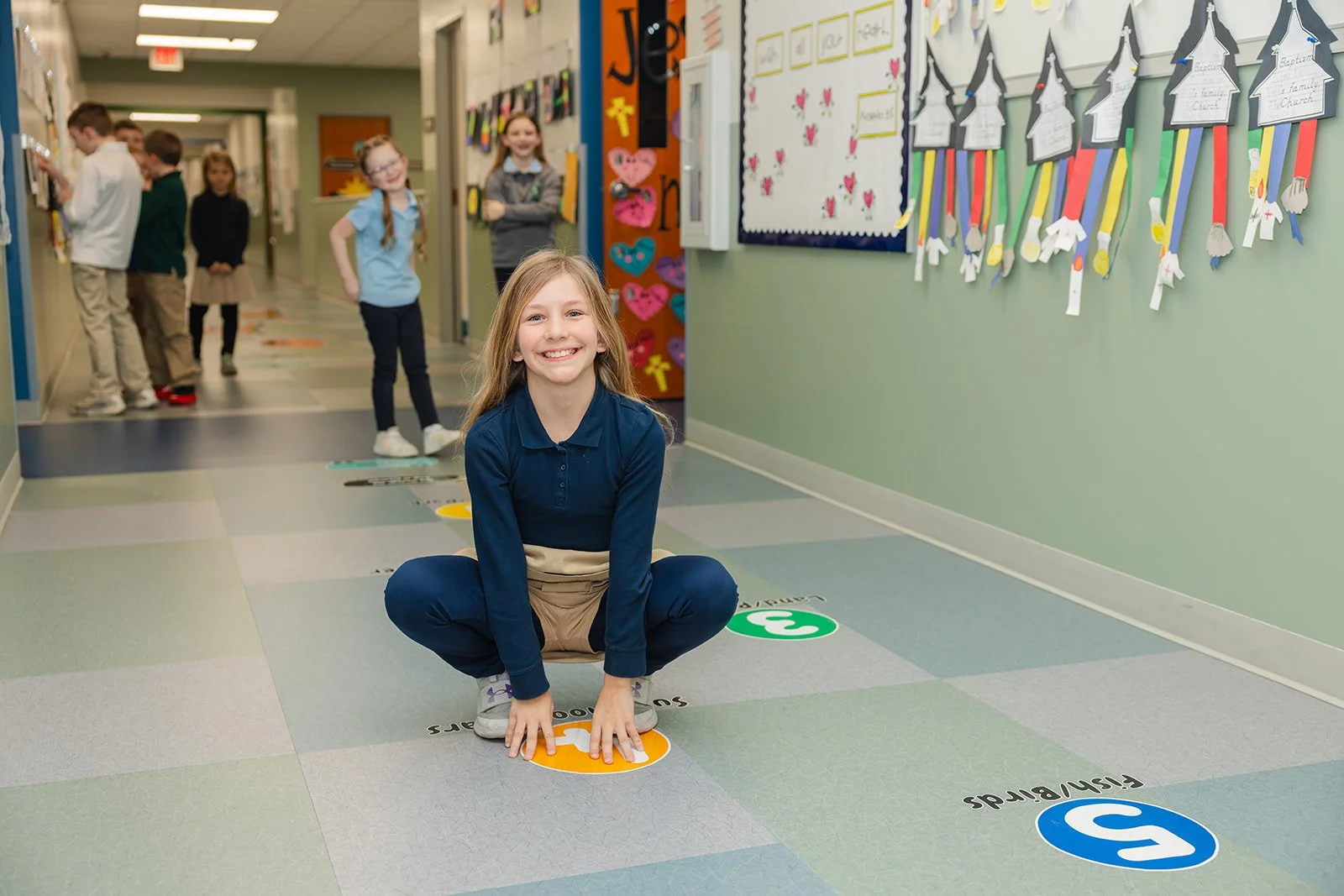
A floor sensory path is a wonderful choice when you want movement to become a natural part of the school day. Students can hop, jump, balance, squat, follow footprints, and complete other purposeful movements as they travel through the hallway.
Floor paths work especially well when:
You have a dedicated hallway or open floor area.
You want a permanent, highly visible movement resource.
Multiple classrooms will use the path throughout the day.
Your students benefit from whole-body movement and heavy-work activities.
You want movement breaks to be easily available without gathering extra equipment.
Sacred Steps floor decals are commercially printed for heavy daily traffic and can be waxed over as part of your school’s normal floor-care routine. Once installed, the path is ready whenever students need it—during transitions, scheduled sensory breaks, indoor recess, therapy sessions, or those moments when a child simply needs to move before returning to class.
Before choosing a floor path, consider hallway width, doorways, traffic patterns, and custodial routines. A path does not always need to run in one perfectly straight line. Stations can be spaced out, turned, or arranged to work around the features of your building.
Choose a Wall Sensory Path When Floor Space Is Limited
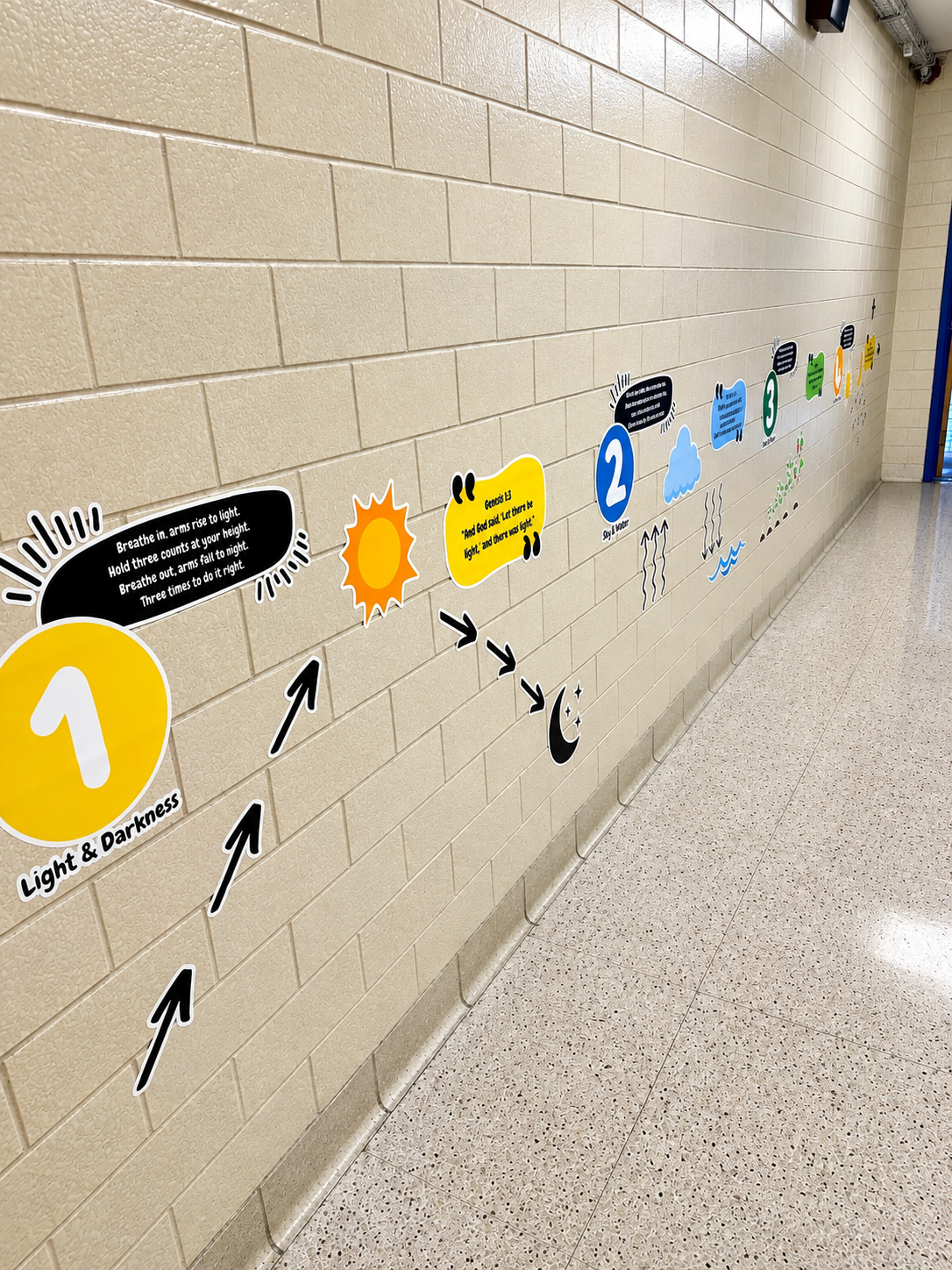
Do you have a narrow hallway, a busy traffic pattern, or floors that are not suitable for decals? A wall path may be the perfect solution.
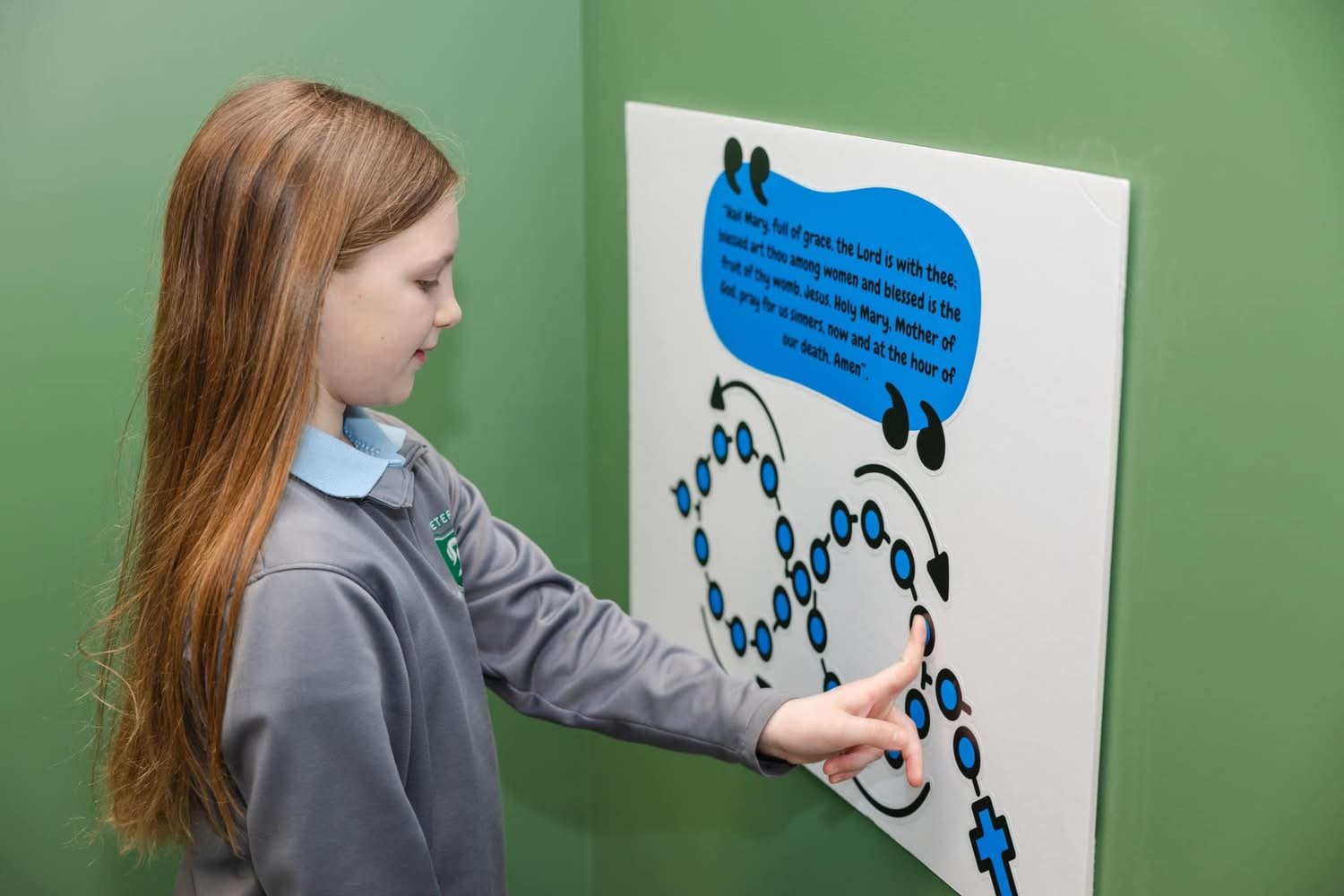
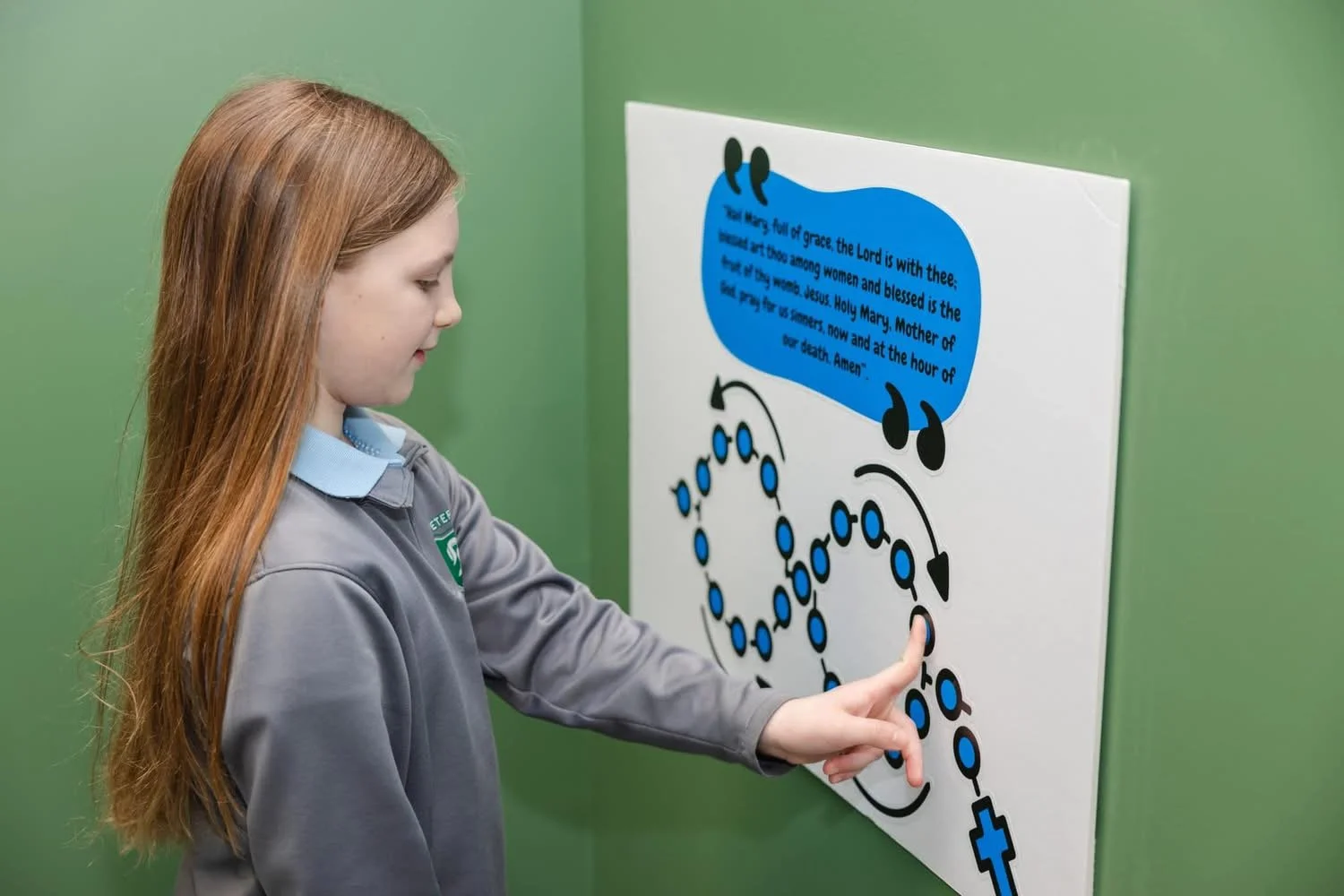
Wall activities can encourage students to reach, stretch, push, breathe, trace, pray, cross midline, and complete calming or strengthening movements—all without taking up valuable floor space.
Wall paths are a strong choice when:
Hallways are narrow or need to remain clear.
You want activities near a classroom, counseling office, prayer space, or sensory area.
You would like to add regulation supports at different heights.
You want a quieter movement experience with less jumping or traveling.
You have a beautiful blank wall just waiting to do something useful!
Wall-based options can also be especially helpful for older students who may prefer activities that feel a little more discreet. Designs such as Who God Says I Am, Days of Creation, and Beatitudes Blessings combine movement and regulation with meaningful faith-based messages.
Sacred Steps wall decals are removable, making them a practical option for many school and church environments.
Choose a Portable Sensory Path When Flexibility Matters Most
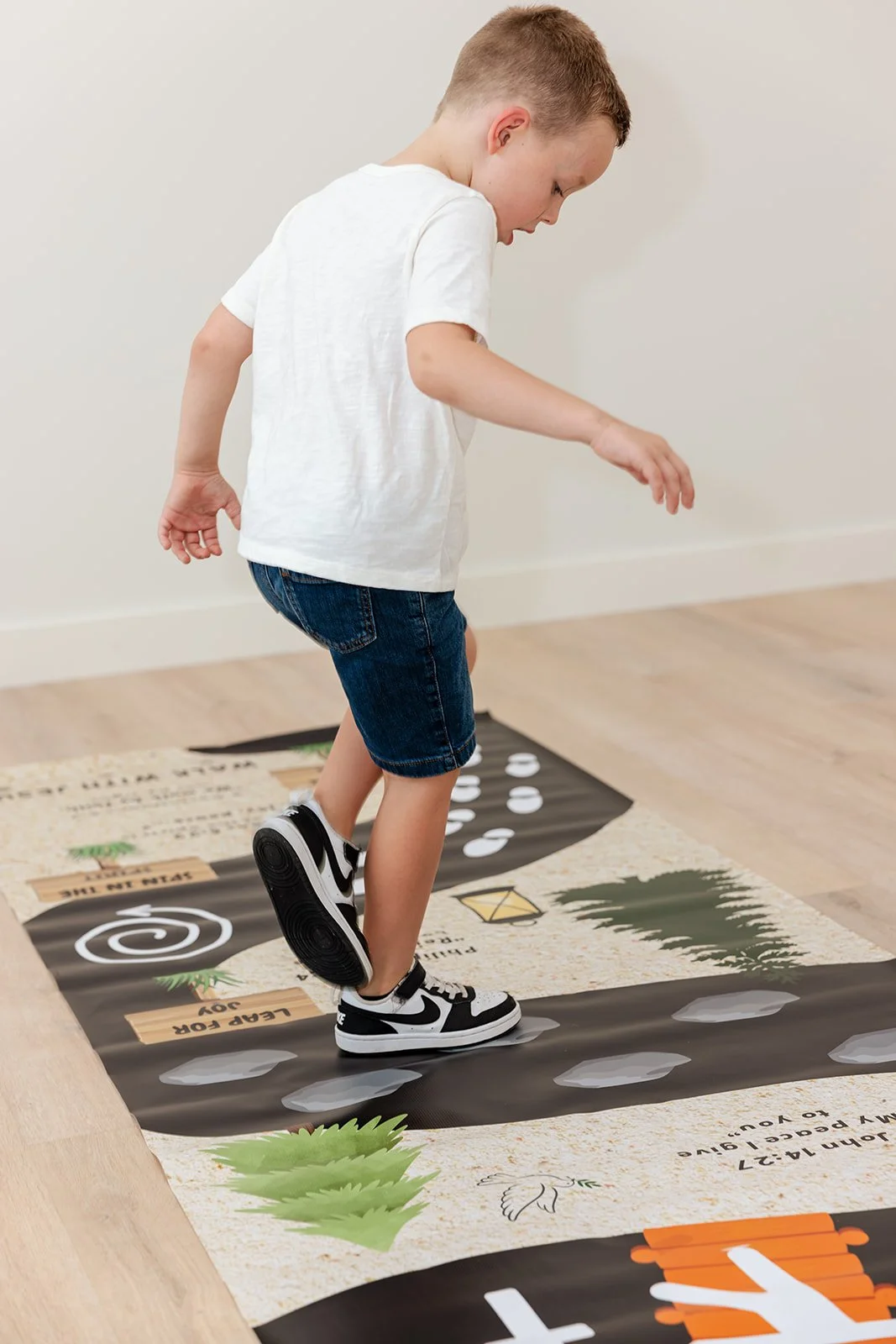
Sometimes the best sensory space is wherever your students happen to be that day.
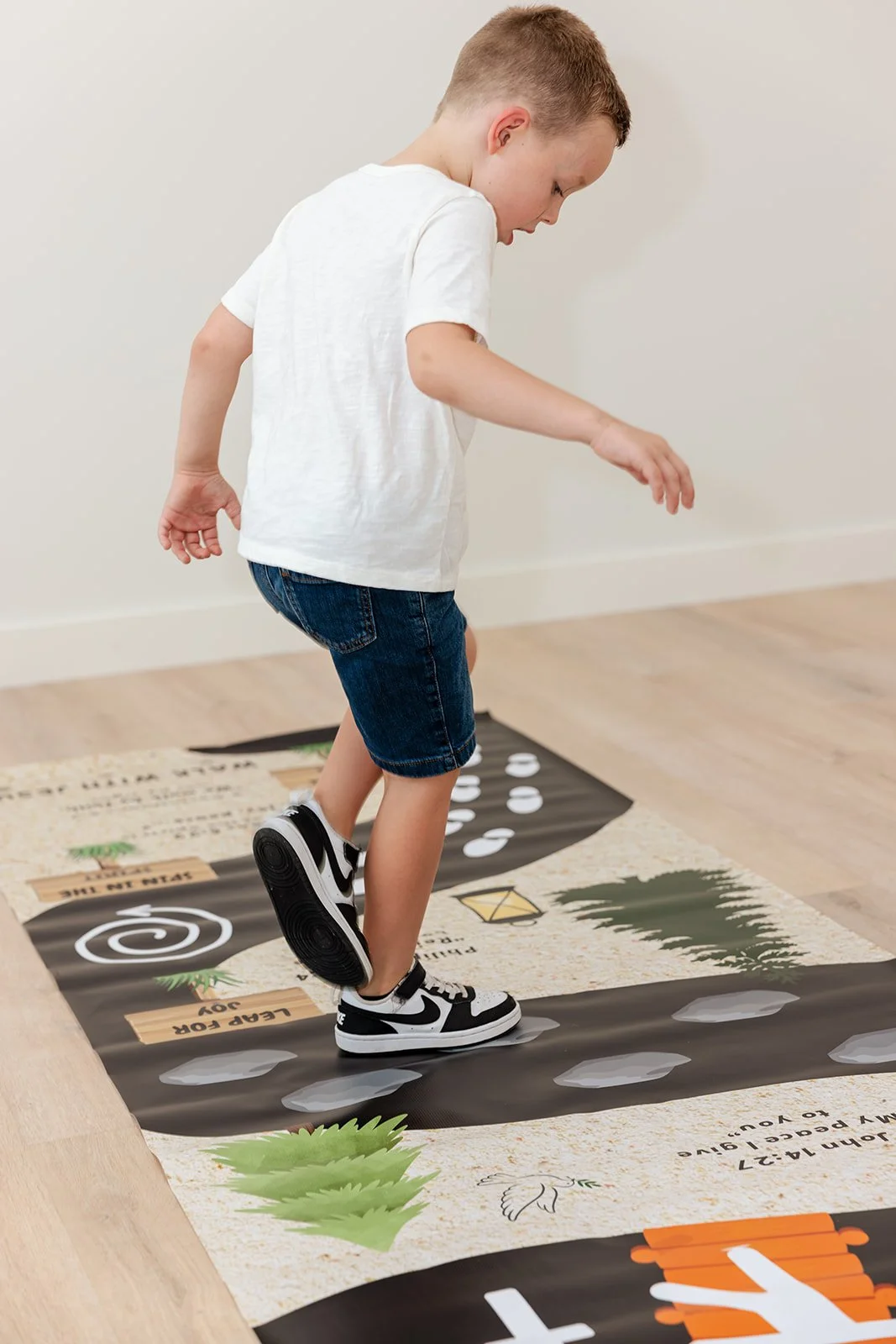
Portable sensory paths are printed on durable 3' x 10' canvas mats. They can be rolled out in a classroom, preschool room, parish center, therapy space, hallway, or counseling area—and then rolled up and stored when the activity is finished.
A portable path may be the best fit when:
You need to move the resource between classrooms or buildings.
You rent your space or cannot install permanent decals.
You want an easy option for special events, faith formation, indoor recess, or sensory-friendly Mass.
You have limited space and need to store the path between uses.
You want to begin with a smaller investment before selecting a full permanent path.
Portable paths are also an easy way for teachers to add purposeful movement to the day without rearranging an entire classroom. Roll it out, let students move, and roll it back up—no construction project required!
For smaller preschool and early-childhood spaces, the Little Steps portable paths offer the same grab-and-go flexibility in a compact 24" x 72" size.
Could Your School Use More Than One Format?
Absolutely! Many schools find that a combination works best.
For example, a school might place a full floor path in a main hallway, add calming wall activities near the counselor’s office, and keep a portable path available for classrooms or special events. A Starter Set can also introduce several permanent activities in a smaller area before the school expands to a full path.
Think less about choosing the single “perfect” format and more about where students need support during their day:
Where do transitions become difficult?
Where do students wait?
Where could a child safely take a short movement break?
Which areas are accessible to the greatest number of students?
Would a permanent resource be used more consistently, or does your team need flexibility?
Those answers will usually point you toward the best choice.
Are Sensory Paths Difficult to Install?
Most schools install their Sacred Steps Sensory Paths themselves. I provide installation instructions and am available to help with placement and layout before installation begins. Having two or three people makes the process much easier, especially for larger floor pieces.
If your school would prefer installation assistance, travel installation may also be available for an additional fee based on location and travel expenses.
Still Not Sure? Send Me Your Space!
You do not need to have everything figured out before reaching out. In fact, some of my favorite projects have started with a photo of an empty hallway and the question, “What could work here?”
Send me a few pictures, approximate dimensions, the ages of the students you serve, and anything you hope the space will accomplish. I will give you my honest recommendation about whether a floor, wall, portable, or combination option would work best.
Narrow hallway? Awkward corner? Small preschool room? Send it anyway. You may have more possibilities than you think!
Explore Sacred Steps Sensory Paths or contact me to begin planning a path for your space!
Is Your School Hallway Working Hard Enough?
Learn how school hallways can support student regulation, movement, transitions, and readiness to learn. Plus, download a free Principal’s Hallway Checklist.
A 5-Minute Hallway Check From a School-Based Occupational Therapist
When we think about preparing a school environment for students, we tend to focus on classrooms.
We arrange desks. We organize materials. We create calm-down spaces. We think about lighting, seating, visual supports, and classroom routines.
But there's another space students use every single day that we don't always think about in the same way:
The hallway.
As a school-based occupational therapist, I spend a lot of time thinking about how the environment affects a student's ability to regulate, transition, participate, and learn.
And hallways are part of that environment.
Students may walk through them dozens of times each day. They transition from preferred activities to non-preferred activities there. They navigate noise, other students, visual stimulation, schedule changes, and expectations—all while being asked to keep their bodies regulated.
So here's a question worth asking:
Is your hallway simply getting students from Point A to Point B—or could it be doing more?
Take a 5-Minute Walk Through Your School
I created a simple Principal's Hallway Checklist to help school leaders look at their hallways through a slightly different lens.
You don't need a formal assessment.
You don't need an OT walking beside you.
Just take five minutes and walk through your building while thinking about a few key areas.
1. Look at the visual environment.
Stand at one end of your hallway and simply look.
Does the space feel organized—or overwhelming?
Can students easily identify important signs and visual cues?
Are bulletin boards and displays intentional, or is every available inch competing for their attention?
For many students, especially those who are easily distracted or overwhelmed by visual input, more isn't always better.
Sometimes creating a more supportive environment starts with deciding what doesn't need to be there.
2. Look for opportunities to move.
We often treat movement as something that happens at recess, in physical education, or during a designated classroom movement break.
But movement doesn't have to be separate from the school day.
It can be built into it.
Could an unused stretch of hallway give students an opportunity to jump, balance, reach, breathe, cross midline, or complete a quick sequence of purposeful movements?
Could a student use that space for a two-minute regulation break and then return to class?
Could movement be used proactively, rather than waiting until a child is already dysregulated?
That's one of the biggest shifts I encourage schools to consider.
3. Pay attention to transitions.
For some students, transitions are easy.
For others, they're one of the hardest parts of the school day.
Leaving a preferred classroom, navigating a busy hallway, remembering where to go next, managing peers and noise, and preparing for an entirely different set of expectations requires a surprising amount of regulation and executive functioning.
As you walk your hallways, ask:
What support is available for the child who struggles here?
It might be a visual cue.
It might be a predictable movement opportunity.
It might be a calming strategy.
Sometimes a relatively small environmental support can make a difficult transition more manageable.
4. Ask whether your hallway helps students return ready to learn.
This is one of my favorite questions.
Instead of thinking only about hallway behavior—Are students quiet? Are they walking? Are they following expectations?—consider what happens after the hallway.
Does the environment help students arrive at their next destination ready to participate?
Purposeful movement can provide opportunities to work on body awareness, coordination, balance, motor planning, regulation, and attention.
A hallway can also reinforce skills we want students to carry back into the classroom:
Confidence.
Patience.
Perseverance.
Kindness.
Leadership.
A hallway doesn't have to be wasted space.
5. Look at the space you already have.
This may be the most practical part of the entire exercise.
Look for:
An empty wall.
An unused corner.
A long stretch of hallway.
A small space outside a counseling office.
An area near the intervention room.
A spot where a portable activity could be rolled out when needed.
You don't necessarily need a dedicated sensory room—or a large budget—to create another opportunity for regulation in your school.
Start with the space you already have.
For Catholic Schools: Look Through One More Lens
In a Catholic school, I would add another question to the hallway walk:
Does our Catholic identity extend beyond our classrooms?
Catholic education has a unique opportunity to surround students with reminders of who they are and Whose they are throughout the entire school day.
Faith formation doesn't have to stop when students leave religion class.
Our hallways and shared spaces can reinforce Scripture, prayer, virtues, Sacraments, and reminders of God's presence.
And our sensory and regulation supports don't have to be separate from that mission either.
We can support the body, mind, AND spirit.
That's one of the reasons I created Sacred Steps in the first place. I wanted Catholic schools to have access to purposeful movement and regulation supports without having to separate those supports from their Catholic identity.
Try This Tomorrow
Take five minutes and walk one hallway in your school.
Don't walk it as an administrator thinking about schedules, supervision, or maintenance.
For five minutes, try to walk it from the perspective of a student.
Ask yourself:
What does this space ask of our students—and what does it give back to them?
Then identify one space that could work a little harder.
That's it.
You don't need to redesign your school.
Start with one hallway. One wall. One corner. One opportunity.
Download the Free Principal's Hallway Checklist
I've turned these questions into a simple printable checklist you can take with you as you walk through your building.
Use it yourself, share it with your leadership team, or walk through the building with your OT, counselor, intervention specialist, or facilities staff.
Catholic school? I've created a Catholic version, too, with an additional section on Faith Throughout the Building.
Want to Learn More?
If your hallway walk leaves you looking at an empty wall or unused stretch of floor and thinking, We could do something with that, I'd be happy to help.
Sacred Steps Sensory Paths offers floor-based, wall-based, and portable movement and regulation supports designed specifically for real school environments.
And you don't need to begin with a full sensory path.
Whether you have $300 or $3,000, we can start with the space and budget you have and determine what could make the greatest impact for your students.
Sometimes transforming a school environment doesn't start with a huge project.
It starts by looking at an ordinary space differently.
About the Author
Trisha Klausing, MOT, OTR/L, is a practicing school-based occupational therapist and founder of Sacred Steps Sensory Paths. Drawing on more than a decade of experience working with students and educators, she creates movement and regulation supports designed for the realities of school environments. Sacred Steps offers both faith-based and universal options to help schools create purposeful opportunities for movement, regulation, confidence, executive functioning, and student success.
Before the First Bell Rings: 7 Proactive Ways to Prepare Students for a Successful School Year
Learn seven proactive ways schools can prepare students—not just classrooms—for a successful school year. Written by a practicing school-based occupational therapist. Plus, get a free Hallway Readiness Checklist.
Every school wants students to have a successful first day.
Teachers decorate classrooms. Administrators finalize schedules. Hallways are waxed. Bulletin boards are filled. Families pack backpacks with brand-new supplies.
But one important question is often overlooked.
Are we preparing our students—or just preparing our classrooms?
As a school-based occupational therapist, I've learned that the most effective supports aren't always the ones we implement after challenges arise.
They're the ones we intentionally build before the first bell rings.
When schools proactively create environments that support movement, self-regulation, executive functioning, and belonging, students are more prepared to learn from the very first day.
Whether you're a principal, teacher, counselor, occupational therapist, or parish leader, here are seven simple ways to prepare students for a successful school year.
And at the end of this article, I'll share a free Hallway Readiness Checklist you can use with your staff before students arrive.
1. Build Movement Into the School Day
Children were never meant to sit still for six or seven hours each day.
Purposeful movement helps students:
Improve attention
Increase focus
Support self-regulation
Prepare their brains for learning
Reduce stress and anxiety
Improve transitions
Movement isn't a reward after learning.
Movement helps make learning possible.
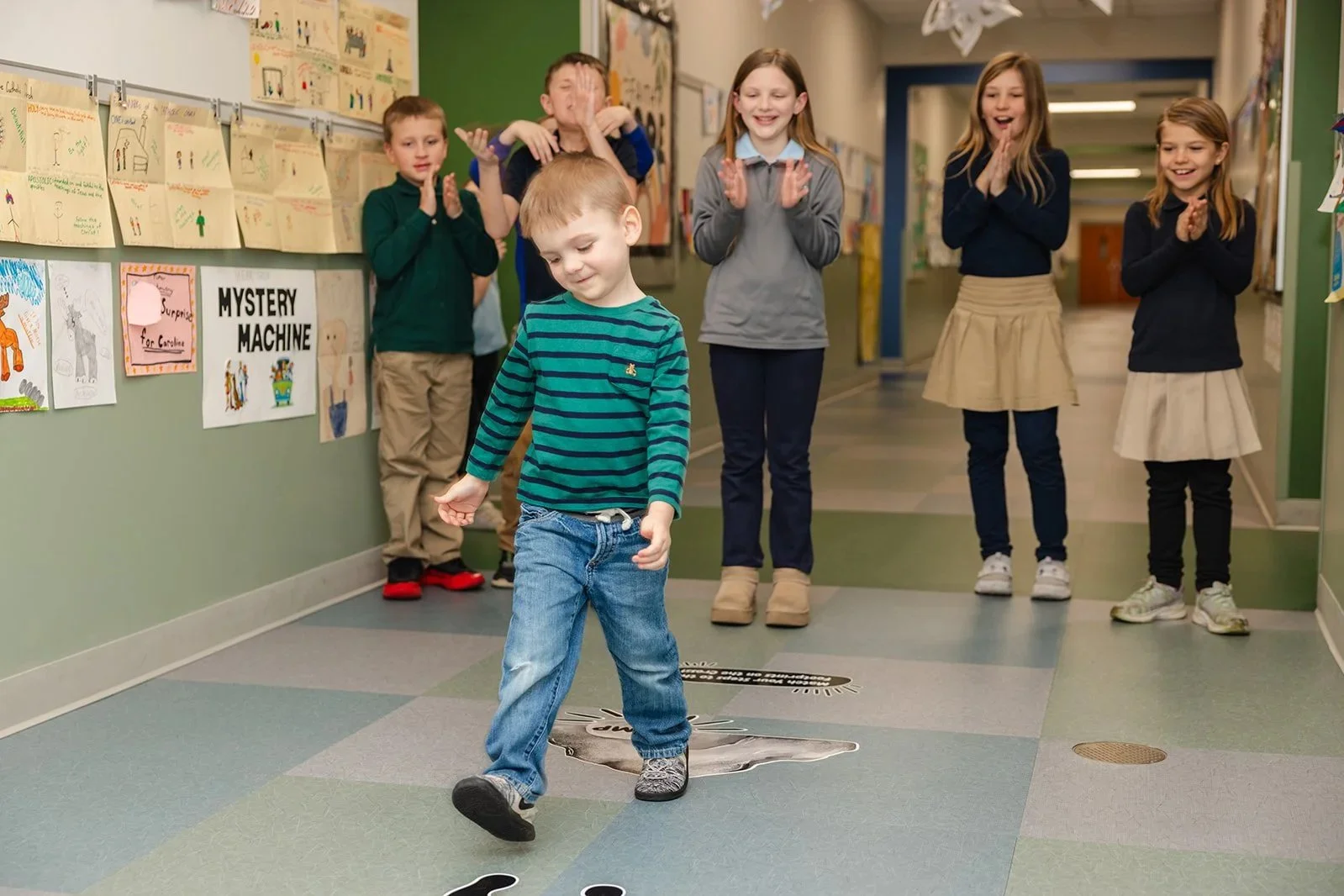
2. Turn Your Hallways Into Learning Spaces
Think about how many times students walk your hallways every day.
Now ask yourself...
What are those hallways teaching?
Hallways don't have to be empty spaces between classrooms.
They can reinforce:
Responsibility
Executive functioning
School values
Faith formation
Every transition becomes another opportunity to teach.
3. Be Proactive Instead of Reactive
One of the biggest shifts I've seen during my years as a school-based OT is moving from:
"What do we do when a student becomes dysregulated?"
to
"How do we help students stay regulated before challenges occur?"
Many students don't need intensive interventions.
They simply need intentional opportunities to move, reset, and regulate throughout the day.
Proactive supports often prevent problems before they begin.
4. Design Supports That Benefit Every Student
One misconception about sensory supports is that they're only for students receiving special education services.
In reality...
Every child has moments when they need:
A brain break
Encouragement
Movement
A chance to reset
Support during transitions
The best school-wide supports help everyone while naturally providing additional support for students who need it most.
That's what inclusion looks like.
5. Reinforce Your School's Mission Every Day
Students may hear your school's mission statement once each morning.
But what if they experienced it dozens of times throughout the day?
Imagine hallways reminding students to be:
Brave
Respectful
Honest
Patient
Helpful
Or, in Catholic schools...
Imagine students being reminded that they are:
Forgiven
Never alone
Called to serve others
Your physical environment can reinforce your mission long after announcements end.
6. Strengthen Executive Functioning Through Everyday Experiences
Executive functioning isn't taught during one lesson.
It's developed over hundreds of small moments.
Students strengthen these skills when they:
Follow multi-step directions
Make choices
Solve problems
Sequence movements
Practice self-control
Remember routines
Movement-based activities naturally encourage many of these skills while keeping students engaged.
7. Remember That Small Changes Can Have a Big Impact
Schools don't need complete renovations to create meaningful change.
Sometimes it begins with:
One hallway.
One calming corner.
One movement station.
One intentional routine.
Small environmental changes can positively influence hundreds of students over the course of a school year.
The goal isn't perfection.
The goal is creating an environment where students feel successful before challenges arise.
Is Your School Ready Before the First Bell Rings?
As you're preparing classrooms, lesson plans, and schedules, don't forget one of the most overlooked learning environments in your building...
Your hallways.
To help schools prepare for a successful year, I've created a Hallway Readiness Checklist specifically for principals, teachers, occupational therapists, counselors, and school leaders.
Inside, you'll evaluate questions like:
✔ Do students have opportunities for purposeful movement throughout the day?
✔ Do your hallways reinforce your school's mission, values, or faith?
✔ Are students given proactive opportunities to regulate before becoming overwhelmed?
✔ Does your environment support executive functioning and successful transitions?
✔ Are your hallways working as hard as your classrooms?
It's a simple resource that helps schools think intentionally about how their physical environment supports learning before the first bell ever rings.
🎁 Get Your FREE Hallway Readiness Checklist
I'd love to send you a complimentary copy!
Simply email me at hello@sacredstepssensorypaths.com
with the subject line:
Hallway Checklist
I'll send you:
✅ The Hallway Readiness Checklist
✅ An OT guide explaining how to interpret your results
✅ Information about a complimentary hallway mock-up customized for your school if you'd like to explore additional ideas.
No obligation.
Just a practical resource designed to help schools start the year strong.
Try This Tomorrow
Before students return, take ten minutes and walk through your school as if you were seeing it for the first time.
Ask yourself:
What are students learning before they even reach the classroom?
Where do students have opportunities to move?
Where are they reminded they're capable?
Where are they encouraged to regulate before becoming overwhelmed?
Does our environment reflect the mission and values we want students to experience every day?
Sometimes the biggest opportunities aren't found inside classrooms.
They're found in the spaces between them.
Want to Learn More?
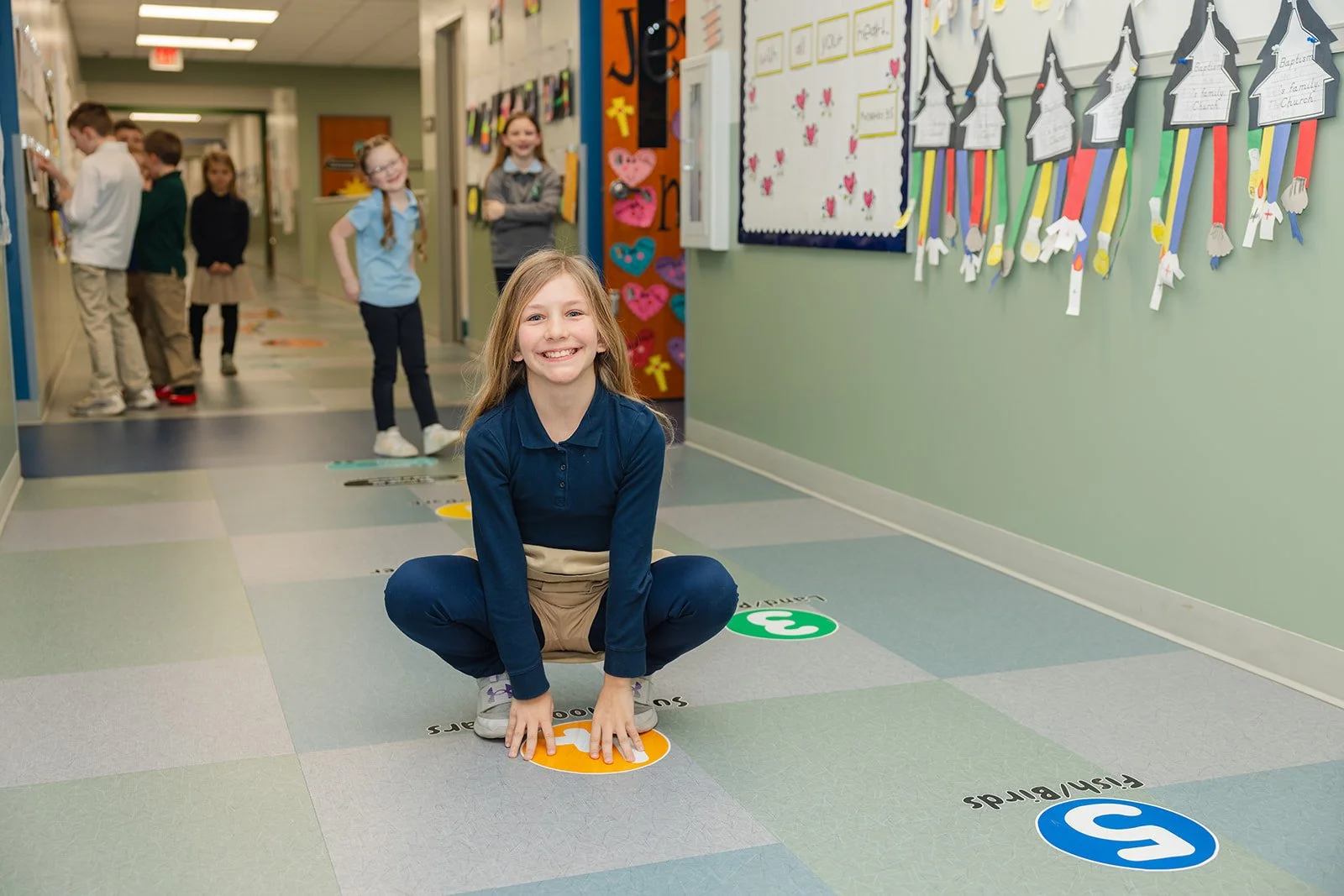
At Sacred Steps Sensory Paths, we believe every hallway has the potential to become a place where students grow academically, socially, emotionally, and spiritually.
Designed by a practicing school-based occupational therapist, our movement-based resources help schools transform ordinary spaces into opportunities for learning, self-regulation, executive functioning, faith formation, and positive school culture.
Whether you're looking for a complete sensory path, a calming space, portable movement activities, or simply ideas for making your school more proactive, we'd love to help.
Contact us today for a complimentary hallway mock-up and discover how your hallways can begin teaching before the first bell ever rings.
About the Author
Trisha Klausing, MOT, OTR/L is a practicing school-based occupational therapist with more than a decade of experience helping children succeed in educational settings. She is the founder of Sacred Steps Sensory Paths, where she designs movement-based resources that support executive functioning, self-regulation, faith formation, and inclusive learning environments. Sacred Steps products are currently being used in schools, parishes, therapy clinics, and community spaces across 27 states and Canada.