What if one of the most valuable learning supports in your school wasn't another program, another worksheet, or another intervention—but simply more opportunities to move?
As a practicing school-based occupational therapist, I spend my days helping students develop the skills they need to participate successfully in their classrooms.
And one thing I've learned over the years?
Sometimes, before we can expect children to sit, focus, and learn, we need to give them an opportunity to MOVE.
That's one of the biggest reasons I created Sacred Steps Sensory Paths.
What Does an Occupational Therapist See That Others Might Miss?
When a student struggles to sit still, follow directions, transition between activities, or complete classroom work, it's easy to focus on the behavior we're seeing.
But as an OT, I'm also looking at what might be happening underneath that behavior.
Is the student having difficulty regulating their level of alertness?
Do they need additional opportunities for movement or proprioceptive input?
Are motor planning, body awareness, or coordination making certain tasks more challenging?
Is the classroom environment contributing to sensory overload?
Not every attention or behavior challenge is sensory-related, and no single strategy works for every child. But understanding how movement, sensory processing, and regulation influence classroom participation can help us provide more effective supports.
That's the OT perspective I wanted to bring to sensory pathways.
A Sensory Pathway Is More Than Colorful Floor Stickers
Sensory pathways are structured movement activities installed on floors or walls—or provided in portable formats—that encourage students to move their bodies with intention.
You might see students:
Jumping between designated targets to practice motor planning and coordination
Crossing midline to encourage bilateral coordination
Following footprints to work on body awareness and balance
Completing wall pushes for proprioceptive input
Tracing calming patterns while practicing controlled breathing
Following movement sequences that challenge attention, sequencing, and executive functioning
These aren't just fun activities, although students certainly enjoy them!
Each activity can provide an opportunity to practice skills that support participation in the school environment.
And because movement is built into a predictable sequence, students can learn to use the pathway as part of their everyday routine.
Why Public Schools Need Proactive Movement Opportunities
One of the things I feel strongly about as a school-based OT is that we shouldn't wait until a child is overwhelmed, frustrated, or struggling before offering regulation supports.
Movement can be incorporated proactively.
Think about the natural transitions that happen throughout a school day:
Before the first bell. A student arrives with lots of energy and needs help settling into the classroom routine.
After recess. Students return excited, energized, and sometimes have difficulty transitioning back to seated work.
Before a challenging academic task. A brief movement opportunity gives students a chance to reset before returning to instruction.
During hallway transitions. A space students already walk through becomes an opportunity for purposeful movement.
Sensory pathways can help schools incorporate these opportunities without requiring teachers to create an entirely new program.
And importantly, these supports don't have to be reserved only for students receiving special education services.
Movement is for ALL students.
Supporting MTSS, SEL, and Classroom Participation
Public schools are already working hard to support students through Multi-Tiered Systems of Support (MTSS), social-emotional learning, positive behavior supports, and classroom interventions.
Sensory pathways can complement these existing efforts.
From an occupational therapy perspective, I see opportunities to address several important areas:
Self-regulation: Helping students recognize their energy levels and practice strategies for becoming more ready to participate.
Executive functioning: Following sequences, remembering directions, shifting between activities, and practicing impulse control.
Motor coordination: Developing balance, bilateral coordination, motor planning, and body awareness.
Attention and readiness: Providing a structured movement opportunity before returning to classroom expectations.
Independence: Teaching students familiar movement routines they may eventually use with less adult prompting.
A sensory pathway isn't a replacement for individualized OT services or other student supports. But it can be one practical resource within a school's broader approach to supporting students.
Why I Designed Sacred Steps Differently
When I began designing sensory pathways, I approached them the same way I approach my work with students.
I didn't want activities that simply looked appealing.
I wanted activities with a purpose.
Every movement should have a reason for being there, whether it's encouraging coordination, promoting body awareness, practicing regulation strategies, or reinforcing positive classroom habits.
I also knew the activities needed to work in real schools.
Schools with busy hallways.
Schools with limited budgets.
Schools without dedicated sensory rooms.
Schools where teachers and intervention specialists are already juggling more responsibilities than ever.
That's why Sacred Steps offers several universal, non-faith-based options specifically suited to public school environments.
Sensory Pathway Options for Public Schools
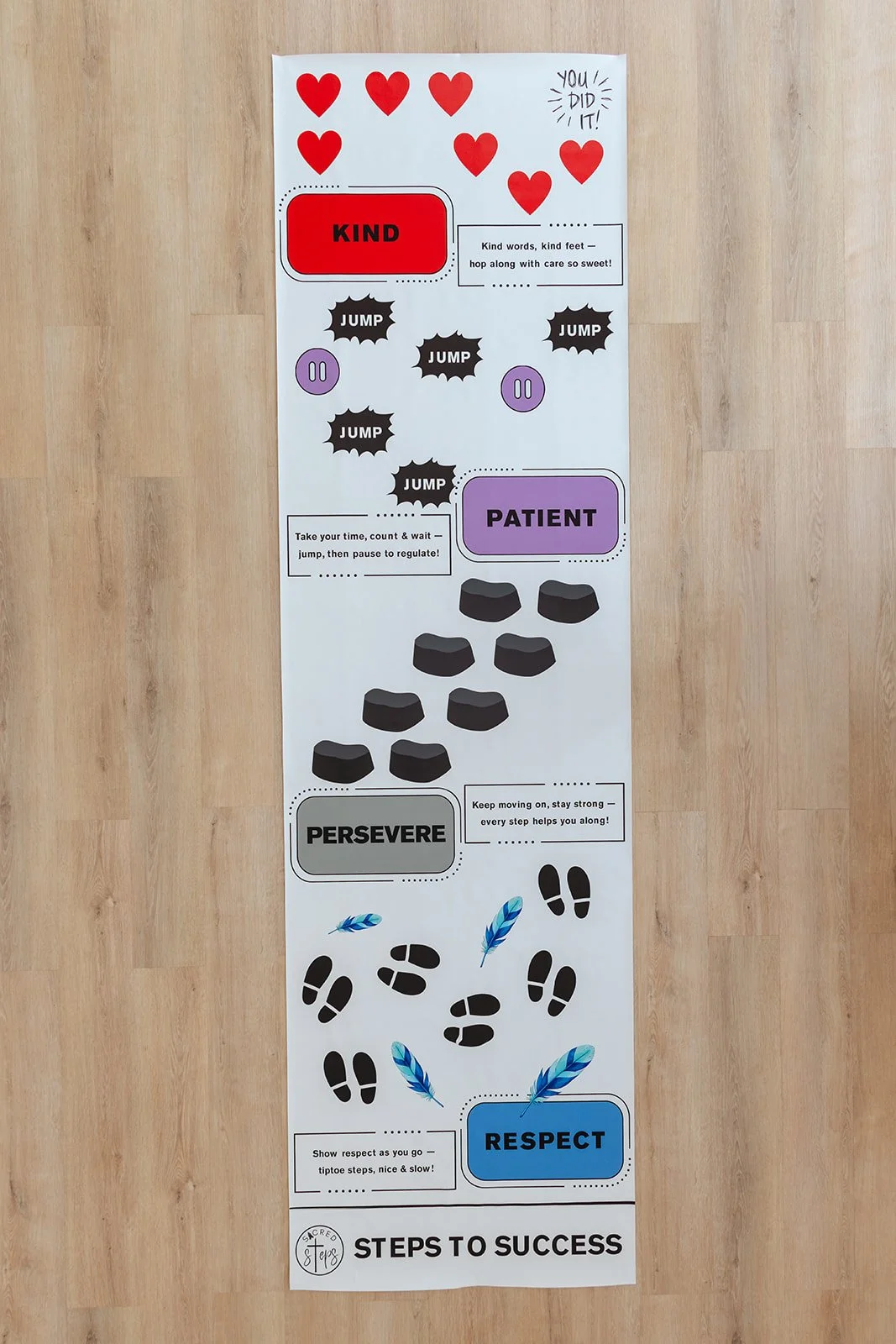
Steps to Success Sensory Path - A full sensory pathway combining purposeful movement with positive character traits, self-regulation, and executive functioning opportunities. It transforms an everyday school space into an interactive movement experience.
Regulation Station Portable Path - A flexible resource incorporating movement and emotional awareness activities. It can be used in classrooms, counseling spaces, therapy rooms, or other appropriate supervised settings.
Leaders in Motion Portable Paths - Movement-based activities that reinforce positive habits, leadership, and character development while giving students opportunities to engage their bodies.
I Can Alphabet Wall Path - An interactive alphabet experience combining positive messages with movement, particularly suited to younger students.
And for schools that aren't ready for a permanent installation, portable paths, desk calming strips, and smaller activity options offer a way to get started.

You Don't Need a Sensory Room to Support Sensory Regulation
I often hear from schools that would love to provide more sensory supports but don't have the space or funding for a dedicated sensory room.
Here's what I want those schools to know:
You can start with the space you already have.
An unused hallway wall.
A section of open floor.
A portable path shared between classrooms.
A small calming activity outside a counseling office.
Sometimes the most practical sensory supports are the ones that fit naturally into a student's existing day.
The goal isn't to add more work for educators. It's to make purposeful movement easier to access.
One Important Reminder From an OT
Sensory pathways are tools, not magic solutions.
Students have different sensory preferences, motor abilities, and regulation needs. An activity that helps one student feel more organized may not have the same effect on another.
That's why adult observation, student choice, accessibility, and thoughtful implementation matter.
Start with a few activities. Watch how students respond. Adjust the movements or timing when needed.
And remember that the ultimate goal isn't simply completing the pathway.
The goal is helping students participate more successfully in their school day.
Ready to Bring Purposeful Movement Into Your School?
Whether you're a principal exploring schoolwide sensory supports, a teacher looking for practical movement opportunities, or an occupational therapist advocating for proactive regulation strategies, I'd love to help.
Sacred Steps Sensory Paths offers OT-designed movement resources for public schools, including permanent floor and wall pathways, portable paths, and smaller sensory activities.
You don't have to start with a huge project.
You just have to start somewhere.
Explore Sensory Pathways for Public Schools →
Need a quote for your principal, PTO, or grant application? Request a Quote →
Because sometimes the best way to help children sit and learn is to let them move first.
About the Author
Trisha Klausing, MOT, OTR/L, is a practicing pediatric school-based occupational therapist with more than a decade of experience supporting students in educational settings. She is the founder of Sacred Steps Sensory Paths, creating OT-designed movement and regulation resources for schools across 28 states. Her work focuses on making purposeful movement, sensory regulation, and executive functioning supports practical and accessible within everyday school routines.