What Is a Holy Path for Kids — and Why Catholic Schools Are Adding Them to Their Hallways
A holy path for kids combines movement, sensory engagement, and faith formation in one. Discover how Catholic and Christian schools are using sacred sensory paths to help students regulate, focus, and grow in faith.
If you've been searching for a "holy path for kids," you're not alone — and you've landed in exactly the right place.
Catholic and Christian schools across the country are discovering a powerful tool that combines two things educators care deeply about: helping kids regulate their bodies and minds, AND growing in their faith. It's called a holy path — and it's transforming school hallways in the most beautiful way.
What Is a Holy Path for Kids?
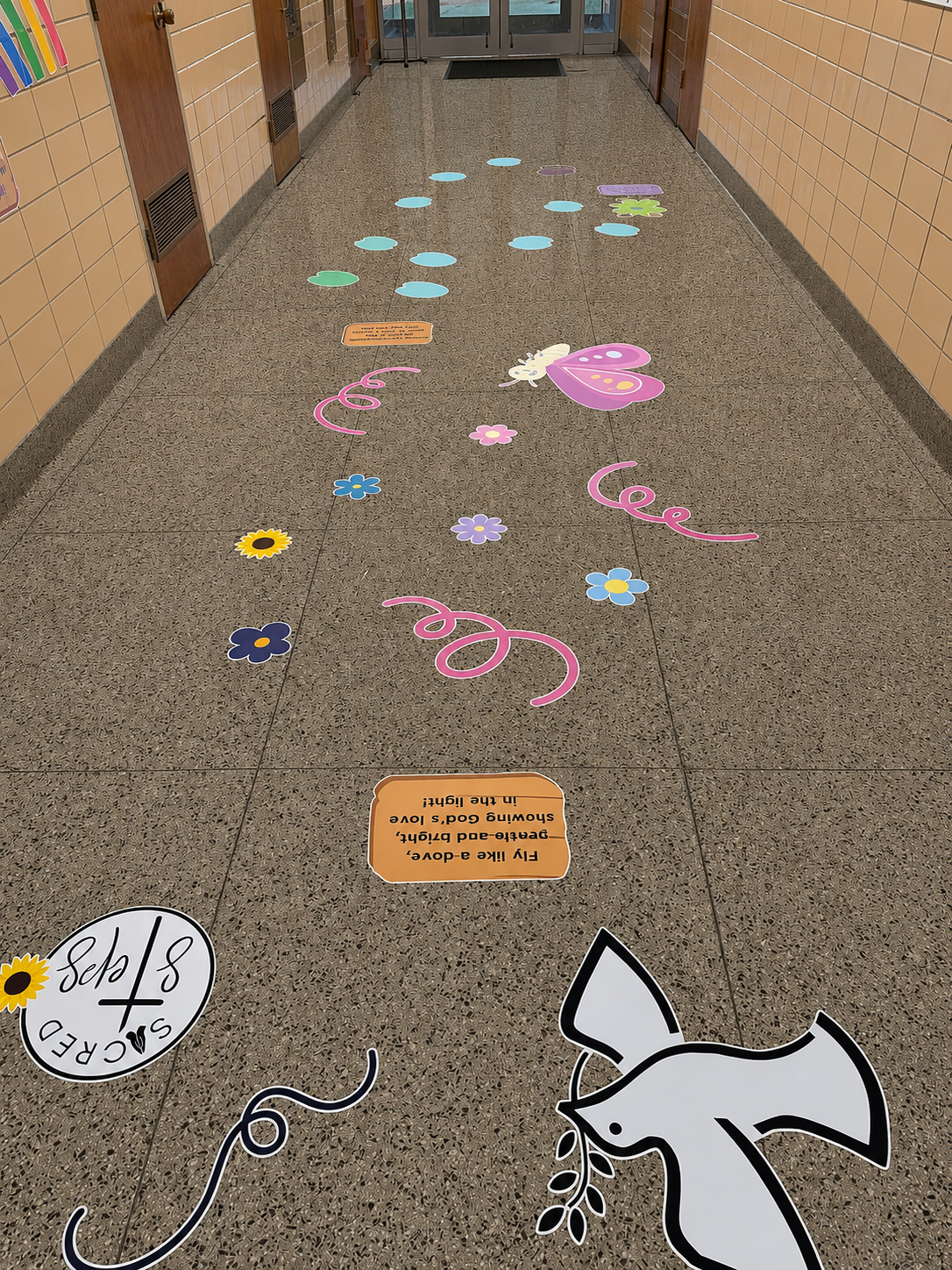
A holy path for kids is a faith-based sensory path installed in a school hallway or common area. Rather than standard shapes or colors, each movement station is tied to a faith-based concept — Bible stories, Catholic virtues, the Sacraments, the fruits of the Holy Spirit, or scripture verses.
As children walk, hop, balance, and move through the path, they aren't just regulating their nervous systems — they're engaging with the foundations of their faith, one step at a time.
Think of it as a living catechism in your hallway. 🙏
Why Movement Matters for Kids
As an occupational therapist with over 10 years of school-based experience, I've seen firsthand what happens when kids don't get enough movement during the school day. They fidget. They struggle to focus. They act out — not because they're choosing to misbehave, but because their sensory systems are crying out for input.
Research consistently shows that movement:
Improves focus and attention in the classroom
Supports emotional regulation
Reduces anxiety
Improves readiness to learn
A holy path gives kids a purposeful, structured way to get that movement — without taking a single minute away from academics or faith formation.
What Makes a Holy Path Different from a Regular Sensory Path?
Standard sensory paths are wonderful tools. But for Catholic and Christian schools, a generic sensory path can feel like a missed opportunity.
A holy path is intentionally designed to weave faith into every movement. At Sacred Steps Sensory Paths, our paths are created by a licensed occupational therapist AND grounded in Catholic and Christian tradition, so every hop, balance, and stretch is connected to something meaningful.
Some of our most popular holy path themes include:
Bible Stories Sensory Path — walking through beloved scripture stories with every step
Fruit of the Holy Spirit Path — reinforcing love, joy, peace, patience, and more
Walk With Jesus Path — 3 ft x 10 ft rollable path features six Scripture-inspired movement activities that support regulation, focus, motor planning, and body awareness
Holy Alphabet Path — faith-based letters from A to Z for younger learners
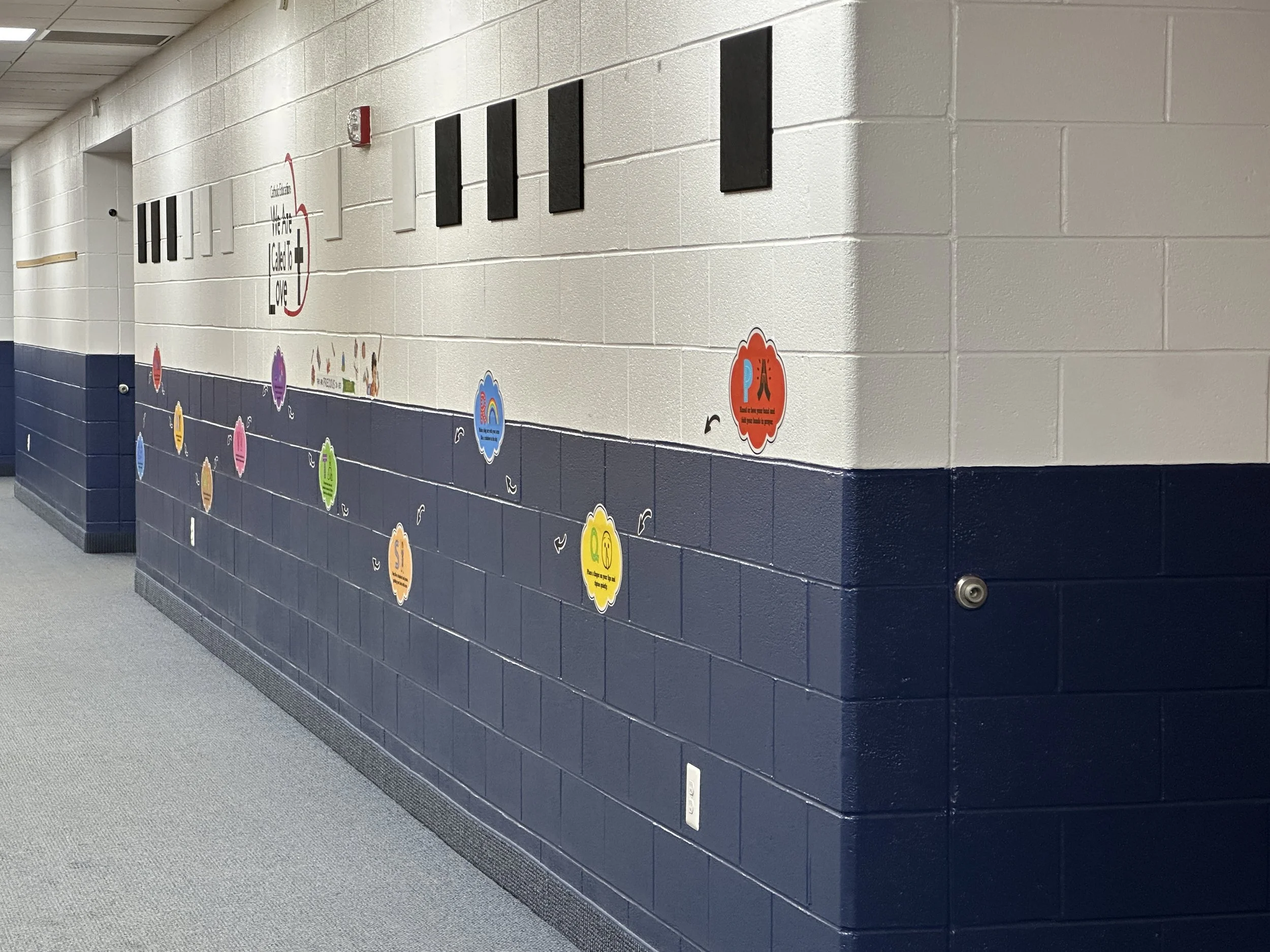
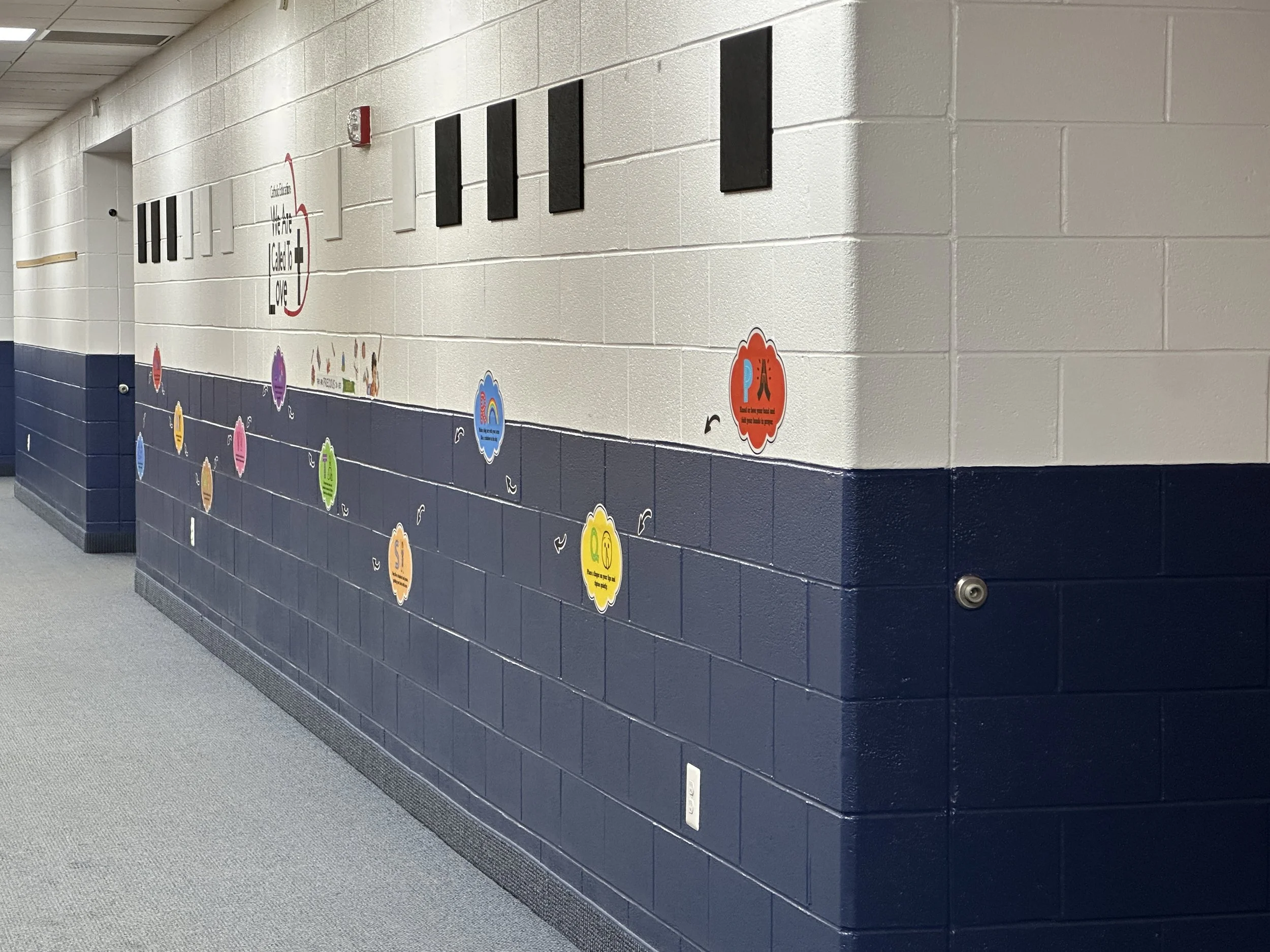
Faith-based Holy Alphabet sensory path installed in a school hallway, featuring letter-themed movement stations designed by a pediatric occupational therapist to support student regulation and faith formation in Catholic and Christian schools.
Who Is a Holy Path For?
Holy paths work beautifully for:
Catholic and Christian elementary schools
Parish preschools and faith-based early childhood programs
Religious education hallways and common areas
Therapy clinics serving faith-based communities
Churches, YMCAs, and community spaces
And the best part? They work for ALL students — not just those with sensory needs. Every child benefits from movement and faith formation woven together throughout the school day.
What Schools Are Saying
Here's a recent review from Delphos St. John's Preschool that sums it up perfectly:
"WOW! We had Sacred Steps Sensory Paths installed last summer and our students loved it during the school year! Families and siblings love it when visiting too. Quick and easy install, and they're still in great shape!"
A full school year of daily use — and still going strong. That's the kind of investment that pays for itself over and over again.
When Is the Best Time to Install a Holy Path?
Summer! Most schools choose to have their holy path installed during the summer months when hallways are clear and there's no disruption to the school day. Sacred Steps installation is quick — typically just a few hours one morning — and your path will be ready and waiting when students return in the fall.
If you're planning for next school year, now is the perfect time to start the conversation.
Ready to Bring a Holy Path to Your School?
Sacred Steps Sensory Paths is the only OT-designed faith-based sensory path company in the country, now serving Catholic and Christian schools in 25 states and Canada.
We'd love to help you create something beautiful — and meaningful — for your students.
👉 Request your FREE custom hallway mockup here and see exactly what a holy path could look like in your space before you commit to anything.
Trisha Nusbaum, OTR/L, MOT is a pediatric occupational therapist with over 10 years of school-based experience and the founder of Sacred Steps Sensory Paths LLC.
Summer Is the Perfect Time to Reimagine Your School Spaces
A school-based OT shares how hallways, walls, and small unused spaces can become sensory paths and calming corners that support student regulation and success.
As a school-based occupational therapist, summer has always been one of my favorite times of year.
Not because school is out, but because it's when educators begin dreaming about what's possible for the year ahead.
The hustle and bustle of the school year slows down. Hallways are quiet. Classrooms are being cleaned and reorganized. Administrators and teachers finally have a chance to step back and ask an important question:
How can we better support our students next year?
Sometimes the answer isn't adding another program, curriculum, or initiative.
Sometimes it's simply looking at the spaces we already have in a new way.
What If Your Hallways Could Do More?
Most school hallways serve one primary purpose: getting students from one place to another.
But what if they could do more?
What if a hallway became a place where students could move their bodies, regulate their emotions, practice executive functioning skills, or build confidence before entering the classroom?
As an OT, I've seen firsthand how movement can help students prepare for learning. A few moments of purposeful movement can help students organize their bodies, improve attention, reduce stress, and transition more successfully throughout the day.
That's why sensory paths have become such valuable tools in schools.
They transform an ordinary hallway into an opportunity for movement, regulation, and success.
Don't Forget About Your Walls
One of the most exciting trends I've seen recently is schools utilizing vertical space in creative ways.
An empty wall can become:
A breathing and mindfulness area
A movement break zone
A faith-based reflection space
A gross motor activity center
Wall-based activities are especially helpful for schools that may not be ready for a full floor installation or are looking to create smaller regulation spaces throughout their building.
Small Spaces Can Make a Big Difference
When schools think about sensory supports, they often imagine large projects.
But some of the most impactful spaces I've seen are surprisingly simple.
A small corner near a counseling office.
A section of hallway outside the library.
An unused wall near a classroom cluster.
A quiet area where students can take a moment to reset before returning to learning.
These spaces don't need to be large to be effective. They simply need to be intentional.
Why Summer Is the Best Time to Plan
Summer offers a unique opportunity to evaluate your building with fresh eyes.
Without students filling the hallways, it's easier to notice:
Underutilized spaces
Areas where transitions are challenging
Locations where students may benefit from movement opportunities
Walls and hallways that could better support student success
It's also the ideal time to plan installations, make updates, and prepare spaces before students return in the fall.
Start by Looking Differently
One of my favorite parts of creating Sacred Steps is helping schools see possibilities they may not have noticed before.
A hallway becomes a sensory path.
An empty wall becomes a calming space.
A transition area becomes an opportunity for movement, regulation, and success.
As educators, we spend so much time thinking about what happens inside our classrooms. Sometimes the greatest opportunities exist just outside them.
As you prepare for another school year, I encourage you to take a walk through your building and ask yourself:
What could this space become?
You may be surprised by the answer.
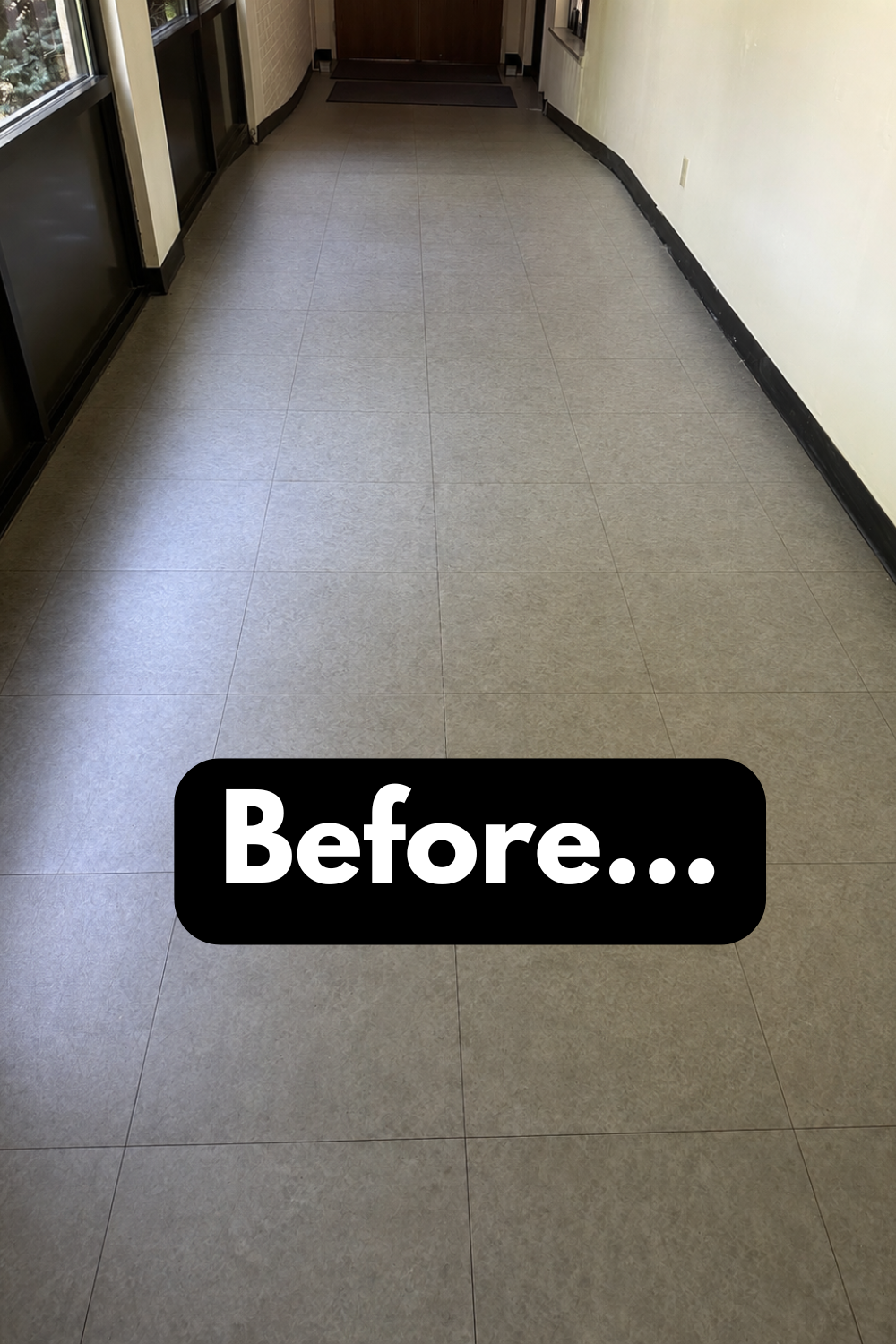
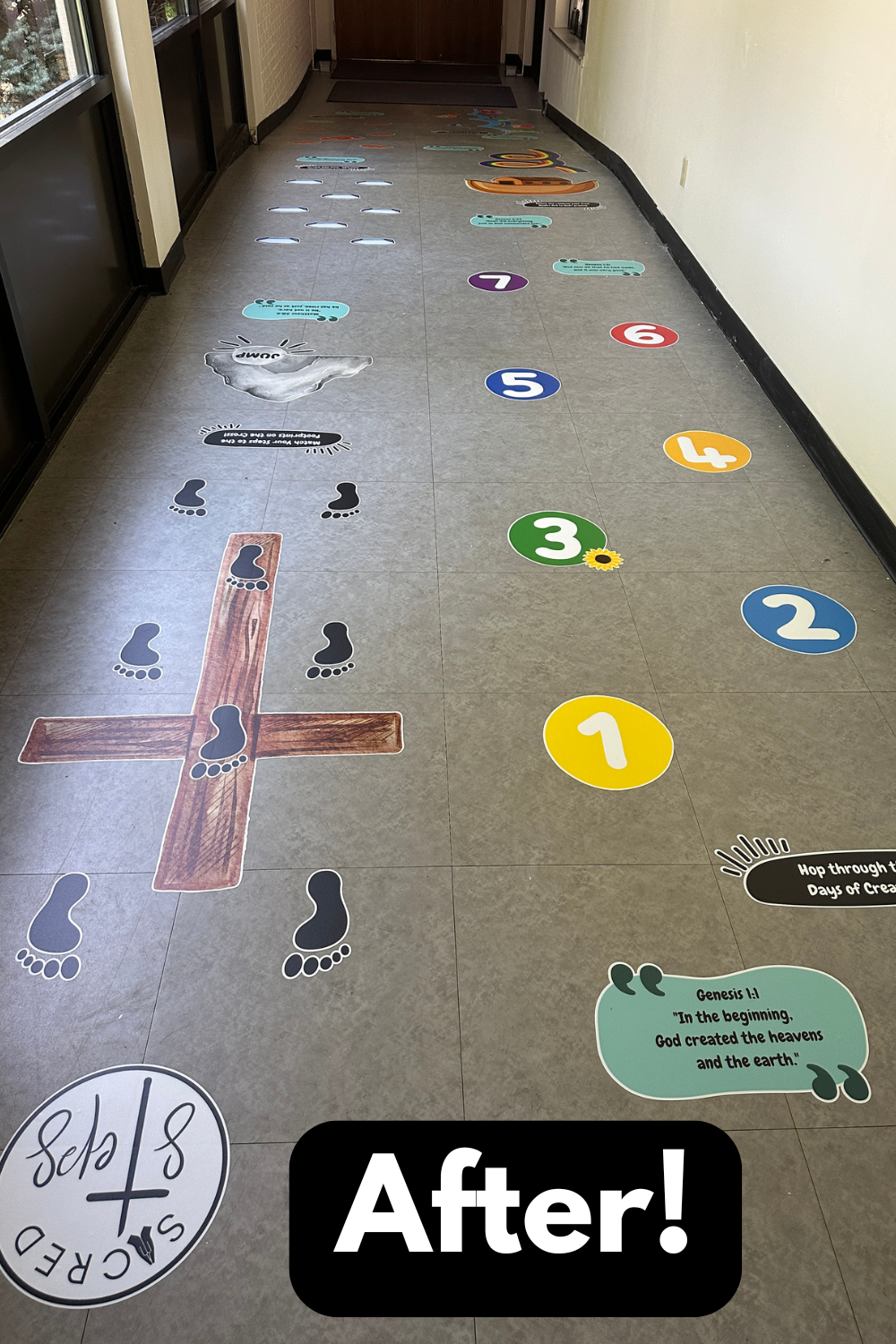
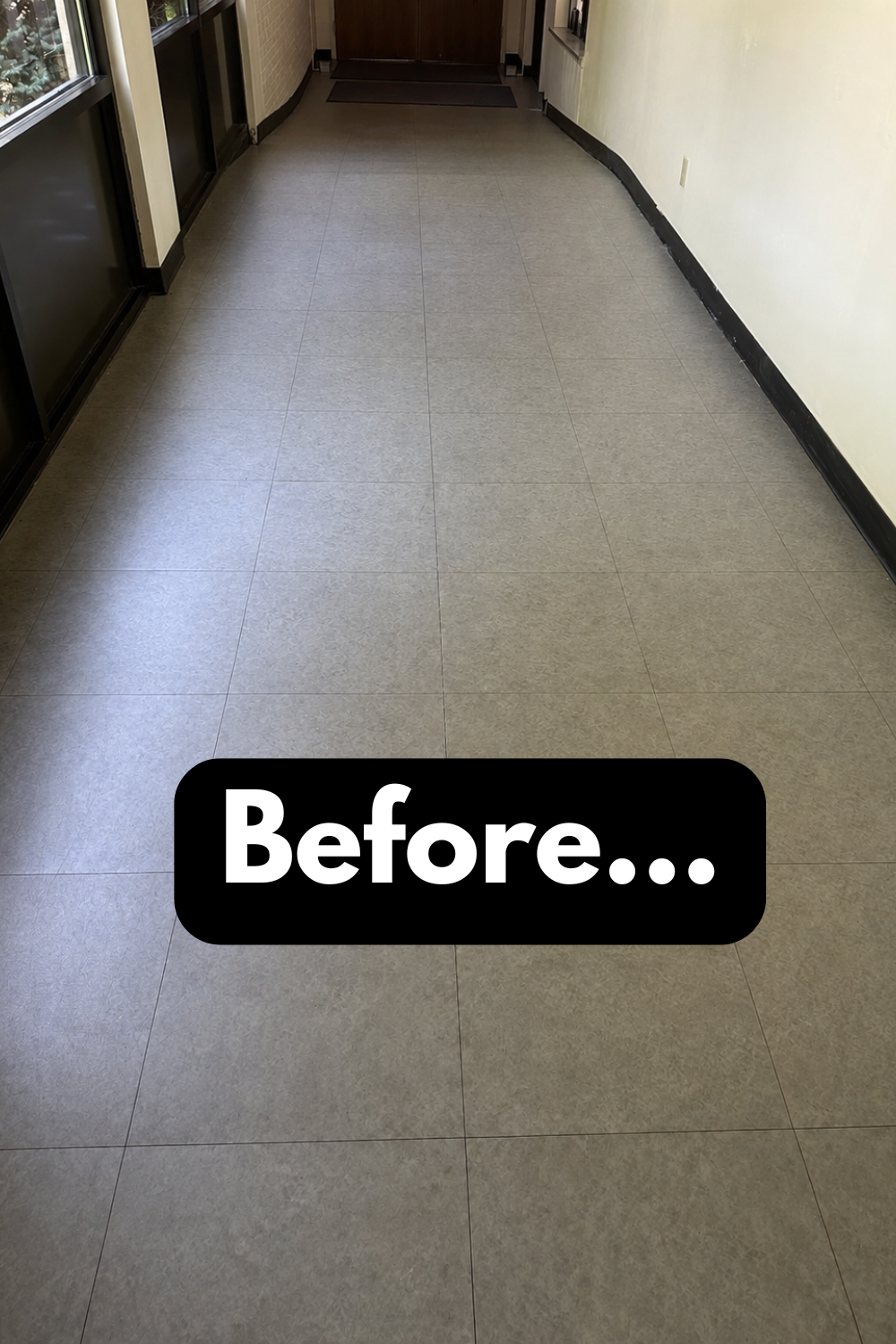
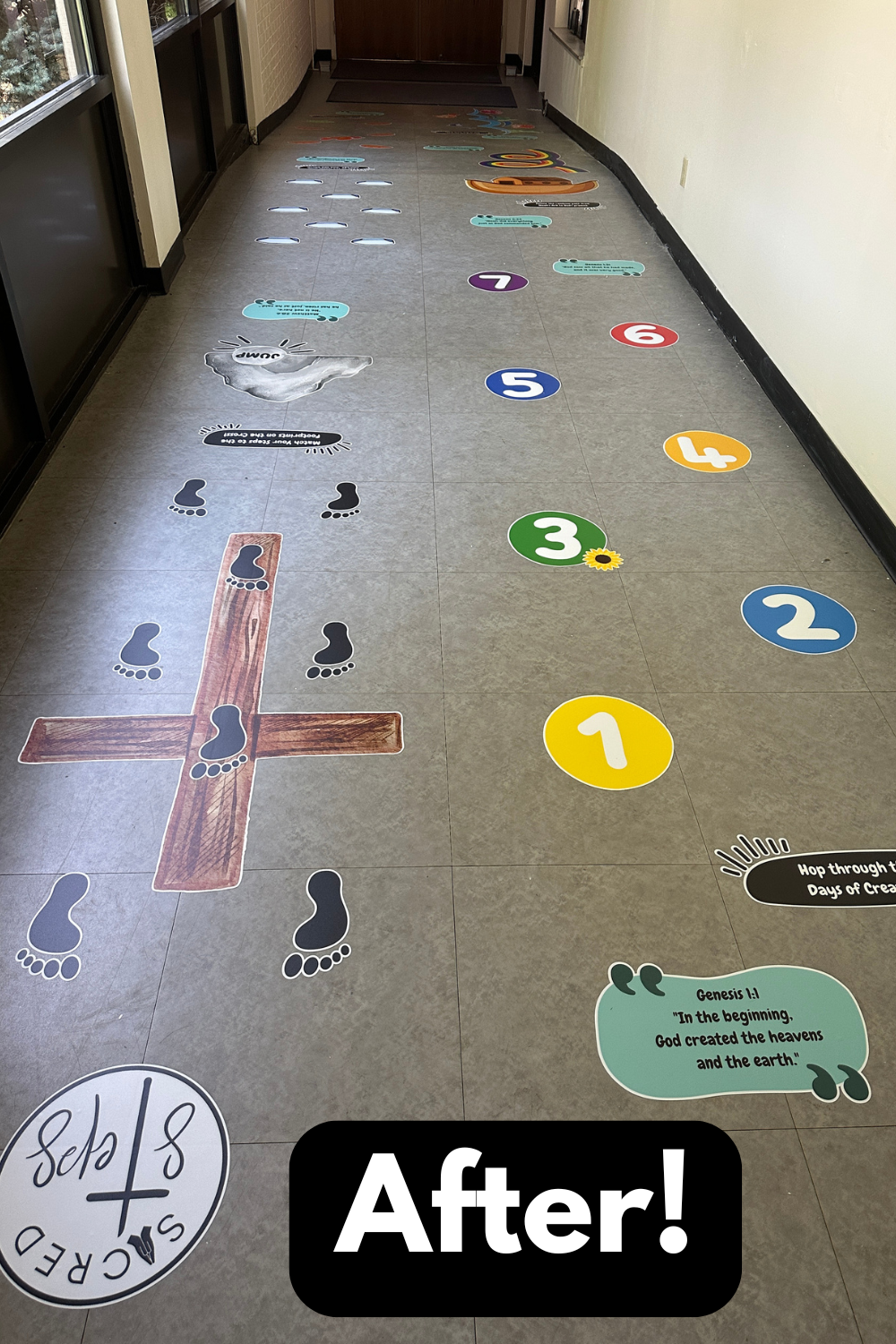
An underutilized hallway at a Catholic school in Missouri…
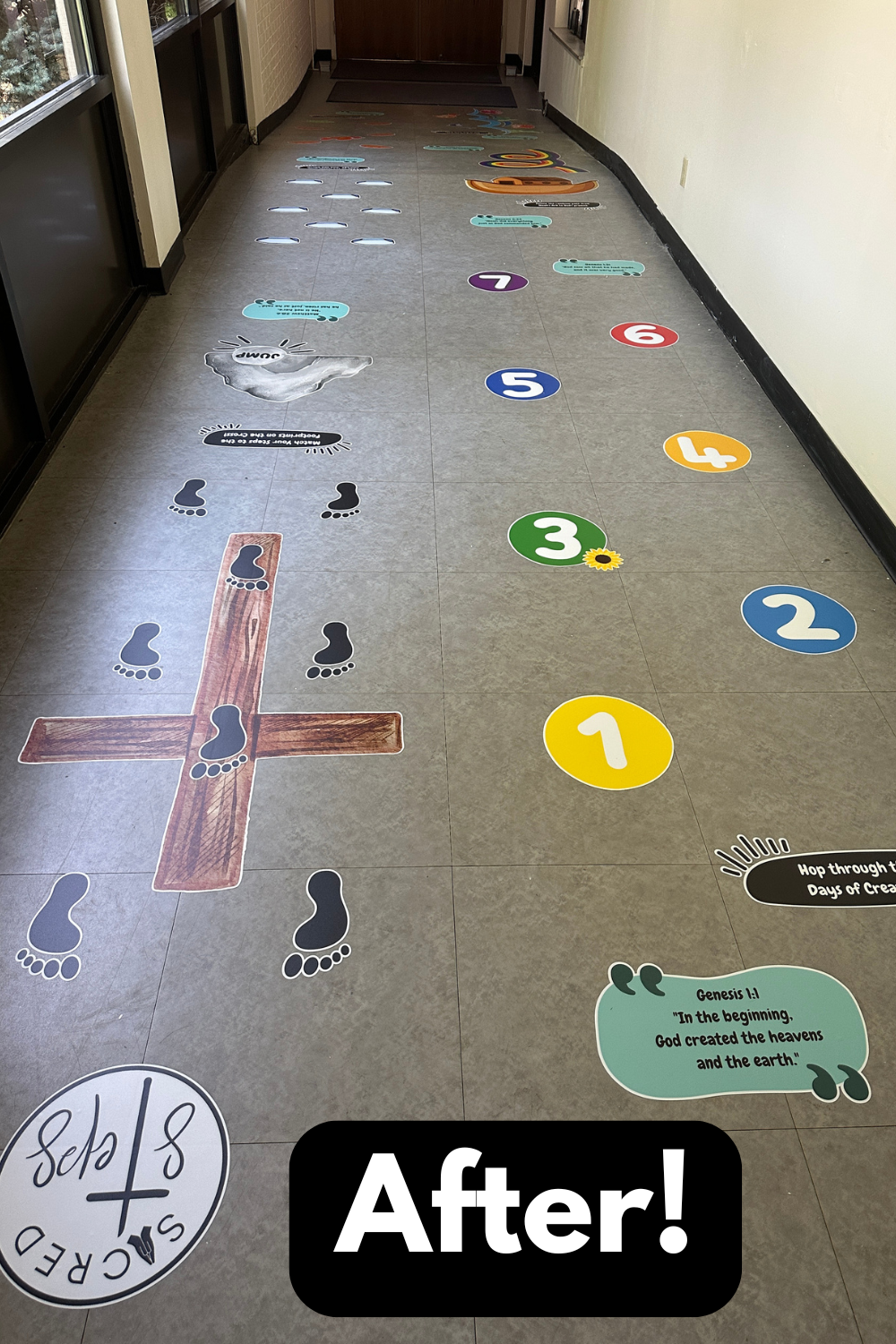
Catholic school hallway transformed into a faith-based sensory pathway that supports student regulation, focus, and faith formation.
What Is a Sensory Pathway? Signs, Benefits & School Examples
What is a sensory pathway? Discover how sensory pathways work in schools, their benefits for student regulation and focus, real examples, and OT-designed ideas for creating one in your school.
If you've heard the term "sensory pathway" but aren't exactly sure what it means, you're not alone.
Over the past several years, sensory pathways have become increasingly popular in schools, therapy clinics, libraries, hospitals, and community spaces. But many educators and administrators are still wondering:
What is a sensory pathway, and why are so many schools adding them?
As a school-based occupational therapist, I'd love to help answer that question.
What Is a Sensory Pathway?
A sensory pathway is a series of intentional movement activities designed to help students move, regulate, refocus, and return to learning. In schools, sensory pathways can provide proactive movement opportunities throughout the day without requiring a dedicated sensory room.
Students might:
Hop
Jump
Balance
Stretch
March
Cross midline
Trace shapes
Practice deep breathing
Complete gross motor challenges
The goal is simple: provide structured movement opportunities that help students regulate their bodies and prepare for learning.
Many sensory pathways are installed in school hallways, allowing students to use them during transitions throughout the day.
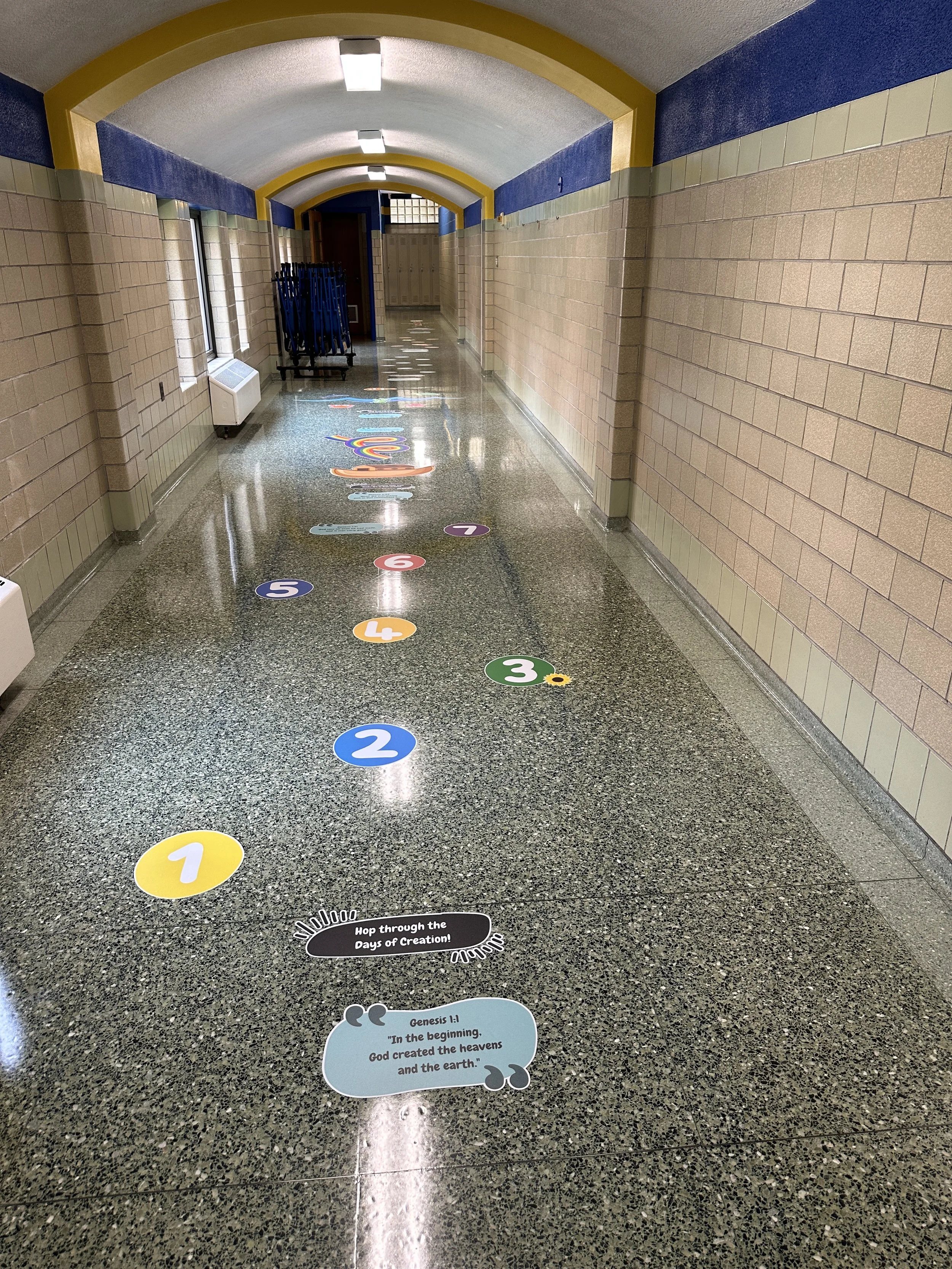
Sensory pathway for schools in Catholic elementary school hallway; https://www.sacredstepssensorypaths.com/store/p/bible-stories-sensory-path
Why Do Schools Use Sensory Pathways?
Movement plays a critical role in a child's ability to focus, regulate emotions, and participate successfully in the classroom.
When students are struggling with attention, self-regulation, anxiety, impulsivity, or transitions, a brief movement break can make a significant difference.
Schools often use sensory pathways to support:
Student Regulation
Sensory pathways provide students with opportunities to move their bodies in ways that help them feel more organized, calm, and ready to learn.
Executive Functioning Skills
Many pathways include activities that encourage students to follow directions, sequence movements, maintain attention, and practice self-control.
Positive Transitions
Transitions can be challenging for many students. Sensory pathways create a structured and engaging way for students to move from one activity to another.
Indoor Movement Opportunities
Weather doesn't always cooperate. Sensory pathways give students a way to move throughout the day, even when outdoor activities aren't possible.
Inclusive Support
One of the best things about sensory pathways is that they benefit all students. While they can be particularly helpful for students with ADHD, anxiety, autism, sensory processing differences, or executive functioning challenges, every child can benefit from purposeful movement.
Where Are Sensory Pathways Installed?
One of the reasons sensory pathways have become so popular is their flexibility.
Schools are installing sensory pathways in:
Hallways
Libraries
Counseling offices
Calming corners
Early childhood wings
Resource rooms
Common areas
Church and parish spaces
Many schools also incorporate wall-based sensory activities when floor space is limited. Other schools choose portable sensory paths that can be rolled out when needed and stored away when space is limited.
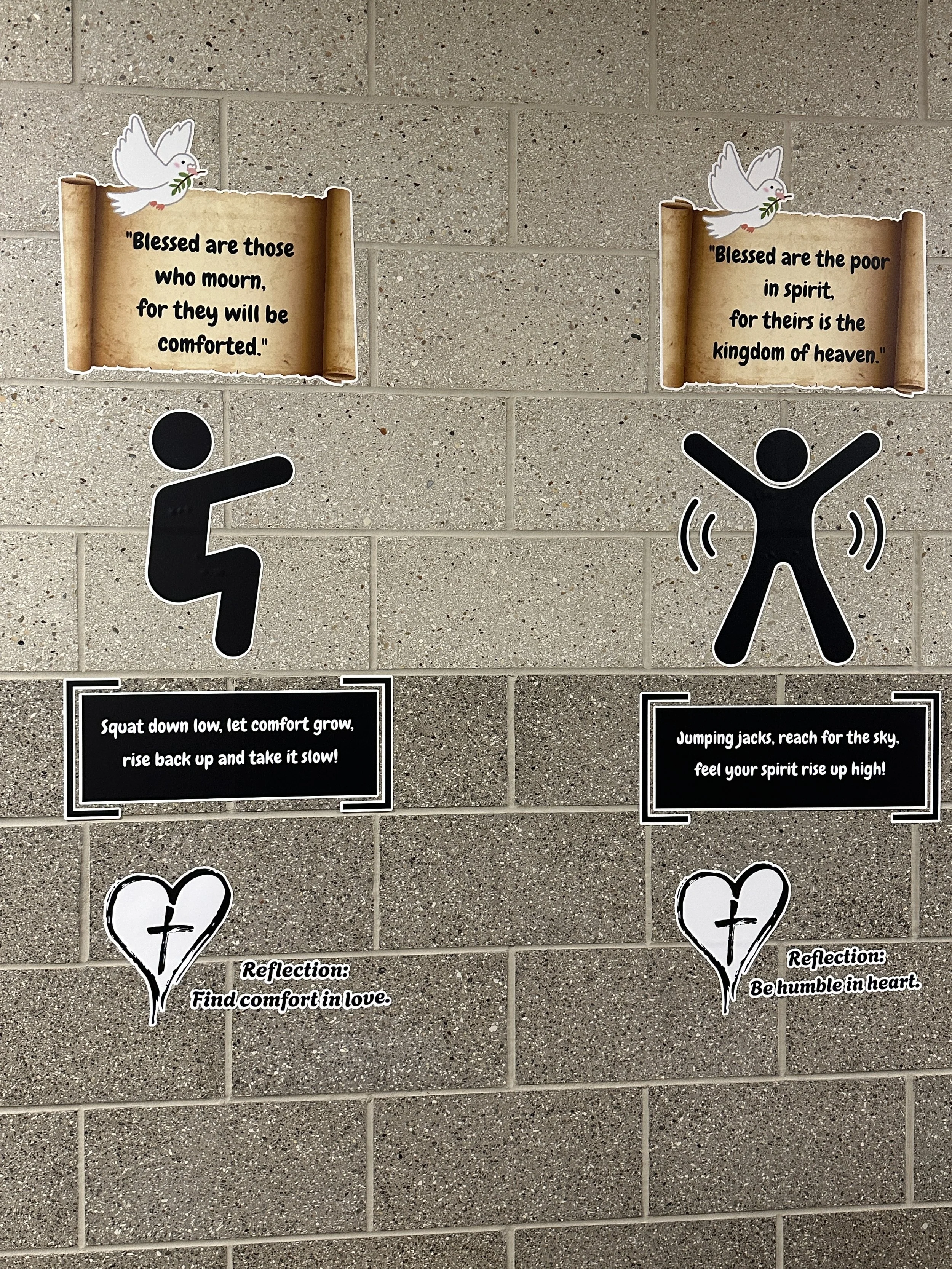
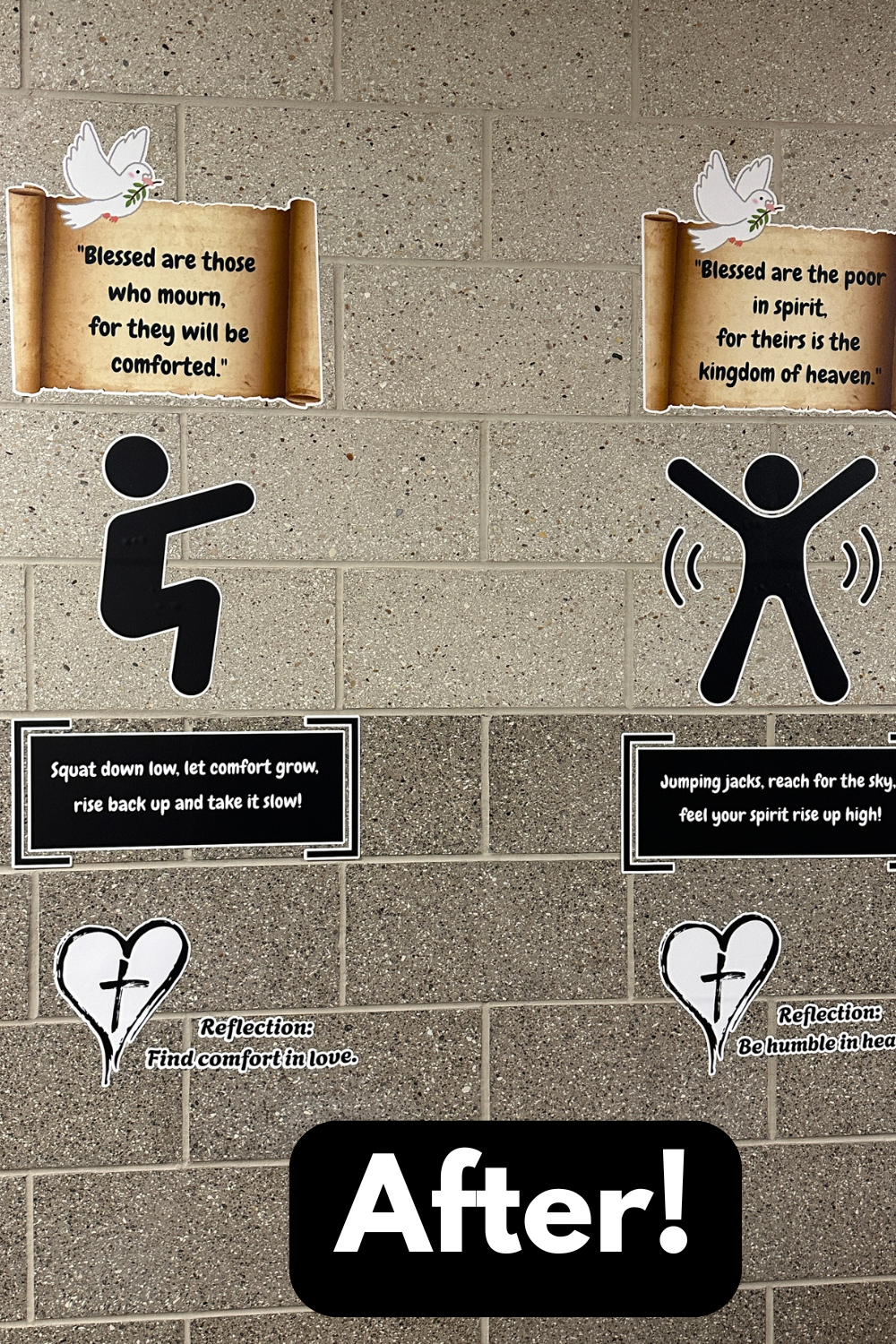
Limited floor space? A wall sensory path is the perfect solution. https://www.sacredstepssensorypaths.com/store/p/beatitudes-blessings-wall-sensory-path
Examples of Sensory Pathway Activities
Every sensory pathway is unique, but common activities include:
Animal walks
Hopping patterns
Balance challenges
Cross-body movements
Deep breathing exercises
Visual tracking activities
Gross motor sequences
Mindfulness prompts
These activities encourage students to move in ways that support both physical and cognitive development.
What Makes Faith-Based Sensory Pathways Different?
While many sensory pathways focus solely on movement, some schools are looking for ways to combine movement with meaningful learning opportunities.
This is especially true in Catholic and Christian schools.
Faith-based sensory pathways allow students to engage with:
Bible stories
Scripture
Catholic virtues
The Sacraments
Prayer
Religious education concepts
At Sacred Steps, some of our most popular faith-based options include the Bible Stories Sensory Path, the Who God Says I Am Path, and the Sacred Sacraments Path, each designed to combine purposeful movement with meaningful faith formation.
As students move through the activities, they are not only supporting regulation and focus but also reinforcing their faith in a way that feels active, engaging, and memorable.
How Sacred Steps Sensory Paths Are Different
As both a school-based occupational therapist and a Catholic business owner, I wanted to create something that supported the whole child.
That's why Sacred Steps combines purposeful movement with faith formation.
Our sensory pathways help students:
Regulate their bodies
Improve focus and attention
Strengthen executive functioning skills
Support positive behavior
Reinforce Catholic identity
Engage with Scripture and faith-based concepts
To our knowledge, Sacred Steps remains the only faith-based sensory path company specifically designed for Catholic and Christian schools.
Is a Sensory Pathway Right for Your School?
If your school is looking for ways to:
Support student regulation
Improve transitions
Encourage movement throughout the day
Create more purposeful learning spaces
Strengthen Catholic identity
A sensory pathway may be an excellent fit.
The best part? Many schools already have the perfect space.
An empty hallway.
A blank wall.
A transition area that could become something more.
Schools often begin with a full hallway path, a portable path, or even a smaller starter set before expanding over time.
Sometimes the most impactful school improvement projects don't require additional space—just a new way of thinking about the space you already have.
If you're interested in exploring what a sensory pathway could look like in your school, I'd be happy to create a complimentary mockup using photos of your space. You can explore our faith-based sensory paths, portable paths, and starter sets here: https://www.sacredstepssensorypaths.com/
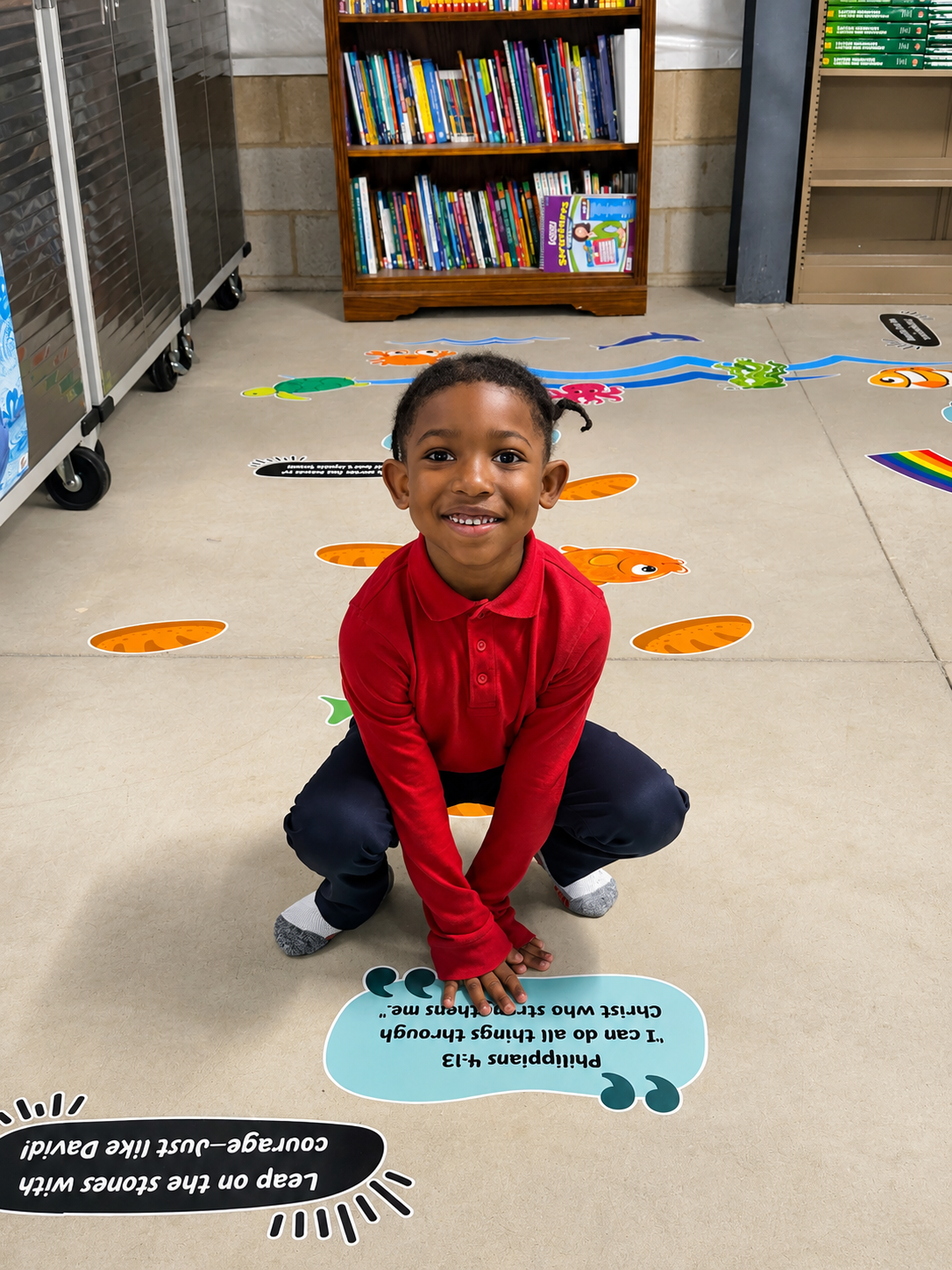
5 Mistakes Schools Make When Installing Sensory Paths (And How to Fix Them)
Thinking about adding a sensory path to your school hallway? An OT with 10+ years of school-based experience shares the 5 most common installation mistakes — and exactly how to avoid them.
After working with schools in 25 states and Canada, I've seen a lot of sensory path installations go really well — and a few that didn't quite land the way they were supposed to.
As an OTR/L with over 10 years of school-based experience, I want to share the five most common mistakes I see so your installation goes smoothly from day one.
Mistake #1: Installing in the Wrong Location
Not every hallway is created equal. A sensory path tucked in a dark corner near the boiler room isn't going to get used. The best locations are high-traffic, well-lit hallways that students pass through naturally during transitions — not out-of-the-way spaces that require a special trip.
The fix: Choose a hallway that students already use daily. The path should feel like a natural part of their routine, not a detour.
Mistake #2: No Staff Introduction or Buy-In
A sensory path installed over a weekend with no staff training is a sensory path that collects dust. Teachers and aides need to understand why the path is there, who it's for, and how to use it as a tool — not just a decoration.
The fix: Do a brief staff walkthrough before students ever set foot on it. Even 10 minutes makes a huge difference in how consistently it gets used.
Mistake #3: Installing Over Waxed Floors Without Proper Prep
This is the one that catches schools off guard. Freshly waxed floors can prevent the adhesive from bonding properly, leading to edges that curl or tiles that shift over time.
The fix: Make sure floors are clean, dry, and free of wax buildup in the installation area before applying. Summer installation is ideal — custodial staff have more time and the floors can be properly prepped without disrupting students.
Mistake #4: Choosing Activities That Don't Match the Students
A path designed for kindergarteners won't engage middle schoolers — and vice versa. I've seen schools order a path based purely on aesthetics without thinking through the age range, cognitive level, or sensory needs of the students who will actually use it.
The fix: Think about your specific population first. Who needs this most? What kind of input are they seeking — heavy work, balance, coordination, calming? The path should be chosen for your kids, not just your hallway.
Mistake #5: Treating It as a One-Time Novelty
The schools that get the most out of their sensory paths are the ones that intentionally build it into daily routines — morning arrival, transitions between classes, after lunch, before specials. The schools that struggle are the ones who unveil it with fanfare and then never mention it again.
The fix: Build the path into your schedule intentionally. Assign it a purpose. Make it a consistent tool, not a one-time event.
The Bottom Line
Sensory paths work. I've seen them completely transform the energy of a school hallway — calmer transitions, fewer behavioral disruptions, and kids who arrive at their next class ready to learn.
But like any tool, they work best when they're used thoughtfully and intentionally. Avoid these five mistakes and you'll set your school up for success from day one.
Thinking about adding a sensory path to your school? I'd love to help you find the right fit. Request a free custom hallway mockup and I'll show you exactly what it could look like in your space — no commitment required.
About the Author
Trisha Klausing is an OTR/L with over 10 years of school-based experience and the founder of Sacred Steps Sensory Paths — the only OT-designed, faith-based sensory path company in the country. Sacred Steps paths are now in 25 states and Canada.
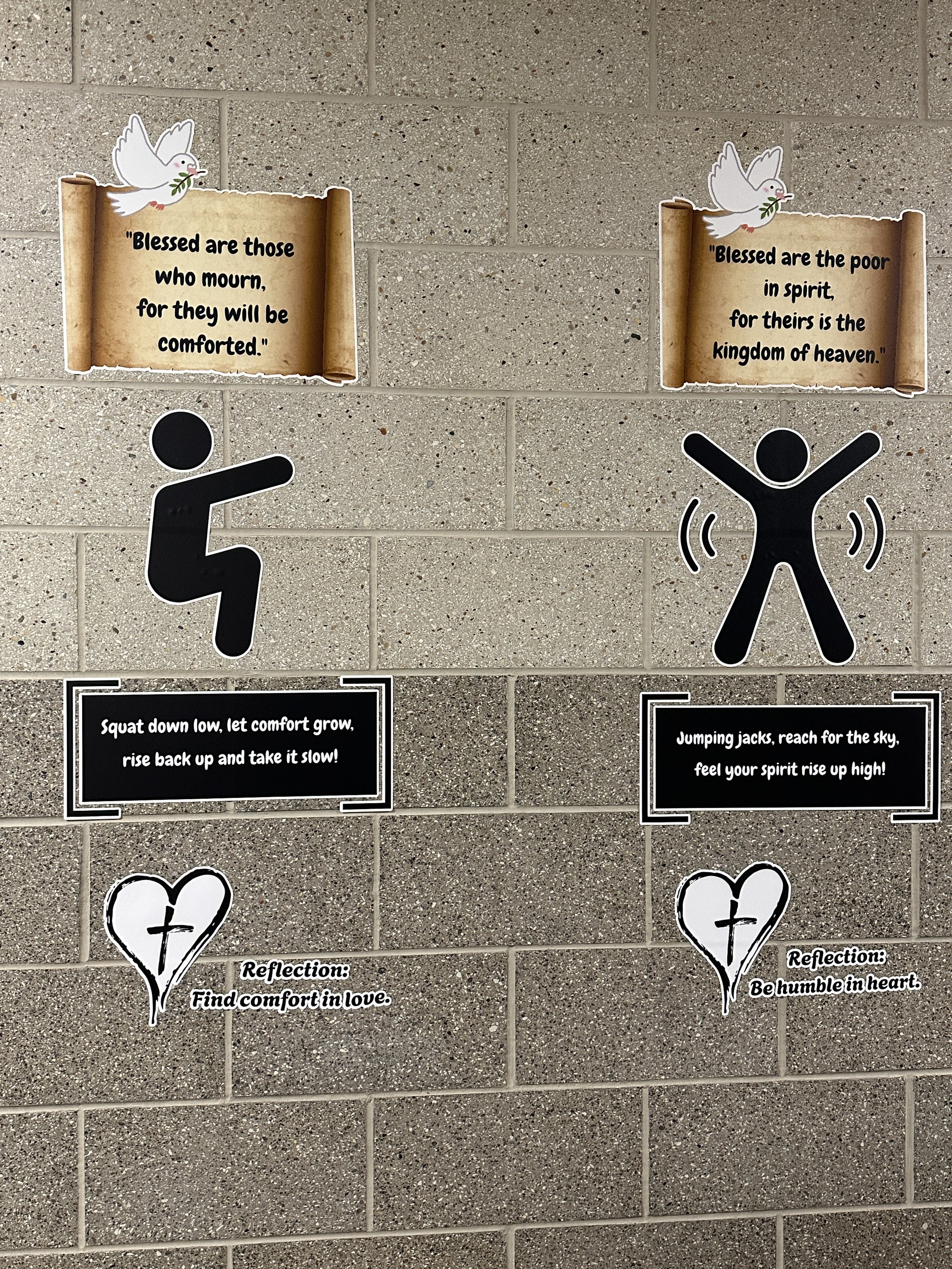
See It Before You Buy It — Free Custom Sensory Path Mockup for Your School
Not sure what a Sacred Steps Sensory Path would look like in your school? Send us a photo of your hallway and we'll create a FREE custom mockup — no obligation. OT-designed paths for Catholic schools, Christian schools, and public schools.
One of the most common things I hear from principals and school administrators before they order a Sacred Steps Sensory Path is some version of this:
"I love the idea — I just can't picture what it would actually look like in our hallway."
I get it. Buying a sensory path is a real investment. You're committing to a permanent change to your school environment, and it can be hard to visualize how a product will look in your specific space based on photos of someone else's school.
So I started offering something that has completely changed the conversation — and I want to make it available to every school that's been on the fence.
I will create a free custom mockup showing exactly what a Sacred Steps Sensory Path could look like in your specific space. No cost. No obligation.
What Is a Custom Mockup?
A custom mockup is a personalized visual created specifically for your school. You send me a photo of your hallway, wall, counseling office, library, or common area — and I'll show you what a Sacred Steps path would look like installed in that exact space.
It's not a generic rendering. It's YOUR hallway, YOUR space, with a Sacred Steps path placed exactly where it would live.
This gives you something incredibly powerful before you spend a single dollar: the ability to see it, share it with your staff, show it to your school board, and make a confident, informed decision.
Why I Started Offering This
As a school-based OT I've spent over a decade walking the hallways of schools. I know that every building is different — different dimensions, different floor colors, different wall configurations, different traffic patterns.
I also know that the biggest barrier between a principal who loves the idea of a sensory path and a principal who actually orders one is often just confidence. Confidence that it will fit. Confidence that it will look right. Confidence that it will work in their specific building.
A custom mockup removes that barrier completely.
When a principal can see their own hallway transformed — can show their staff exactly what the Ten Commandments path would look like outside the third-grade classrooms, or where the Bible Stories path would go near the gym — the decision becomes so much clearer.
Several schools that have received mockups have told me it was the moment they went from "I'm interested" to "I'm ready to order."
What Spaces Work Best?
Sacred Steps paths are more flexible than most people realize. Here are the spaces I most commonly mockup for schools:
Hallways — The most common installation. A path running along one wall of a school hallway, typically near classrooms that need extra regulation support or near high-traffic transition areas like the gym, cafeteria, or specials wing.
Walls — Wall-mounted paths work beautifully in spaces where floor installation isn't ideal. They're also a great option for smaller spaces and can be combined with floor elements for a full sensory experience.
Counseling offices — A calming station or small portable path in a school counselor's office gives students a regulation tool before they head back to class. Even a small corner can be transformed.
Libraries — Libraries are increasingly being used as calm spaces and flexible learning environments. A sensory path near the entrance or along a wall gives students a movement break that transitions them into a focused reading mindset.
Common areas — Cafeteria exits, gym entrances, main office waiting areas — any high-traffic space where students regularly transition can benefit from a purposeful movement tool.
Therapy rooms — For schools with OT or counseling spaces, a portable path is a perfect addition to the therapy toolkit. No installation needed — just roll it out and go.
Faith-Based and Public School Options
Sacred Steps offers paths for every school setting.
For Catholic and Christian schools, our faith-based paths weave Scripture verses and faith themes into every movement activity — the Ten Commandments, Bible Stories, Fruit of the Spirit, Who God Says I Am, the Holy Alphabet, and more. Your hallway becomes a place where faith and movement meet every single day.
For public schools, our neutral paths use universal values and research-based frameworks — the Regulation Station (inspired by Zones of Regulation), Leaders in Motion (inspired by Leader in Me), and Steps to Success (focusing on character values like kindness, perseverance, and respect). No faith-based language — just powerful, OT-designed movement for every student.
Both lines are commercially printed on heavy-duty vinyl, built to last 5-7 years, and available in portable and permanent versions.
How to Get Your Free Mockup
It couldn't be simpler:
Take a photo of your hallway, wall, counseling office, library, or any common area in your school
Email it to me at hello@sacredstepssensorypaths.com with a note about your school type (Catholic, Christian, or public) and any paths you're considering
I'll create your custom mockup and send it back to you personally — usually within a few business days
That's it. No forms to fill out. No sales call required. Just a personalized visual that helps you see exactly what's possible in your space.
A Special Offer — Through June 15th Only
Right now, through June 15th, I'm also offering something extra for schools that are ready to move forward:
Purchase any full Sacred Steps path and choose a FREE activity to add to your order — a $150-$200 value at no cost to you.
Whether that's a calming station for your school counselor's office, an extra movement stop in your hallway, or a Rainbow Reset for your calming corner — you choose, and we add it free.
Summer is truly the perfect time to install. Your custodial team can lay the path and wax right over it before students return in the fall — and your hallways will be ready and waiting on Day 1.
See What Other Schools Are Saying
"The sensory paths have been a blessing for all of our students. Our elementary students love walking down the path every day and in middle school, students stop between classes to follow the rosary." — Brandi Lumley, Assistant Principal, Saint John the Baptist Catholic School
"Trisha was very professional, the installation was perfect, the product is beyond my expectations, and our students absolutely love the sensory path. I couldn't ask for a better experience and result." — Tracy Koenig, Principal, St. Patrick's Catholic School, Bryan, OH
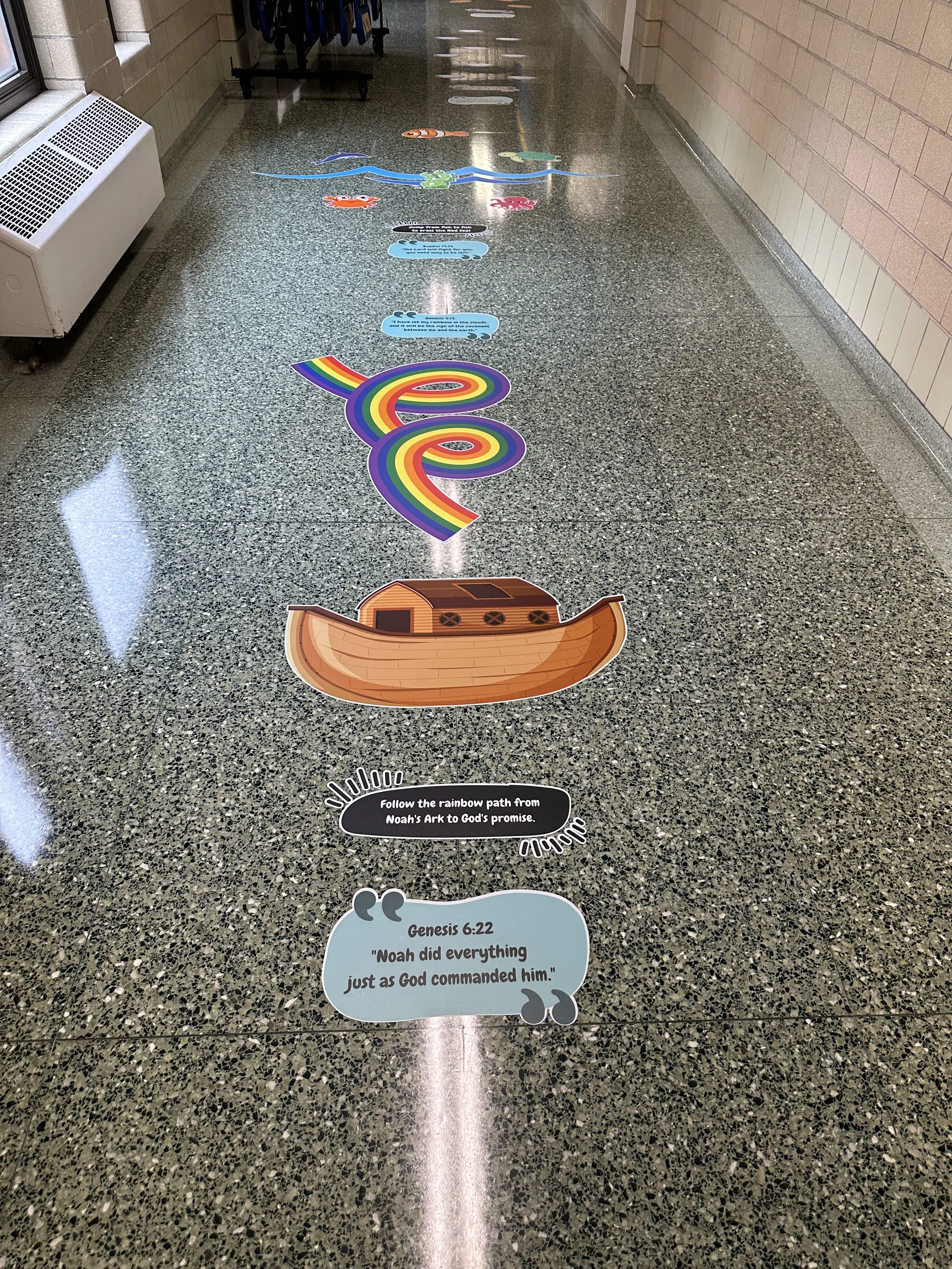
"Our students love using the Noah's Ark portable sensory pathway during times of transition throughout the school day. Being able to transport the pathway easily from room to room is so nice, and it is easy to store. We're so happy with this product!" — Kaitlyn Little, Vice Principal, St. Joseph the Worker School, Winnipeg, Manitoba
Ready to See What's Possible?
Your hallway has potential you might not even realize yet. Let me show you what it could look like.
👉 Email a photo to: hello@sacredstepssensorypaths.com
👉 Or request a free sample: www.sacredstepssensorypaths.com/contact
👉 Shop all paths: www.sacredstepssensorypaths.com/store
Your students are ready to move. Is your school ready for Sacred Steps? 🙏
Sacred Steps vs. Other Sensory Paths — What Makes Sacred Steps Different?
Comparing Sacred Steps Sensory Paths to other sensory path companies? See how OT-designed, faith-based sensory paths for Catholic schools, Christian schools, and public schools compare to generic decal sets and other sensory path brands.
If you've been searching for a sensory path for your school hallway, you've probably discovered that there are quite a few options out there. Colorful floor decals, hallway stickers, movement paths — the market has grown significantly as more schools recognize the power of purposeful movement.
So how do you choose? And what makes Sacred Steps Sensory Paths different from everything else on the market?
As the OT who designed Sacred Steps, I want to give you an honest, transparent comparison — because I believe when you understand the differences, the right choice becomes clear.
What Most Sensory Paths Have in Common
Before we dive into differences, let's acknowledge what most sensory path companies do well. The general concept — getting kids moving through structured, sequential activities in a hallway — is solid and supported by research. Movement breaks improve focus, reduce behavior incidents, and support sensory regulation. Whether you choose Sacred Steps or another company, installing ANY sensory path in your school hallway is better than an empty one.
That said, not all sensory paths are created equal.
The Main Categories of Sensory Paths on the Market
Generic Hallway Decal Sets
These are the most common — and the most affordable — option on the market. Companies like Wall Decor Plus More and similar vendors sell individual vinyl decals featuring frogs, footprints, dots, and shapes that schools arrange themselves into a movement sequence.
What they do well:
Very low cost (often $50-200)
Easy to order and ship
Schools can arrange them however they want
What they lack:
No OT design — activities are not clinically sequenced for sensory regulation
No therapeutic intent behind the layout
No faith integration for Catholic or Christian schools
Generic designs that aren't specific to your school's mission or values
Schools have to figure out the layout themselves with no guidance
Often will not last past one school year, and most are peeled up within one quarter
Larger Sensory Path Companies
Larger companies offer more complete packages — pre-designed layouts with multiple activities, professionally printed on quality vinyl. Some also offer portable options.
What they do well:
Professional quality printing
Complete layout packages
Good variety of themes and designs
Established track record in schools
Some portable options available
What they lack:
Not OT-designed by a licensed occupational therapist with clinical school-based experience
No faith-based options for Catholic, Christian, or faith-integrated schools
Portable options, where available, are not clinically sequenced for sensory regulation
No connection to sensory integration principles or self-regulation frameworks
One-size-fits-all approach without clinical expertise behind the design
What Makes Sacred Steps Different
Here is where I want to be direct — not to disparage anyone, but because these differences genuinely matter for the children in your school.
1. Designed by a Licensed OT — Not a Graphic Designer
Every Sacred Steps path was designed by me, Trisha Klausing, OTR/L — a licensed occupational therapist with over 10 years of school-based experience working directly with children who have sensory processing differences, autism, ADHD, and developmental delays.
That means every activity in every path is purposefully sequenced to:
Move from alerting to organizing to calming input
Target specific sensory systems (proprioceptive, vestibular, tactile)
Build in bilateral coordination, motor planning, and body awareness
Support self-regulation before returning to the classroom
This isn't guesswork. This is clinical expertise applied to hallway design.
2. The ONLY Faith-Based Sensory Path on the Market
If you are a Catholic school, Christian school, or faith-based community, Sacred Steps is in a category of one.
Every faith-based path weaves Scripture verses, faith themes, and movement activities into a seamless whole. Your students don't just regulate their bodies — they encounter their faith in motion. Themes include the Ten Commandments, Bible Stories, Fruit of the Spirit, Who God Says I Am, the Holy Alphabet, and more.
No other sensory path company offers this. Period.
3. Portable Paths That Are Actually Therapeutic
Some sensory path companies offer portable options — but Sacred Steps portable paths are the only ones designed by a licensed OT with clinical sequencing built into every activity. That means the movement your students do on a Sacred Steps portable path isn't just fun — it's therapeutic.
Sacred Steps offers both:
Permanent paths — commercially printed floor and wall installations that transform your hallway into a permanent faith-filled movement space
Portable paths — roll-out paths that require zero installation, can move from room to room, work in any space, and can be sanitized between uses — with OT-designed clinical sequencing built in from the start
4. Commercially Printed on Heavy-Duty Vinyl
Sacred Steps paths are not paper stickers or foam tiles. Every path is commercially printed on heavy-duty vinyl that is:
Built to withstand constant foot traffic in busy school hallways
Easy to clean and wipe down — important for infection control
Designed to last years, not months
Safe for all floor surfaces including tile, hardwood, and commercial carpet
5. Proven Across 25 States and Canada
Sacred Steps is now installed in schools, therapy clinics, and faith communities across 25 states and Canada — and growing every day. Each installation represents a school that trusted Sacred Steps to deliver on its promise.
The Bottom Line
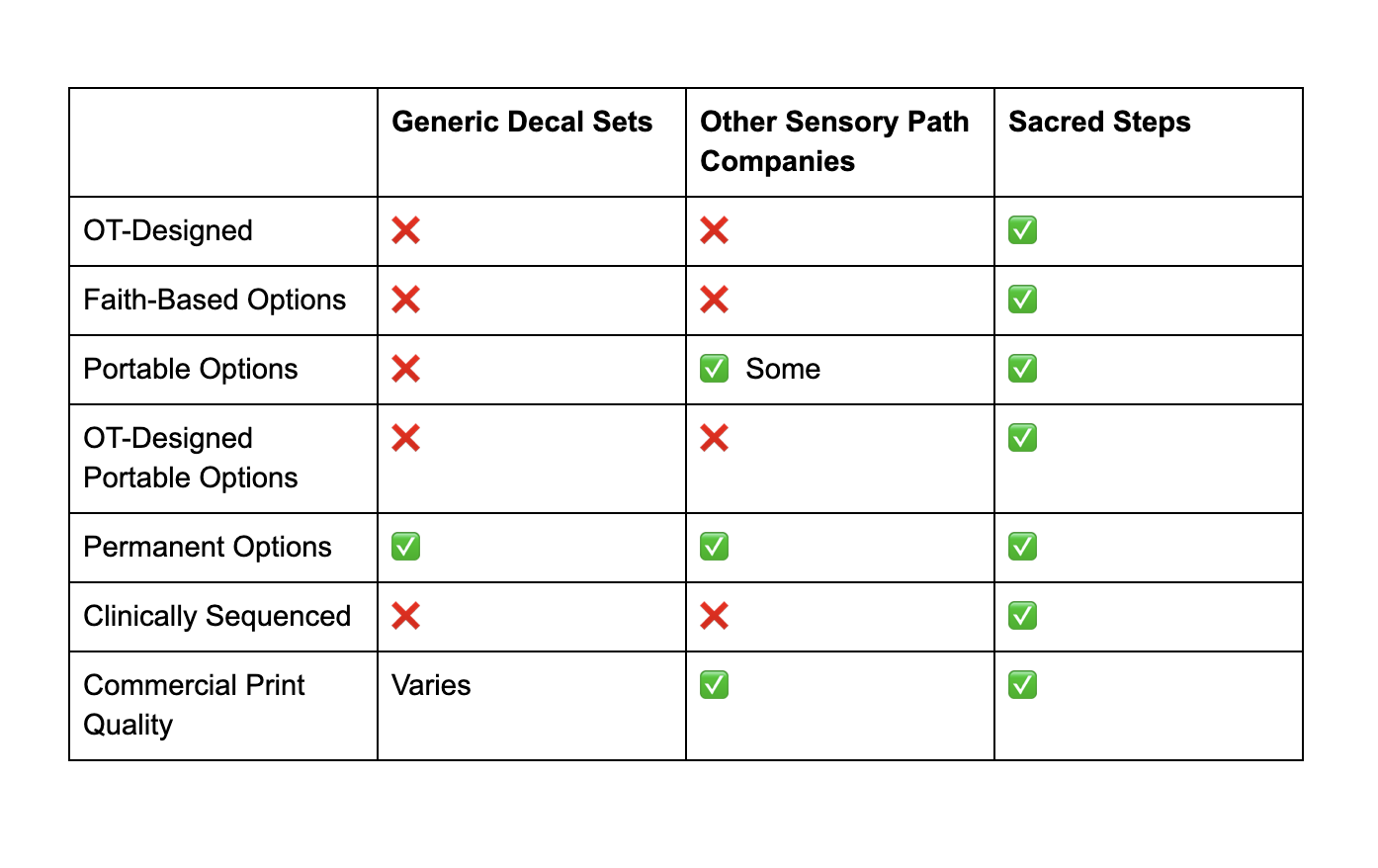
Which Sensory Path is Right for Your School?
If you are a Catholic or Christian school looking for a sensory path that integrates your faith mission with purposeful movement — Sacred Steps is your only option. There is nothing else like it on the market.
If you are a public school looking for an OT-designed, clinically sequenced movement path that goes beyond colorful decals — Sacred Steps has a full line of non-faith paths including the Regulation Station, Leaders in Motion, and Steps to Success.
If you are a pediatric therapy clinic looking for a movement tool your OT and PT teams can actually use therapeutically — Sacred Steps portable paths are designed by a clinician, for clinicians.
If you just need the cheapest option possible — generic decal sets exist, and again, any movement is better than none. But if you want something designed with clinical expertise, built to last, and available in both faith-based and universal designs — Sacred Steps is worth every penny.
Try Before You Commit
I offer free samples to schools and clinics because I want you to feel the quality before you invest. Request yours today and see the difference for yourself.
👉 Request your free sample: www.sacredstepssensorypaths.com/contact
👉 Shop all paths: www.sacredstepssensorypaths.com/store
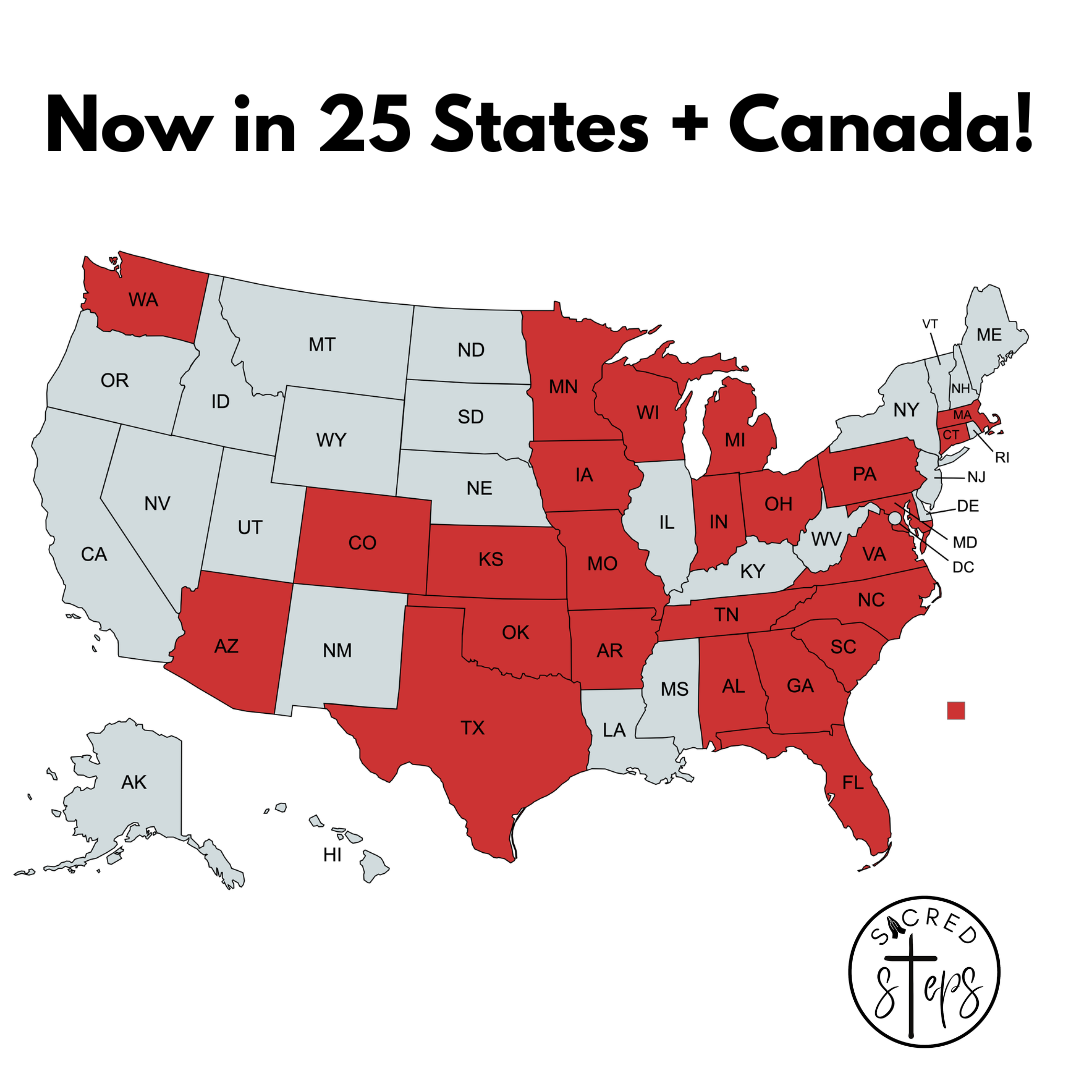
We're Now in 25 States + Canada — And I'm Still Pinching Myself
Sacred Steps Sensory Paths has reached 25 states and Canada! Discover OT-designed, faith-based sensory paths for Catholic schools, Christian schools, and public schools. Free activity with any full path purchase through June 15th.
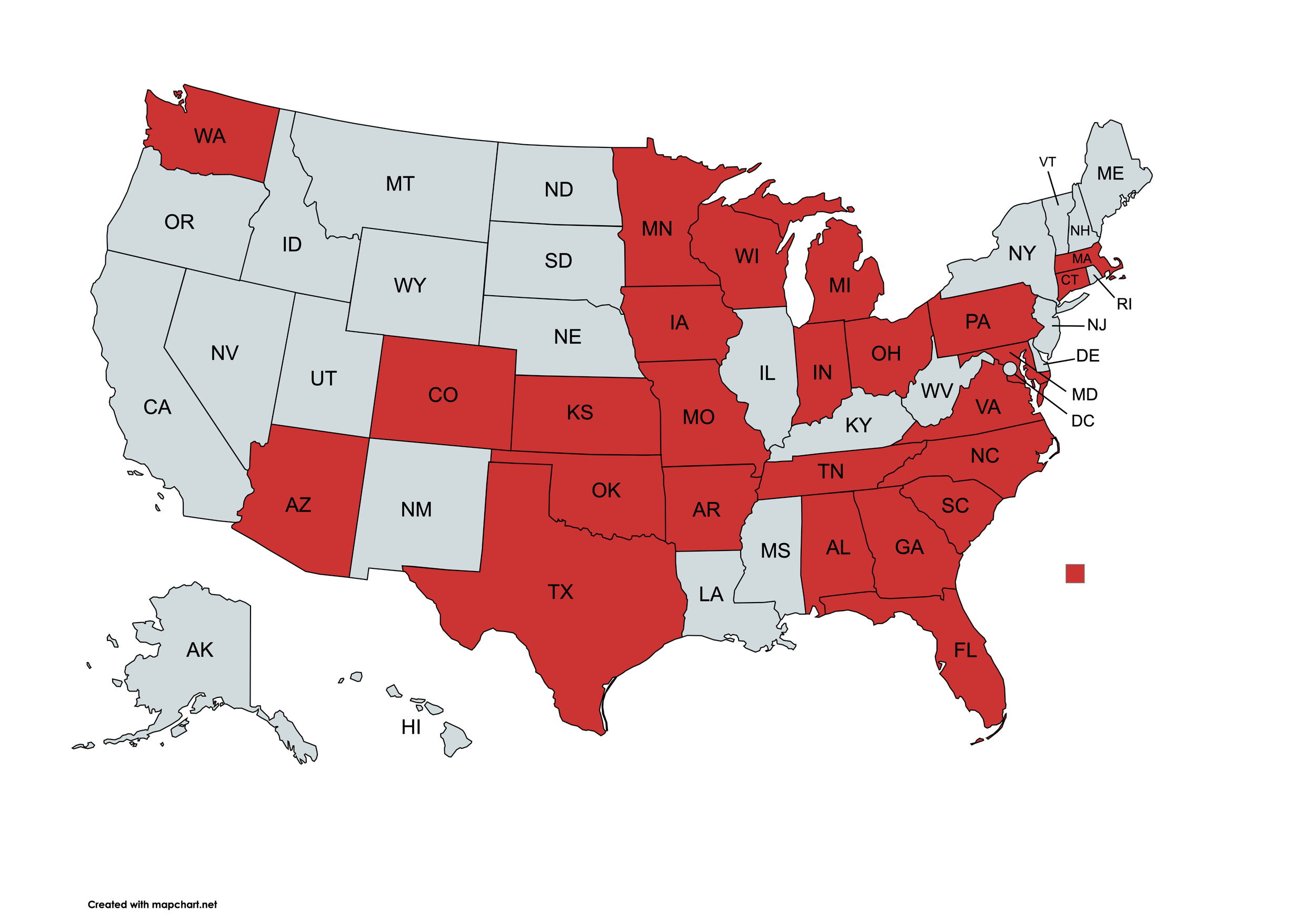
When I created Sacred Steps Sensory Paths, I was sitting at my kitchen table in small-town Ohio with a dream, a background in pediatric occupational therapy, and a deep belief that children deserve hallways that work as hard as their teachers do.
I never imagined that just a few years later, I'd be writing a blog post about reaching 25 states and Canada.
But here we are. And I am so, so grateful.
From One State to Twenty-Five
Sacred Steps started right here in Ohio — a Catholic mom and school-based OT who wanted to bring faith-integrated, purposeful movement to the schools she served. The idea was simple: what if a school hallway could do more than just connect one classroom to the next? What if it could be a place where children regulate, reset, and reconnect with their bodies — and their faith?
That idea resonated. First with Ohio schools. Then with schools in neighboring states. Then across the country.
Today Sacred Steps Sensory Paths are installed in:
Catholic schools and Christian schools serving students from PreK through high school
Public schools using evidence-based movement to support social-emotional learning
Community spaces including churches, therapy clinics, and ministry spaces
And several schools in Canada 🇨🇦
Every single dot on that map represents a principal who took a chance, a school counselor who advocated for their kids, an OT who knew movement mattered, and a community that believed children deserve better than an empty hallway.
What Schools Are Saying
We recently received this 5-star review that stopped me in my tracks:
"Our students love using the Noah's Ark portable sensory pathway during times of transition throughout the school day. Being able to transport the pathway easily from room to room is so nice, and it is easy to store. We're so happy with this product!"
— Kaitlyn Little, Vice Principal | St. Joseph the Worker School | Winnipeg, Manitoba
This is exactly why I do this work. Not for the map. Not for the milestones. For the students who walk a little calmer, focus a little better, and feel a little more seen because their school invested in movement that matters.
What Makes Sacred Steps Different
There are sensory paths on the market. But there is only one line of OT-designed, faith-integrated sensory paths built specifically for Catholic schools, Christian schools, and faith communities.
Every Sacred Steps path is:
✝️ Faith-integrated — Scripture verses, faith-based themes, and movement activities that reinforce what students are learning in their faith community. Themes include the Ten Commandments, Bible Stories, Fruit of the Spirit, Who God Says I Am, the Holy Alphabet, and more.
🧠 OT-designed — As a licensed occupational therapist with over 10 years of school-based experience, I designed every path using the principles of sensory integration, gross motor development, and self-regulation. These aren't just pretty floor stickers — they're clinical tools disguised as hallway art.
📦 Flexible — Sacred Steps offers both permanent floor and wall installations AND portable paths that require zero installation. Whether your school wants a full hallway transformation or a roll-out-and-go solution, there's a Sacred Steps path for you.
🏫 Inclusive — We also offer a full line of non-faith-based paths for public schools, including the Regulation Station, Leaders in Motion, and Steps to Success paths — all OT-designed and built for any school setting.
A Special Celebration Offer
To celebrate reaching 25 states and Canada, we are offering something special — but only through June 15th:
Purchase any full Sacred Steps path and choose a FREE activity to add to your order — a $150–$200 value at no cost to you.
Whether that's a calming station for your school counselor's office, an extra movement stop in your hallway, or a Rainbow Reset for your calming corner — you choose, and we add it free.
Free samples are also available for qualifying schools. There is no better time to get Sacred Steps into your building before fall 2026.
State 26 Is Out There
Every time a new school joins the Sacred Steps family, I feel it. It's not just a sale — it's a child somewhere who is going to move through a hallway differently. A teacher who is going to notice something shift in her students. A principal who is going to wonder why they didn't do it sooner.
State 26 is out there. Could it be yours?
How Much Does a Sensory Path Cost Per Student? Less Than You Think.
Wondering if a sensory path fits your school budget? Here's the real cost breakdown — per student, per day — and why Sacred Steps is the highest-ROI investment your school can make.
When principals and administrators hear the price of a Sacred Steps Sensory Path, the first reaction is almost always the same:
"That's a lot."
And I understand that reaction completely. Schools are working with tight budgets, competing priorities, and a list of needs that always seems longer than the funds available.
But I want to share a number that changes the conversation every single time.
$0.026.
That's what a Sacred Steps Sensory Path costs per student, per day. Let me show you the math.
The Math
Our most popular path — the Bible Stories Sensory Path — is $1,395.
For a school of 300 students, over a 180-day school year:
$1,395 ÷ 300 students ÷ 180 days = $0.026 per student per day.
Less than three cents.
Now let's put that in context.
No other intervention in this comparison costs less than three cents per student per day.
And none of them work before the child even reaches the classroom door.
What You're Getting for Three Cents
A Sacred Steps Sensory Path is not a passive decoration. It is an active, OT-designed intervention that serves every student in your building, every single school day, for years.
Here's what happens when a child walks through a Sacred Steps path:
Proprioceptive input — jumping, pressing, and bearing weight organizes the nervous system and improves body awareness.
Vestibular input — balance and movement activities improve alertness and attention.
Bilateral coordination — crossing midline activities activate both hemispheres of the brain simultaneously, preparing students for focused learning.
Motor planning and sequencing — following the path's sequence builds executive function skills.
Predictable routine — the consistency of the path signals to the nervous system that it's time to focus, reducing transition-related anxiety.
All of this happens in the hallway, before the child sits down, before the teacher has to manage the transition, before the instructional minute is lost.
For $0.026 per student per day.
The True Cost of NOT Having a Sensory Path
Here's the question I really want school leaders to sit with:
What does dysregulation cost your school every day?
Minutes of instructional time lost to difficult transitions
Teacher energy spent managing behavior rather than teaching
Students pulled from class for behavioral support
Staff burnout and turnover driven by challenging classroom environments
Administrative time spent on behavior incidents and parent communications
These costs are real. They're significant. And they happen every single day in schools without proactive sensory supports in place.
A sensory path doesn't eliminate all of these challenges. But it meaningfully reduces the frequency and intensity of dysregulation — before it ever reaches the classroom. For thousands of schools across the country, the return on that investment is felt within the first week.
Why Summer Is the Time to Act
Every Sacred Steps path is custom printed specifically for your school — this is not an off-the-shelf product. Production takes time, and schools that order in the summer are first in the production queue.
The benefits of summer installation are significant:
Empty hallways make installation easy and stress-free
No disruption to the school day or student learning
Your path is ready and waiting on the very first day of school
Students arrive in September to something new, exciting, and immediately beneficial
Schools that wait until August scramble. Schools that wait until October miss the entire first quarter.
Summer is the window — and it's open right now.
Faith-Based and Universal Options Available
Sacred Steps paths are available in faith-based designs for Catholic and Christian schools — including our most popular Bible Stories path — with Scripture woven into every movement activity.
Universal, non-faith-based designs are also available for public schools and non-denominational settings.
Portable options that require zero installation are available for clinics, ministry spaces, and schools that need flexibility.
Ready to Run the Numbers for Your School?
Every school is different — different hallway sizes, different student populations, different budget structures. That's why I offer a completely free, no-obligation consultation call.
We talk about your space, your students, and your goals. I help you figure out exactly which path makes the most sense. No pressure. Just a real conversation between two people who care about kids.
For less than three cents per student per day — your students deserve this.
👉 Shop Sacred Steps Sensory Paths
📧 Questions? Email hello@sacredstepssensorypaths.com — I read every message personally.
And through June 15 — every full path purchase includes a FREE single activity station ($150 value). Just order and email me — I'll add it automatically.
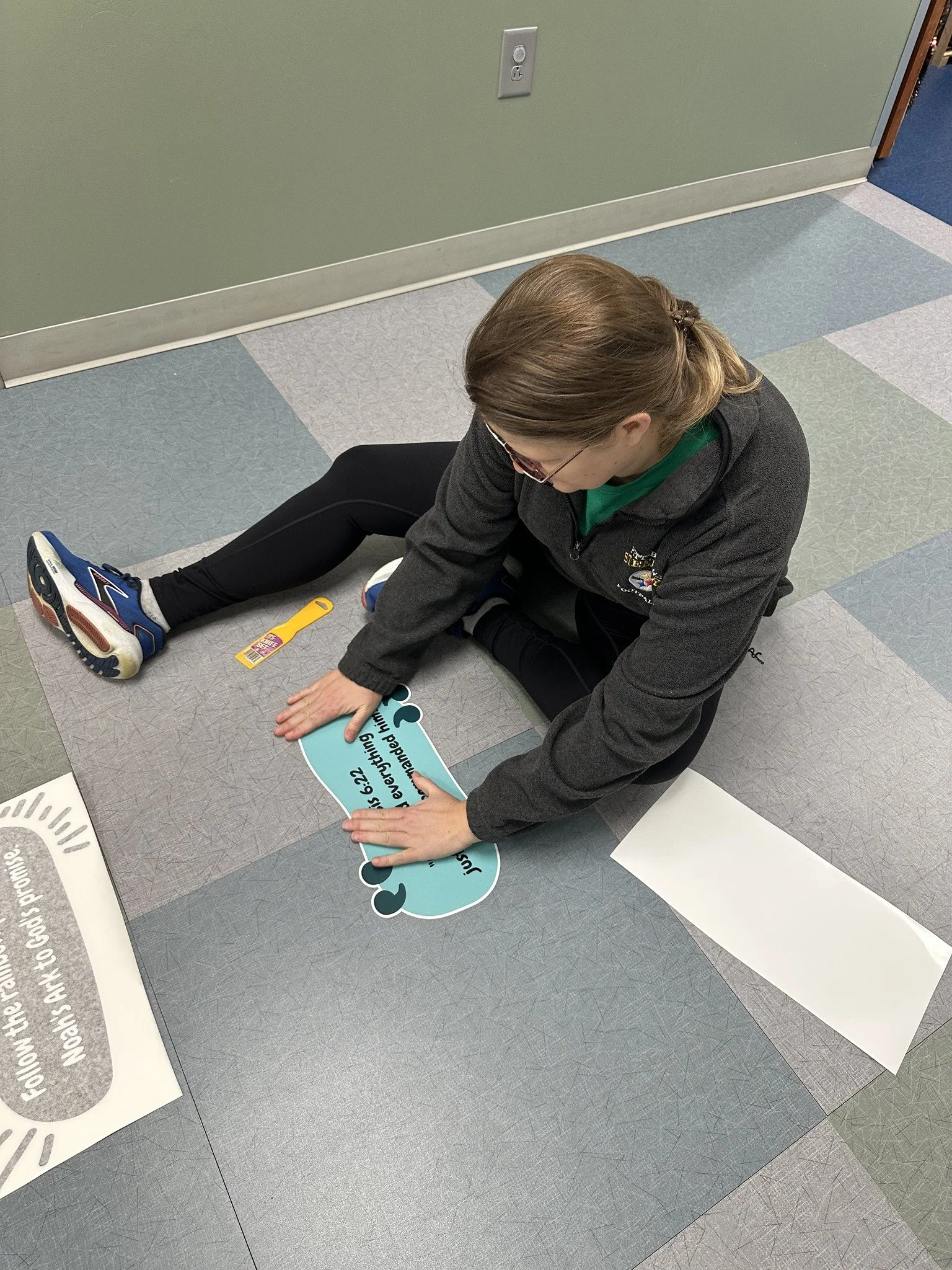
How Easy Is It to Install a Sensory Path? Easier Than You Think.
Wondering how hard it is to install a sensory path in your school hallway? Easier than you think! Here's exactly what installation looks like — tools, timing, and tips from a school-based OT.
It's the question I get more than almost any other:
"This looks amazing — but how hard is it to actually install?"
I completely understand the hesitation. When most people hear "floor decals in a school hallway," they picture a professional installation crew, a facilities department sign-off, a two-week wait, and a bill that rivals the path itself.
The reality? You need a spray bottle, a squeegee, a clean floor — and a free afternoon.
That's it.
Here's exactly what installation looks like from start to finish.
What Comes With Your Path
Every Sacred Steps sensory path arrives with:
All decals, commercially printed and ready to apply
Step-by-step written installation instructions
A installation video you can watch before you start and reference as you go
You don't need to hire anyone. You don't need special tools (except a small squeegee for bubble-free smoothing). You don't need a facilities background. The instructions are clear, the video makes it visual, and I'm always available by email if you have questions along the way.
How Long Does It Take?
Plan on 2 to 3 hours for a full path installation, depending on:
How many stations are included in your path
How many people are helping (more people makes it significantly faster and easier!)
The condition and size of your floor space
Is that a big time commitment? I'd argue no — especially when the result is a beautiful, permanent path that will serve your students every single day for years. Most principals and OTs tell me they installed it on a Friday afternoon, a summer workday, or during a long weekend. By Monday morning, students were already using it.
Step-by-Step: What Installation Actually Looks Like
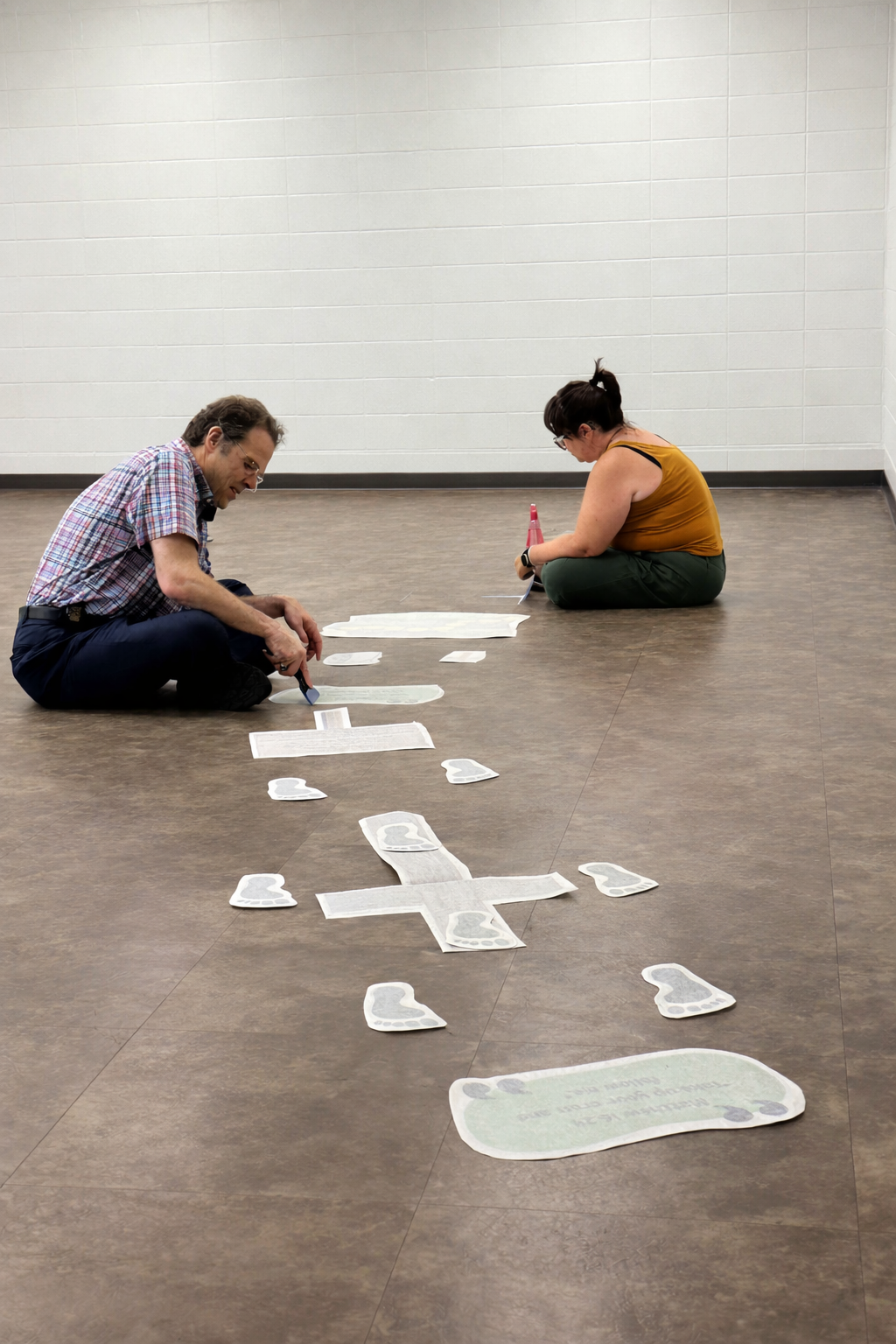
Step 1: Choose Your Location and Lay It All Out First
Before you apply a single decal, lay everything out on the floor in the order it will be installed. This is the most important step — and one of my favorites to watch because it's the moment it all becomes real.
Spread the decals out in sequence, spacing them according to the instructions. Step back and look at the full path. Adjust spacing as needed. This is your chance to make sure everything flows the way you want before anything is permanent.
Having a second person during this step is incredibly helpful. One person can hold decals in place (or use painters tape) while the other steps back to check spacing and alignment.
Step 2: Clean the Floor Thoroughly
This is the step people most often want to skip — and it's the one that matters most for longevity.
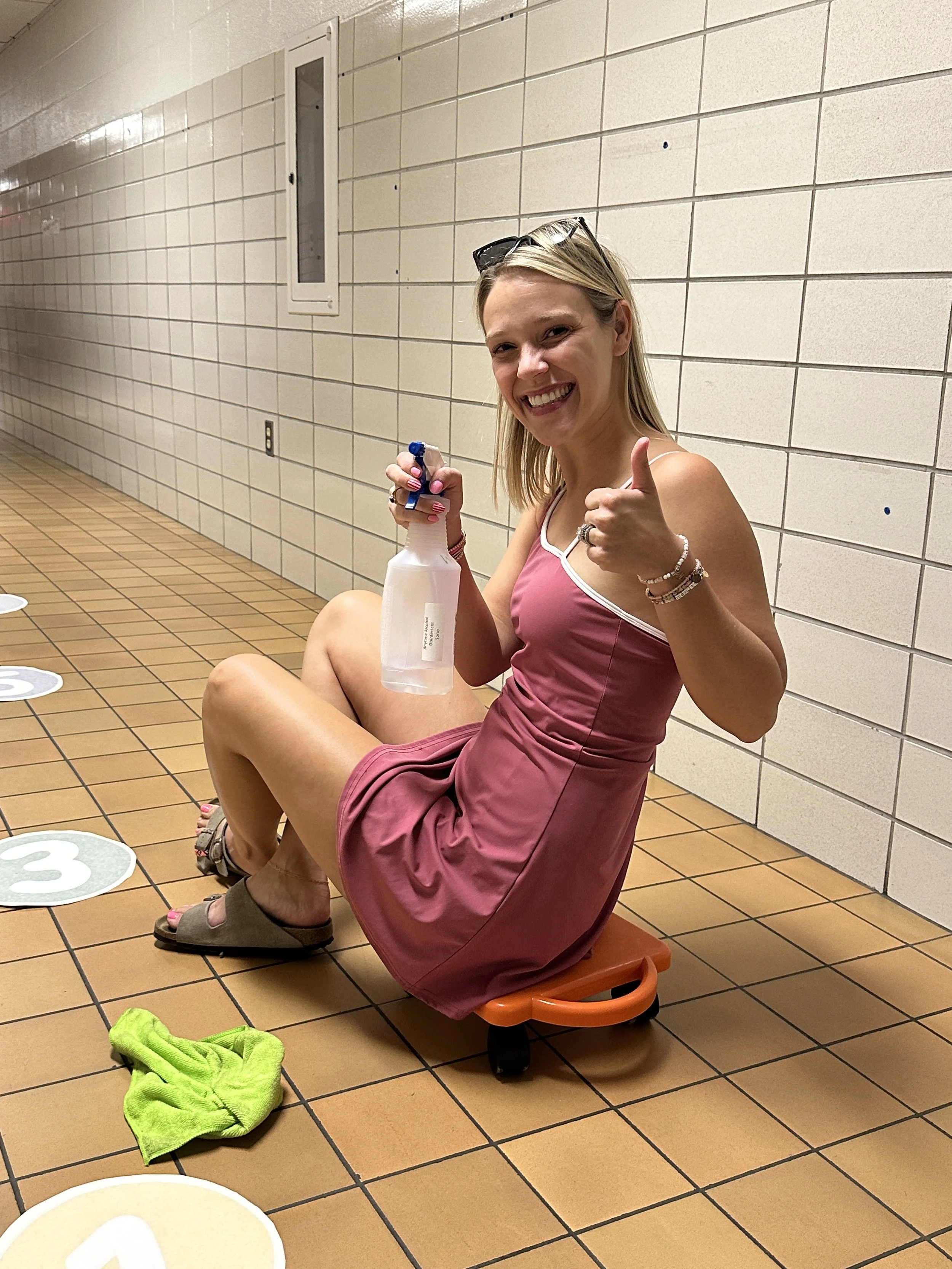
Sweep or vacuum the area first, then wipe down the floor with a clean damp cloth to remove any dust, wax residue, or debris. Let it dry completely before applying any decals.
A clean surface means better adhesion, cleaner edges, and a path that stays put for years. This step takes maybe 15 minutes but makes a significant difference in the final result.
Pro tip: Avoid installing on freshly mopped floors or in cold temperatures — both can affect adhesion.
Step 3: Apply Each Decal
This is where the magic happens — and it's much easier than it looks.
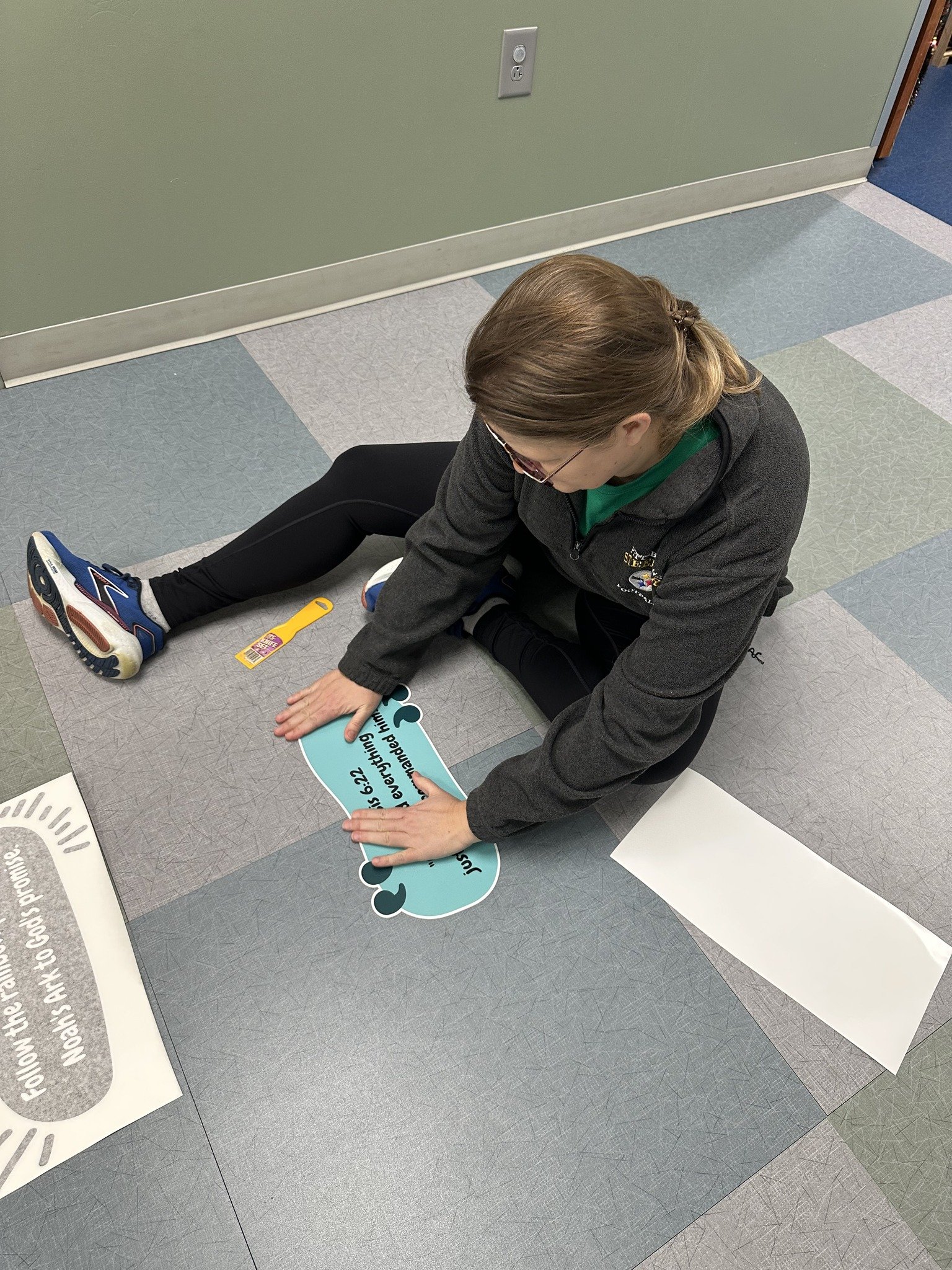
Lightly wipe the floor surface, then peel the backing from your decal and position it on the surface. Once it's positioned correctly, use your squeegee tool to smooth the decal from the center outward, pushing out any air bubbles or water. Work slowly and firmly. Starting from a corner, peel the top layer slowly off, using the squeegee as needed to firmly adhere it to the surface. Once the top layer is fully removed, take the squeegee over it one more time…and move on to the next piece!
This method gives you a beautiful, bubble-free result that looks professionally installed — because it is professionally made, and the application method is designed to match.
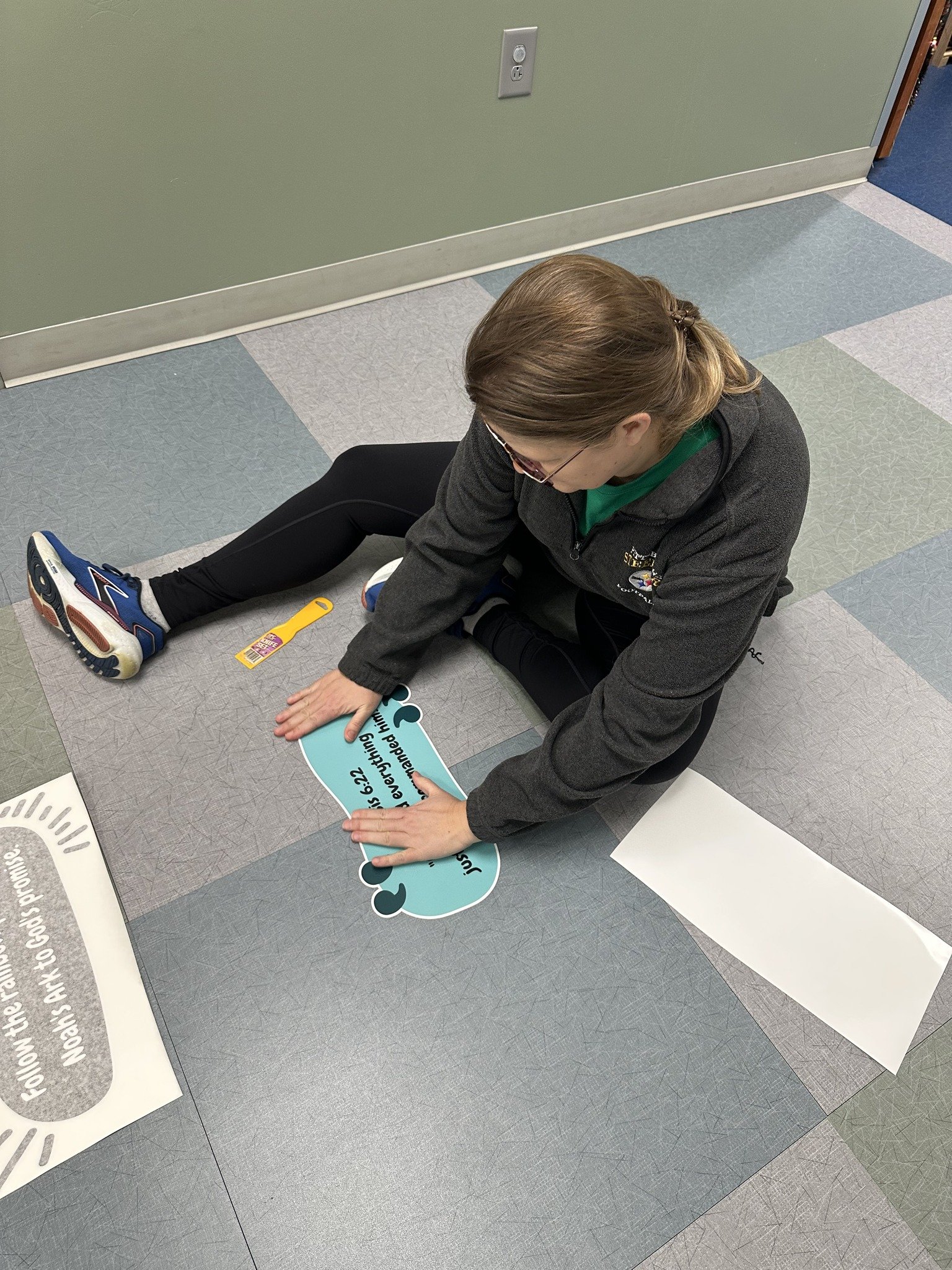
Step 4: Smooth, Press, and Repeat
Work your way through each decal one at a time, following the layout you established in Step 1. Take your time with each one. There's no rush.
For larger decals, having a second person hold one end while you position the other makes application much easier and reduces the chance of the decal folding onto itself.
Who Can Do the Installation?
This is my favorite part of the answer: almost anyone.
I have seen Sacred Steps paths installed by:
School principals on a summer workday
OTs during a professional development day
Parent volunteers on a Saturday morning
Teachers staying late on a Friday
Maintenance staff who expected a complicated job and were pleasantly surprised
A principal and a custodian working together during lunch
You do not need to be an OT. You do not need installation experience. You do not need to hire anyone.
If you are in Ohio, I offer free installation — I come to you, bring everything, and have your path ready before I leave. It's one of my favorite parts of this work. 🙏
What About Wall Decals?
Many Sacred Steps paths include both floor AND wall activities. Wall installation is even simpler than floor installation — same method, same squeegee, just vertical instead of horizontal. The instructions and video cover both.
The Most Common Question: Will It Damage My Floor?
No. Sacred Steps decals are designed to be applied to standard school floor surfaces — vinyl tile, linoleum, sealed concrete — without damaging the floor underneath. They can be removed if needed, though they are not reusable once removed. With proper installation on a clean surface, you can expect your path to last for years — holding up beautifully to daily student traffic.
If you have an unusual floor surface or any concerns about your specific floor type, reach out before ordering and I'll walk you through it.
Tips From Real Installations
After installing paths in schools across multiple states, here's what I've learned:
Bring a friend. Two people makes everything faster, easier, and more fun. It's genuinely a great team-building activity — ask any of the principals and OTs who have done it together.
Watch the video first. I know it's tempting to just dive in, but watching the short installation video before you start gives you a mental map of the whole process and makes each step feel familiar when you get there.
Start with a smaller decal to get the feel. Before you tackle your largest decal, practice the method on a smaller one. By the time you get to the big pieces, you'll feel confident and efficient.
Summer is ideal. Empty hallways, no students underfoot, and no time pressure make summer the easiest installation window. Most schools plan their installation during summer break so the path is ready to surprise students on the first day of school. 🎉
Take photos as you go. First, because you'll want them. Second, because your students and parents will LOVE seeing the before and after. And third — I'd love to see them too! Tag @sacredstepssensorypaths when you share.
Ready to Install Your Path?
If you've been putting off ordering because installation felt like a barrier — I hope this post just removed it.
Two to three hours. A spray bottle and a squeegee. Step-by-step instructions and a full video. And a path that will make your hallway extraordinary for years to come.
If you’re still exploring the concept, start with our guide to what a sensory pathway is and how it supports students in schools.
👉 Shop Sacred Steps Sensory Paths
📧 Questions? Email hello@sacredstepssensorypaths.com — I read every message personally.
Ohio schools: free installation is available. Just ask!
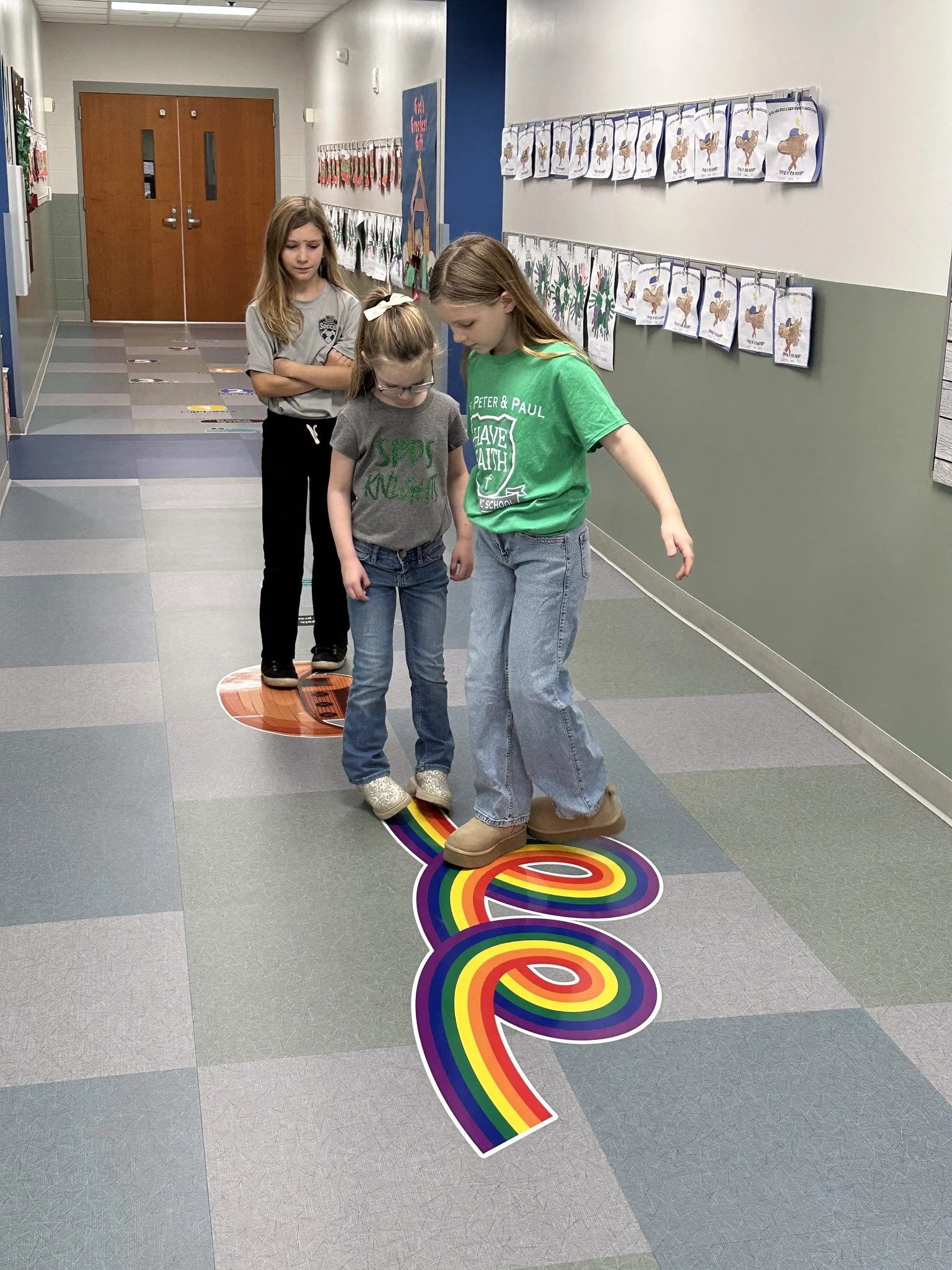
How to Fund a Sensory Path for Your School — Grants, Resources, and Ready-to-Use Language
Budget constraints shouldn't stand between your students and the resources they need. Here's exactly how to fund a Sacred Steps Sensory Path for your school — including specific grant sources, ready-to-use language, and a free downloadable guide to make the process as easy as possible.
You found the perfect sensory path for your school. Your OT loves it. Your principal is intrigued. And then someone asks the question that stops so many great ideas in their tracks:
"How are we going to pay for it?"
Budget constraints are one of the biggest barriers between schools and the resources their students need. But here's the thing — there are more funding options available for sensory and regulation tools than most educators realize. And with the right grant language, applying for that funding is a lot less intimidating than it sounds.
This post walks you through exactly how to fund a Sacred Steps Sensory Path for your school — including specific grant sources, ready-to-use language, and a free resource to make the process as easy as possible.
Why Sensory Paths Qualify for Grant Funding
Before we talk about where to find money, it helps to understand why sensory paths are a strong candidate for grant funding in the first place.
Sacred Steps Sensory Paths were designed by a school-based occupational therapist specifically to support student regulation, focus, and whole-child development. That means they aren't just fun hallway decorations — they're clinically informed tools that address real, documented student needs.
Grant funders — whether they're foundations, government programs, or community organizations — want to fund things that make a measurable difference for students. Sensory paths check every box:
They support students with IEPs and sensory processing needs
They improve self-regulation and reduce classroom disruptions
They benefit ALL students, not just those with identified challenges
They require a one-time investment with no ongoing costs
They are evidence-informed and OT-designed
That combination makes a sensory path a compelling, fundable project — especially when you have the right language to make that case.
Grant Sources to Explore
For Public Schools
Title I Funds - If your school qualifies for Title I funding, these federal dollars can be used for tools that support academic achievement — including sensory and regulation resources that help students access learning. Talk to your Title I coordinator about whether a sensory path fits within your school's approved uses.
IDEA (Individuals with Disabilities Education Act) - IDEA funds are specifically designated to support students with disabilities. If your school has students with IEPs who would benefit from a sensory path — and most schools do — IDEA funding is worth exploring with your special education director.
21st Century Community Learning Centers - This federal program funds extended learning opportunities and enrichment programs. If your school has a before or after school program, sensory path resources may qualify.
State Department of Education SEL Grants - Many states now offer grants specifically for social-emotional learning resources. A sensory path that supports regulation, self-awareness, and interpersonal skills is a perfect fit. Search your state's Department of Education website for current grant opportunities.
Local Community Foundations - This is one of the most overlooked and most accessible funding sources for schools. Nearly every county in the United States has a community foundation that offers small grants to local organizations — including schools. Search "[your city or county] community foundation grants" to find what's available in your area.
PTO/PTA Mini-Grants - Many PTOs and PTAs offer small grants for school improvement projects. A Starter Set at $600 is well within the range of most PTO grant programs — and parents love funding things they can see their kids using every day.
Local Businesses and Civic Organizations - Rotary Clubs, Lions Clubs, Kiwanis, and similar organizations frequently fund school improvement projects in their communities. A brief presentation about the impact of a sensory path is often all it takes to secure a donation.
For Faith-Based Schools-
Diocese or Parish Grants - Many dioceses and parishes offer school improvement or ministry grants specifically for Catholic and faith-based schools. Contact your diocese's school office or development office to ask about available funding.
Catholic Community Foundation - Check with your local diocese about Catholic Community Foundation grants — many dioceses have foundations that fund exactly these kinds of projects.
Knights of Columbus - The Knights of Columbus frequently fund Catholic school and community projects. Your local council is a great place to start.
Local Community Foundations - Most community foundations are open to faith-based schools, especially for projects that serve children and families in the community.
Anonymous Donor or Benefactor Outreach - Don't underestimate the power of sharing your vision with your school community. Many faith-based schools have found that a heartfelt letter to parents, alumni, or parish members about a specific project generates surprising generosity — especially when the project is as visible and meaningful as a sensory path. A special “Donated By” vinyl decal can also be added to recognize their donation if they would like!
Ready-to-Use Grant Language
One of the biggest reasons schools don't apply for grants is the time and effort it takes to write the application. We've done the heavy lifting for you.
Here's sample language you can copy, paste, and customize for your specific grant:
Project Description (Short Version) - [School Name] is seeking funding to install a Sacred Steps Sensory Path — an occupational therapist-designed movement path that helps students regulate their bodies, improve focus, and develop self-regulation skills through structured, purposeful movement activities embedded in our school hallways.
Need Statement (Public School) - Students at [School Name] face daily challenges with self-regulation, focus, and transition management that directly impact their ability to learn. A Sacred Steps Sensory Path would provide a structured, evidence-informed solution that benefits ALL students — not just those with identified needs.
Need Statement (Faith-Based School) - As a school committed to nurturing the whole child — body, mind, and spirit — we recognize the deep connection between physical regulation and spiritual formation. A Sacred Steps Sensory Path would provide our students with a structured, faith-integrated movement experience that supports regulation, character development, and readiness to learn.
Sustainability Statement - Sacred Steps Sensory Paths are commercially printed on heavy, high-quality materials designed for long-term school use. Once installed, the path requires no ongoing costs, subscriptions, or maintenance — making this a one-time investment with lasting impact for years of student use.
Start Small — The Starter Set Strategy
If a full path feels out of reach right now, here's the strategy that works for many schools: start with a Starter Set.
At $600, Starter Sets includes three OT-designed stations that can be funded through a single PTO grant, a small community foundation award, or even a school fundraiser. And here's the best part — every dollar you spend on a Starter Set applies toward the full path when you're ready to grow. You're never starting over.
Many schools have funded their Starter Set through a small local grant, seen the impact firsthand, and then used that proof to apply for larger funding for the full path. It's a smart, low-risk way to get started — and it gives you a compelling success story to include in your next grant application.
Download the Full Grant Language Guide
I put together a complete grant language toolkit with short, medium, and long project descriptions, goals and objectives, budget templates, and a full list of grant sources for both public and faith-based schools.
It's free — because I want your students to have this resource, and I want to make it as easy as possible for you to make it happen.
👉 Want the full grant language guide? Email me at hello@sacredstepssensorypaths.com and I'll send it right over!
Here to Help
Not sure which path is the right fit for your grant application? I offer free, no obligation consultations and would love to help you figure out the best option for your school — and your budget.
📅 Book a free consultation: calendly.com/hello-sacredstepssensorypaths/30min 🌐 sacredstepssensorypaths.com
Every student deserves a school environment that meets them where they are. Let's make it happen together.
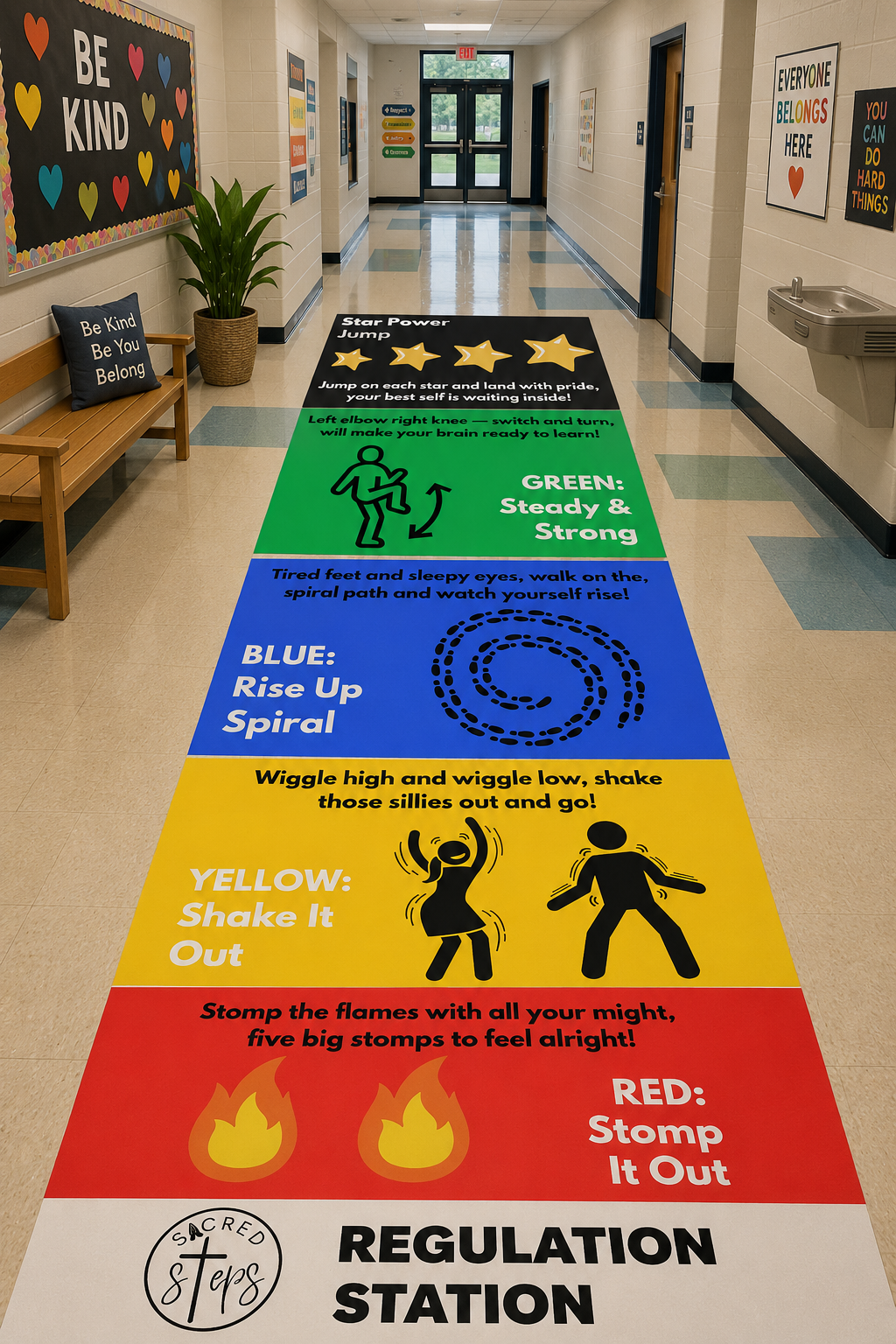
Why Portable Sensory Paths Are a Game-Changer for Schools (And Why i Just Launched Three New Ones!)
Portable sensory paths are changing the way schools approach movement, regulation, and purposeful activity in the school day — and the best part? No installation required. In this post, we're sharing the benefits of portable sensory paths and introducing three brand new paths designed for K-5 schools.
If you've ever wanted to bring a sensory path into your school but felt held back by the logistics — the installation, the facilities approval, the commitment — this post is for you.
Portable sensory paths are here, and they are changing the way schools think about movement, regulation, and purposeful activity in the school day.
What Is a Portable Sensory Path?
A portable sensory path is exactly what it sounds like — a sensory path that goes wherever you need it. No installation. No adhesive. No facilities department approval required.
Our portable paths are commercially printed on heavy, high-quality paper and measure 3 feet wide by 10 feet long — big enough to make a real impact, easy enough to roll up and store in a closet when you're done.
Roll it out in a hallway. Set it up in a therapy room. Bring it into a classroom for a brain break. Pack it up and take it to a different building entirely. The flexibility is the whole point.
Why Portable Matters More Than You Think
Schools are busy, complicated places. Even when staff members are passionate about bringing sensory tools into their buildings, the road to "yes" can be long.
Permanent floor paths require:
Administrative approval
Facilities department coordination
Installation time and cost
A commitment to one location — forever
Portable paths remove every single one of those barriers. A teacher, OT, or school counselor can order one, receive it, and have it rolled out in their space the same day — no permission slip required.
For schools that are newer to sensory paths or working with limited budgets, portable paths are also the perfect low-commitment entry point. Try it. See how your students respond. Build the case for a permanent path later.
The Benefits of Sensory Paths in the School Day
Whether portable or permanent, sensory paths offer powerful benefits for students — and the research on movement-based learning backs this up.
Improved Self-Regulation - Structured movement gives students' nervous systems what they need to reset. When kids are dysregulated — anxious, frustrated, unfocused, or overwhelmed — purposeful physical activity helps their bodies and brains recalibrate so they can return to learning.
Smoother Transitions - Hallway transitions are one of the most dysregulating parts of the school day. A sensory path gives students something intentional to focus on as they move between spaces — turning a chaotic moment into a calming, structured one.
Increased Focus and Attention - Movement breaks that include cognitive engagement — like reading prompts, following instructions, or making choices — prime the brain for learning. Students who move with purpose arrive at their next activity more ready to engage.
Character and SEL Development - The best sensory paths don't just move bodies — they build character. Embedding SEL concepts, leadership principles, or faith-based values into movement activities means students are reinforcing important lessons every time they walk the path.
Our Three New Portable Sensory Paths
We are so excited to introduce three brand new portable sensory paths, each designed with a specific school community in mind:
🟢🟡🔵🔴 Regulation Station Path
Inspired by zones-based regulation strategies, the Regulation Station Path walks students through intentional movement activities tied to each zone — helping them identify how their body feels and what it needs. Perfect for OTs, school counselors, and any educator using zones-based approaches in their school.
Please note: The Regulation Station Path is not affiliated with or endorsed by The Zones of Regulation® or Leah Kuypers/Social Thinking Publishing.
⭐ Leaders in Motion Path
For Leader in Me schools who want to bring the 7 Habits off the poster and into the hallway, the Leaders in Motion Path is a movement-based experience built around habit-based prompts and activities. Available in Set 1 (Habits 1-4), Set 2 (Habits 5-7), or the Complete Bundle.
Please note: The Leaders in Motion Path is not affiliated with or endorsed by the Leader in Me program or FranklinCovey.
👣 Steps to Success Path
A universal, OT-designed sensory path built around character development and self-regulation. The Steps to Success Path is a purposeful movement experience that helps students build focus, confidence, and regulation skills — one step at a time. A beautiful fit for any school community.
Who Are Portable Paths For?
The short answer? Everyone.
School OTs looking for a flexible tool they can use across multiple rooms or buildings
School counselors who want a regulation resource that fits in their office or a hallway outside it
Teachers who want to add movement breaks without rearranging their classroom
Principals and administrators who want to pilot a sensory path before committing to a permanent installation
Faith-based schools who want to nurture the whole child — body, mind, and spirit — through purposeful movement
Ready to Bring a Portable Path to Your School?
All three of our new portable sensory paths are available now at sacredstepssensorypaths.com. Not sure which path is the right fit for your school? Book a free consultation and I'll help you figure it out — no pressure, just a conversation.
👉 Shop portable paths 👉 Book a free consultation
Sacred Steps Sensory Paths are designed by a school-based OT with a passion for movement-based learning and whole-child development. Whether your school is faith-based or public, we have a path for you.
Why Starting With a Sensory Path Starter Set Is Actually a Really Smart Move
Not sure if a full sensory path is right for your school? Here's why starting with a Sacred Steps Starter Set is a smart, low-risk way to bring OT-designed movement into your hallway — and how it grows with you.
I hear it all the time from principals and administrators: "We love this — but we're not sure we're ready to commit to the full path."
And honestly? That is a completely valid and smart way to think about it. That is exactly why I created the Starter Sets.
Here is why starting small is sometimes the best first step. 👣
1. You Get to See It In Action Before Going All In
There is something powerful about seeing a sensory path in your own hallway before committing to the full experience. When students start using it — and they will use it every single day — you get to watch the magic happen firsthand. Teachers notice calmer transitions. Kids arrive at class more regulated. Administrators see students engaging purposefully with movement instead of running or being disruptive in the hallway.
The Starter Sets give you that proof of concept at a fraction of the cost. Once you see it working, the decision to add on becomes an easy one.
2. It Fits Smaller Budgets Without Sacrificing Quality
Not every school has $1,500 in discretionary budget — especially mid-year or at the start of a new school year. The Starter Sets are designed to be accessible. Three OT-designed, commercially printed activities for $600 means you can bring Sacred Steps into your school without breaking the budget or going through a lengthy approval process.
And because every dollar you spend on a Starter Set applies toward the full path, you are never leaving money on the table. It is an investment, not a compromise.
3. It Is Perfect for Grant Applications and DonorsChoose
Smaller price points are often easier to fund through grants, PTOs, parent fundraisers, and DonorsChoose projects. Starting with a $600 Starter Set gives you a funded, installed path that you can photograph and use as evidence when applying for larger grants to fund the full path later.
Real photos of real students using the path in your hallway are worth more than any grant application essay.
4. Your Students Will Ask for More
I have never had a school install a Starter Set and say "that's enough." Every single time, within a few months, I hear from the school again — ready to add on. Because once students experience the joy of moving through a purposeful, beautiful path, they want more. And so do the teachers.
The Starter Sets are not a lesser version of the full path. They are the beginning of something bigger.
5. Summer Is the Easiest Time to Add On
If you install a Starter Set now, you will have the rest of the school year to watch it work, gather photos and testimonials, build excitement among your staff, and plan for expansion over the summer. Empty hallways make installation a breeze — and your students will come back in the fall to a whole new experience waiting for them.
The Fruit of the Spirit Starter Set
The newest Starter Set features three activities from our brand new Fruit of the Spirit Sensory Path — Joy, Patience, and Goodness — for just $600. It is the perfect introduction to faith-based sensory movement for Catholic schools, and every dollar applies toward the full 9-activity path.
🍓 Shop the Fruit of the Spirit Starter Set — $600
https://www.sacredstepssensorypaths.com/store/p/fruit-of-the-spirit-starter-set
🌟 Shop the Full Fruit of the Spirit Sensory Path — $1,595
https://www.sacredstepssensorypaths.com/store/p/fruit-of-the-spirit-sensory-path
Shop all Starter Sets and Smaller Options —
https://www.sacredstepssensorypaths.com/store/mini-sensory-paths
Have questions? Just reply to any of my emails or reach out through the website. I would love to help you figure out the right starting point for your school. 🙏
Introducing the Fruit of the Spirit Sensory Path — the Most Faith-Filled Path Yet! 🍓
Introducing the brand new Fruit of the Spirit Sensory Path from Sacred Steps — 9 OT-designed activities bringing Galatians 5:22 to life in Catholic school hallways. Available as a full path or starter set!
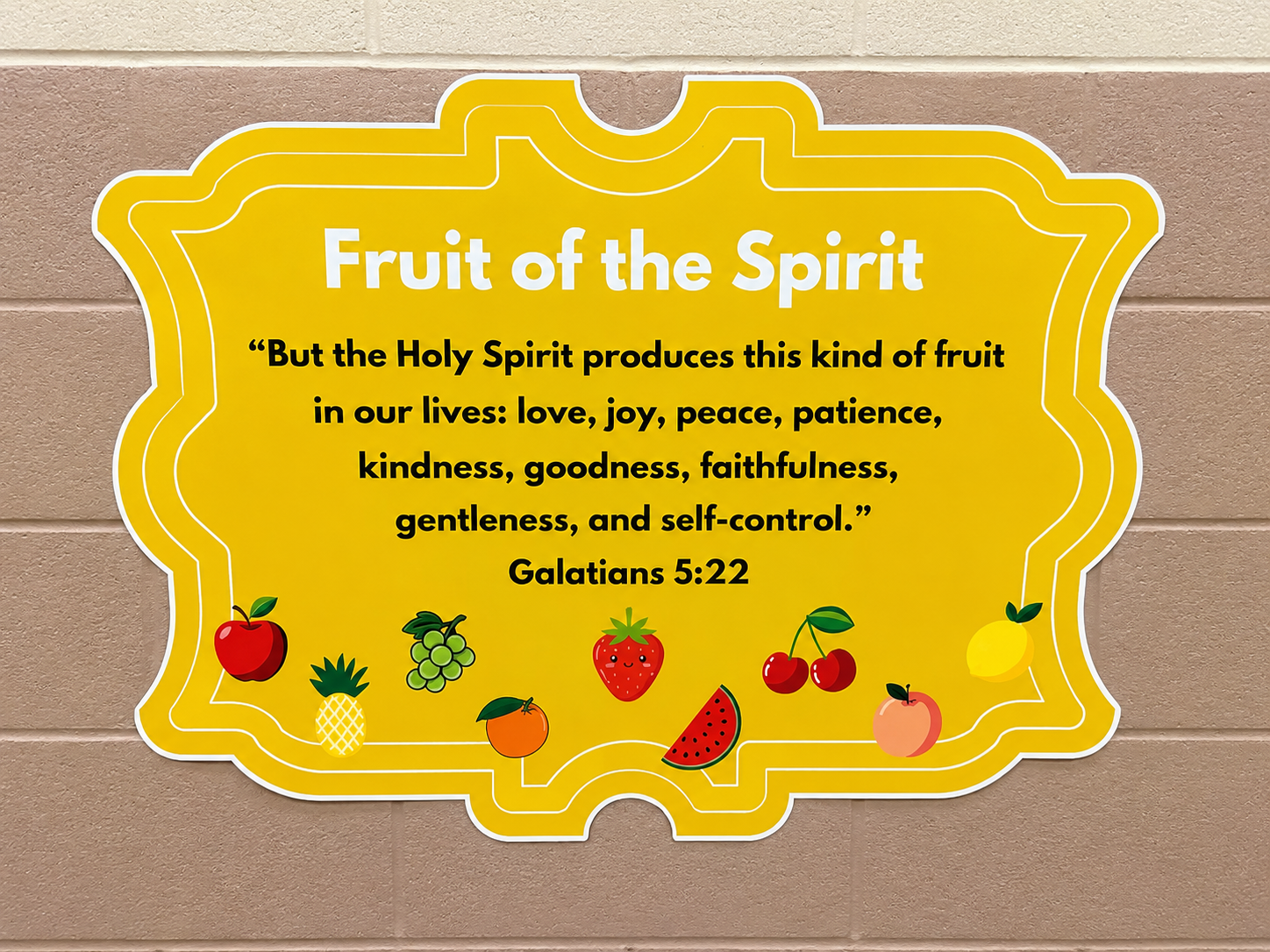
Introducing the brand new Fruit of the Spirit Sensory Path from Sacred Steps — 9 OT-designed activities bringing Galatians 5:22 to life in Catholic school hallways. Available as a full path or starter set!
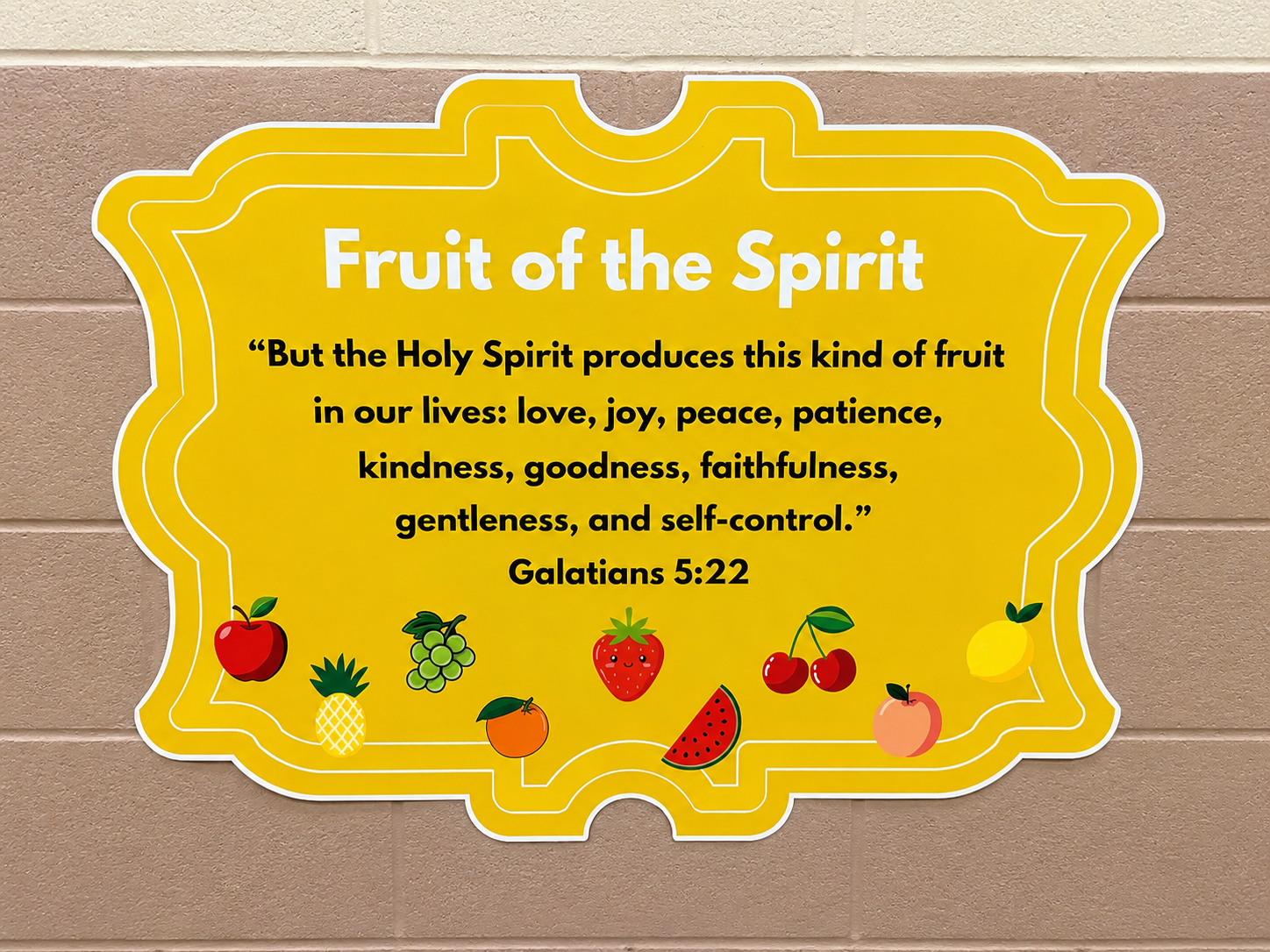
"But the Holy Spirit produces this kind of fruit in our lives: love, joy, peace, patience, kindness, goodness, faithfulness, gentleness, and self-control." — Galatians 5:22
I have been working on this one for a while, and I am so excited to finally share it with you. Meet the brand new Fruit of the Spirit Sensory Path — and honestly, it just might be my favorite path ever created. 🍓🍇🌸
What Makes This Path Special
Every Sacred Steps path is de
signed with intention — but this one feels particularly close to my heart. As an occupational therapist and person of faith, I wanted to create something that truly brings Scripture to life in a way children can feel in their whole bodies, not just read on a page.
The Fruit of the Spirit Sensory Path does exactly that. Each of the 9 activities is designed around one fruit of the Spirit, connecting the spiritual meaning to a purposeful, OT-designed movement experience.
The 9 Activities:
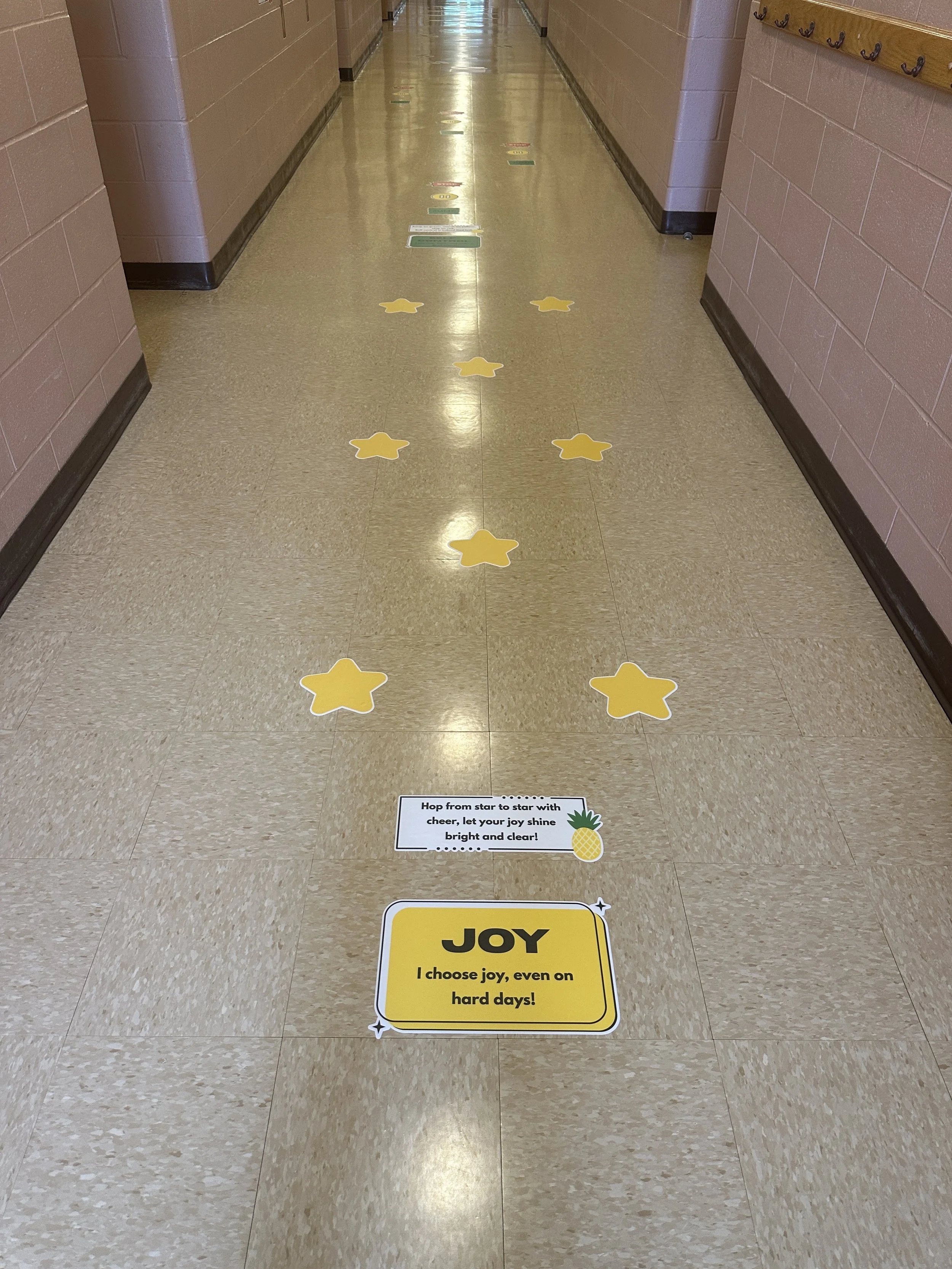
⭐ Joy — Kids hop from star to star declaring "I choose joy, even on hard days!" Building gross motor coordination with every joyful leap.
👣 Patience — Follow footsteps slow and steady with reminders to "slow down" and "breathe." Building motor planning and self-regulation while learning that good things are worth waiting for.
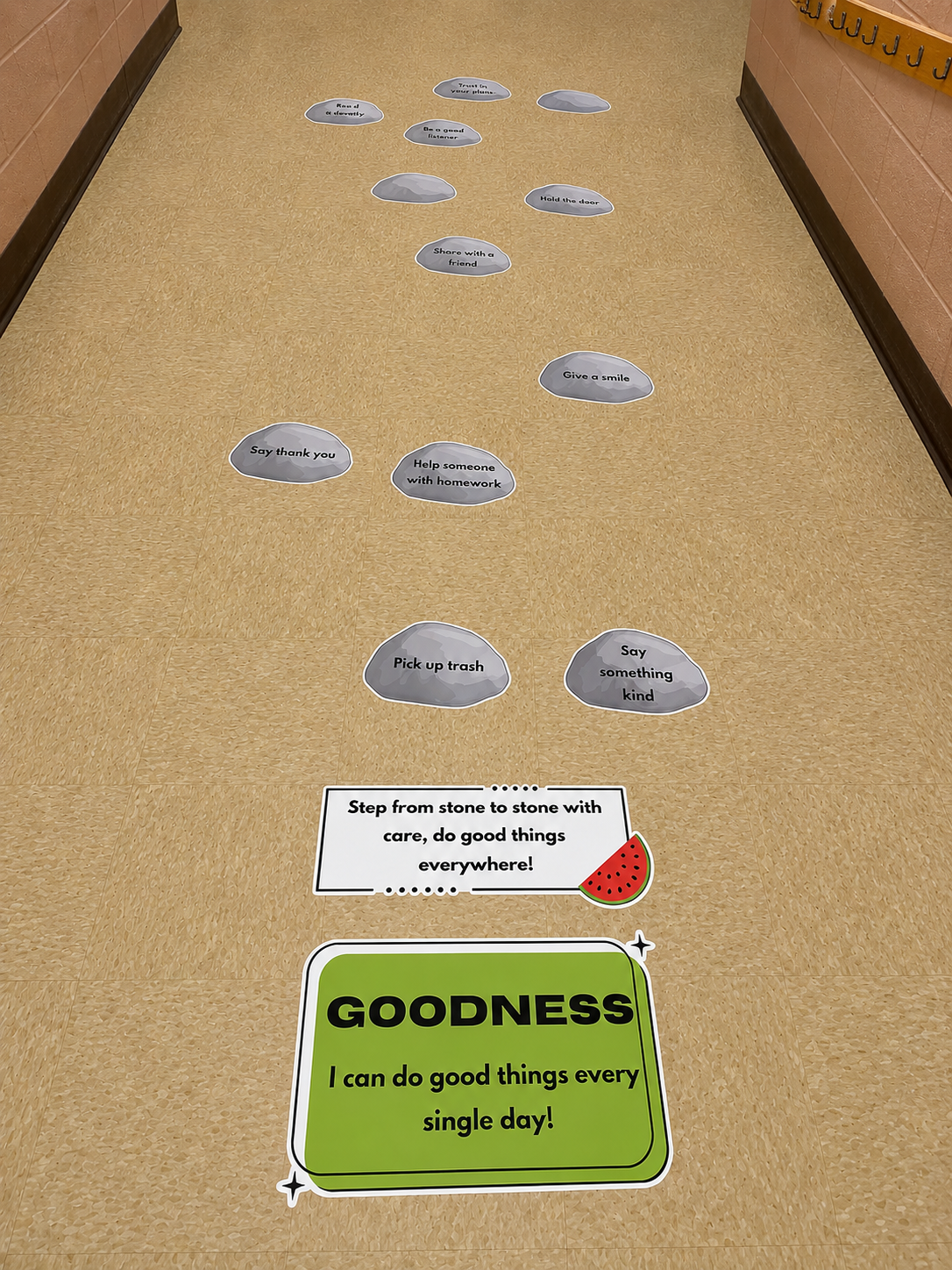
🪨 Goodness — Step from stone to stone printed with acts of goodness like "say thank you," "share with a friend," and "give a smile." SEL and faith beautifully woven together.
❤️ Love — Trace a large heart on the wall with both hands, building bilateral coordination while declaring "God loves me and I can show love to others!"
🌀 Peace — Trace spirals and breathe slowly, feeling God's peaceful calming glow. Perfect for students who need a moment to regulate before class.
🤲 Kindness — Reach across and touch each hand on the wall, building crossing midline skills while spreading kindness across the land.
✝️ Faithfulness — Trace the cross from top to toe, declaring "God is faithful and I can be too!" Beautiful bilateral coordination activity with deep faith meaning.
🌸 Gentleness — Tiptoe petal to petal with care, showing gentleness everywhere. Body awareness and self-control in every soft step.
🚦 Self-Control — Jump on green, march on yellow, stop on red. Self-control is indeed God-led! One of my absolute favorites for helping students practice impulse control in a fun, embodied way.
Plus a stunning Galatians 5:22 title decal to anchor the whole path!
What It Supports:
Every activity was designed by me — a licensed school-based occupational therapist — to support critical developmental skills including gross motor coordination, bilateral coordination and crossing midline, motor planning and sequencing, self-regulation and emotional development, SEL and character development, focus and body awareness.
Two Ways to Get Started
I know that every school has a different budget and a different level of readiness — so I created two options:
🍓 Full Fruit of the Spirit Sensory Path — $1,595 All 9 activities, 5 on the floor and 4 on the wall, plus the Galatians 5:22 title decal. A complete hallway transformation that will last for years. 👉 Shop the full path here
🌟 Fruit of the Spirit Starter Set — $600 Not ready to go all in? Start with Joy, Patience, and Goodness — 3 floor activities that are the perfect introduction to the Fruit of the Spirit path. And every dollar you spend on the Starter Set applies toward the full path when you're ready to grow! 👉 Shop the Starter Set here
Summer Is the Perfect Time
Empty hallways. No disruptions. No students to work around. Summer is hands down the best time to install a sensory path — your school will be ready to welcome students on day one of fall with something truly special waiting for them in the hallway.
Ohio schools — I offer FREE installation. I come to you! 🙏
I would love to help your school bring Galatians 5:22 to life this summer. Feel free to reply to any of my emails or reach out through the website — I read every single message personally and deeply appreciate your support!
School's Almost Out — But Now Is the Perfect Time to Plan for Fall
The countdown is on. Students are watching the clock, teachers are wrapping up the year, and administrators are already thinking about what next fall will look like.
If a sensory path has been on your school's wish list, now is the time to act — not because of urgency, but because summer is genuinely the best time to make it happen.
Empty hallways mean easy, disruption-free installation. Your path will be professionally installed, dried, and ready to welcome students on the very first day of the new school year. No chaos, no interruptions — just a beautiful new space waiting to inspire your kids from day one.
Which Sacred Steps Path Is Right for Your School?
Every school is different, which is why Sacred Steps offers four options to fit your space, budget, and goals.
Floor Path - Our most popular option. The floor path transforms your school hallway into an interactive, faith-filled movement experience featuring Bible stories, Scripture verses, and movement activities. Perfect for schools with long corridors and high student traffic. Students of all ages — from kindergarten through middle school — stop to walk it every single day.
Wall Path - Bring Scripture and movement to any wall space. The wall path is ideal for schools with limited floor space, or for adding a faith element to a specific area like a gym lobby, stairwell, or prayer room. Beautiful, eye-catching, and completely customizable to your space.
Portable Path - Take the sensory experience anywhere. The portable path rolls out and rolls up, making it perfect for therapy rooms, classrooms, gymnasiums, or multi-use spaces. No permanent installation required — just unroll and go.
Starter Set - Not sure where to begin? The Sacred Steps Starter Set is the perfect introduction to faith-based sensory paths at a lower entry point. A great way to bring Sacred Steps into your school and let your students (and staff!) fall in love before expanding.
Not Sure Which One Is Right for You?
That's exactly what our free consultations are for! Book a no-pressure call and we'll talk through your space, your students, and your goals together.
A Special Bonus — This Week Only!
Order any full path by Friday, May 22nd and receive a FREE Rosary Infinity Loop Activity (a $110 value) automatically added to your order. No code needed — it's our gift to you for planning ahead!
The Rosary Infinity Loop is one of our most beloved additions — children trace the infinity loop path while praying the Hail Mary, with footprints to guide proper body placement every step of the way. It's faith and movement beautifully combined.
Here's What School Leaders Are Saying:
"The sensory paths have been a blessing for all of our students. Our elementary students love walking down the path every day and in middle school, students stop between classes to follow the rosary." — Brandi Lumley, Assistant Principal, Saint John the Baptist Catholic School, Madison, AL
"Trisha was very professional, the installation was perfect, the product is beyond my expectations, and our students absolutely love the sensory path. I couldn't ask for a better experience and result." — Tracy Koenig, Principal, St. Patrick's Catholic School, Bryan, OH
Summer Is Short — Let's Make It Count
Sacred Steps Sensory Paths are currently in Catholic schools across 24 states, and every single one of them started with one simple question: which path is right for us?
Let's answer that question together.
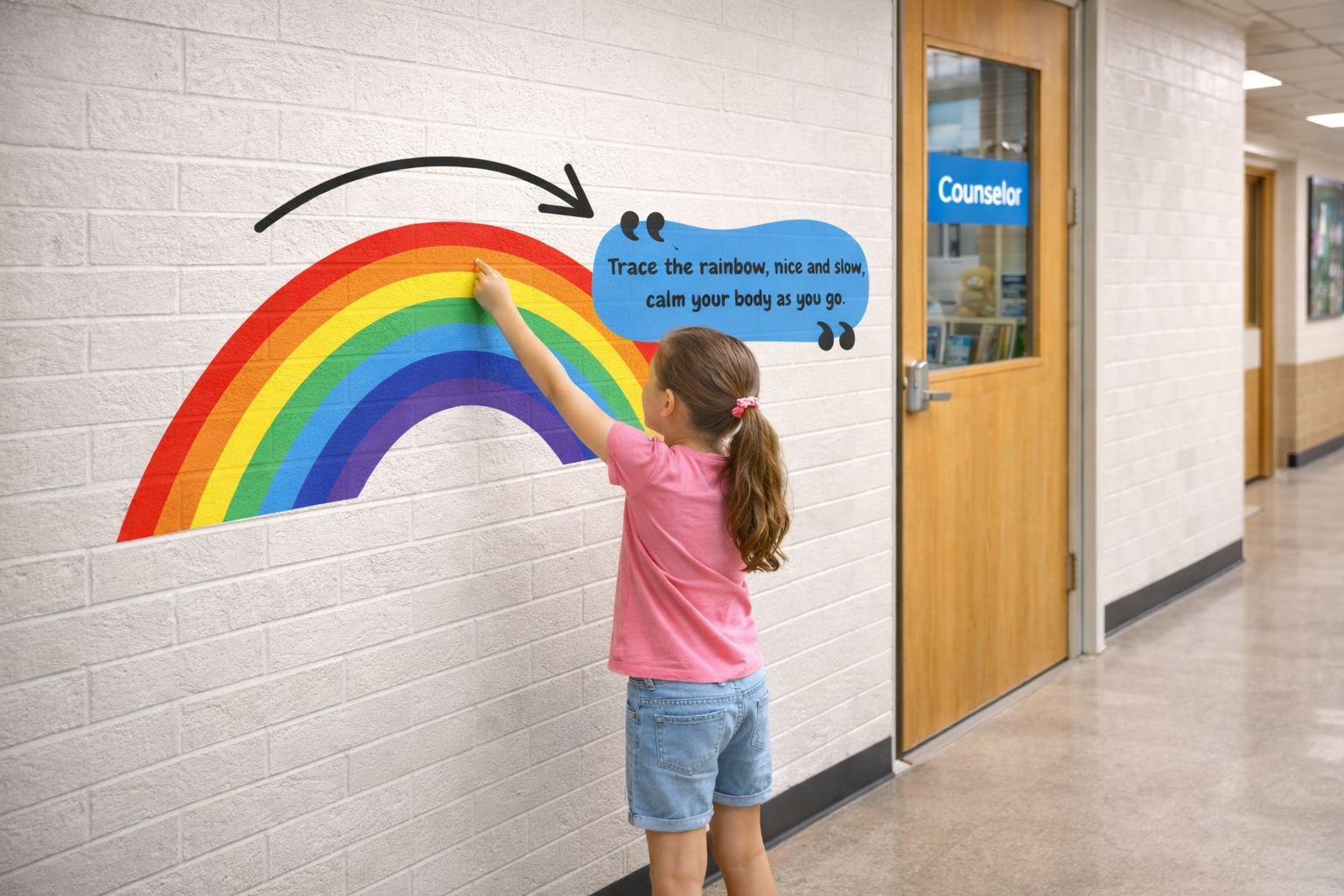
The Difference Between a Calming Corner and a Sensory Path (And Why Your School Needs Both)
A student tracing a rainbow wall decal outside a school counselor's office with the calming prompt "Trace the rainbow, nice and slow, calm your body as you go" — a Sacred Steps calming corner wall activity designed to help students self-regulate before entering the classroom.
If you've been researching sensory tools for your Catholic school, you've probably come across two terms that get used a lot — calming corners and sensory paths. While both are incredibly valuable for students, they serve very different purposes. Here's what you need to know.
What is a Sensory Path?
A sensory path is a series of floor or wall decals placed in a school hallway, classroom, or common area that guides students through a sequence of intentional movement activities. Hopping, balancing, crossing the midline, spinning — each activity is designed with specific occupational therapy goals in mind.
Sensory paths are primarily used during transitions — helping students regulate their bodies as they move from one activity to the next. They're active, engaging, and fun.
At Sacred Steps, our sensory paths also incorporate Scripture verses, saints, and faith-based movement prompts — turning every step into a moment of connection with God. ✝️
What is a Calming Corner?
A calming corner is a designated space — usually in a classroom or hallway nook — where students can go when they feel overwhelmed, anxious, or dysregulated. It's a quiet, intentional space equipped with tools to help them self-regulate before returning to the classroom.
A well-designed calming corner might include:
Visual breathing aids
Sensory tools like fidgets or weighted items
Calming imagery or Scripture
A quiet, low-stimulation environment
Calming corners are primarily used reactively — when a student needs a reset in the moment.
So What's the Difference?
Think of it this way:
A sensory path is proactive — it gives students regular movement input throughout the day so they're less likely to become dysregulated in the first place.
A calming corner is reactive — it gives students a safe place to reset when they do become overwhelmed.
Both are valuable. Both serve different needs. And together, they create a comprehensive sensory-supportive environment for your students.
Why Your School Needs Both
The most sensory-supportive schools use both tools strategically. Students walk the sensory path as part of their regular routine — building regulation into their day. And when a student still needs a reset, the calming corner is there as a safe, welcoming space.
At Sacred Steps, we offer both faith-based sensory paths AND calming corner activity sets — so your entire school environment can nurture the whole child, body, mind, and spirit. 🙏
Browse our sensory paths here. Browse our calming corner sets here.
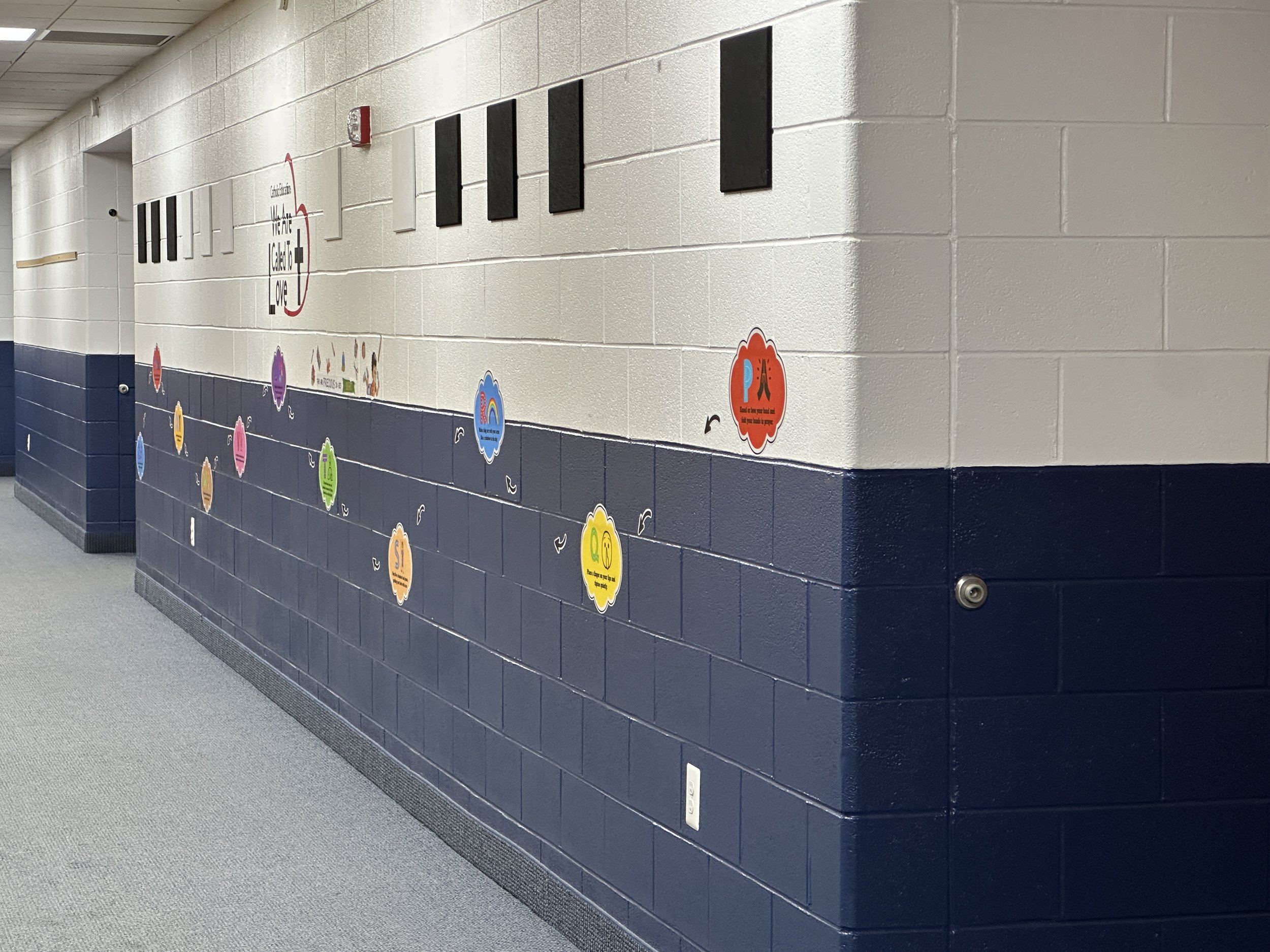
What Makes Sacred Steps Sensory Paths Different From Other Sensory Paths
If you've been researching sensory paths for your school, you've probably come across a few different options. So what makes Sacred Steps different? We're glad you asked.
1. Designed by an Occupational Therapist Sacred Steps Sensory Paths aren't just pretty graphics on a floor. Every activity is intentionally designed by a pediatric OT to target specific sensory and motor goals — bilateral coordination, balance, crossing the midline, and body awareness. There's a therapeutic purpose behind every hop, jump, and step.
2. Faith-Based Content That Reinforces Your Mission Most sensory paths feature generic animals, shapes, or characters. Sacred Steps paths feature Scripture verses, saints, crosses, and faith-inspired movement prompts — turning every step into a moment of connection with God. For Catholic schools, this means your hallway actively reinforces what you're teaching in the classroom.
3. Commercially Printed for Durability Sacred Steps paths are professionally and commercially printed — not DIY or printed at home. That means vibrant colors, clean edges, and durability that holds up to hundreds of students walking over them every day.
4. Options for Every School Whether you're a Catholic school, public school, parish, or therapy space — Sacred Steps has an option for you. Our faith-based paths feature Scripture and saints, while our universal paths incorporate SEL concepts that work in any setting.
5. Portable and Permanent Options Need flexibility? Our portable paths can be moved and repositioned as needed. Prefer something more permanent? Our floor decals create a beautiful, lasting hallway feature. Either way, installation takes minutes and requires no tools or special skills.
6. Proven in Schools Across 24 States Sacred Steps paths are currently serving students in 24 states nationwide — in Catholic schools, public schools, parishes, and therapy spaces. Real schools. Real students. Real results.
"The sensory paths have been a blessing for all of our students. Our elementary students love walking down the path every day and in middle school, students stop between classes to follow the rosary." — Brandi Lumley, Assistant Principal, Saint John the Baptist Catholic School
Ready to see the difference for yourself? Browse Sacred Steps Sensory Paths here.
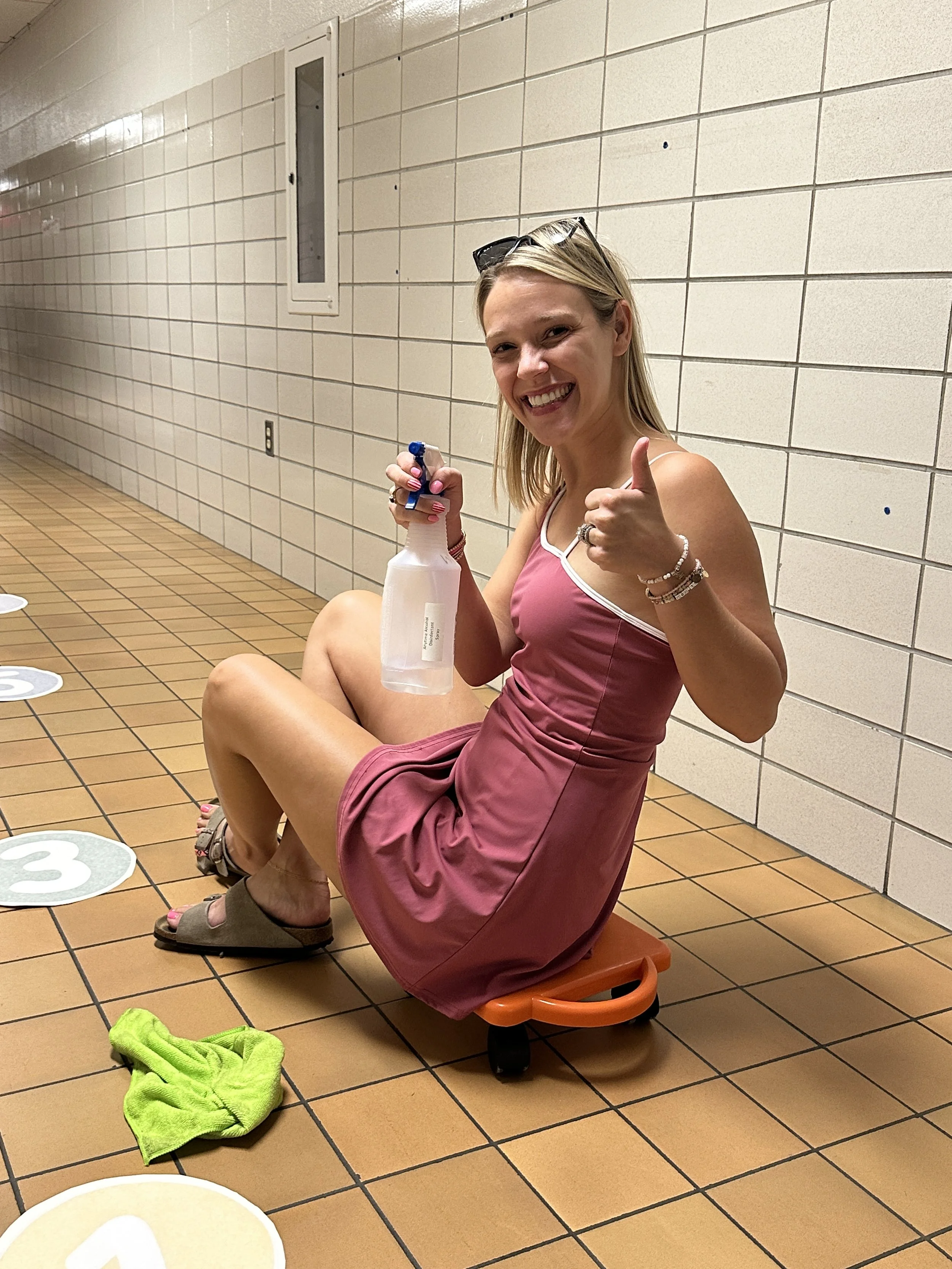
Why Summer Is the Perfect Time to Install a Sensory Path in Your School
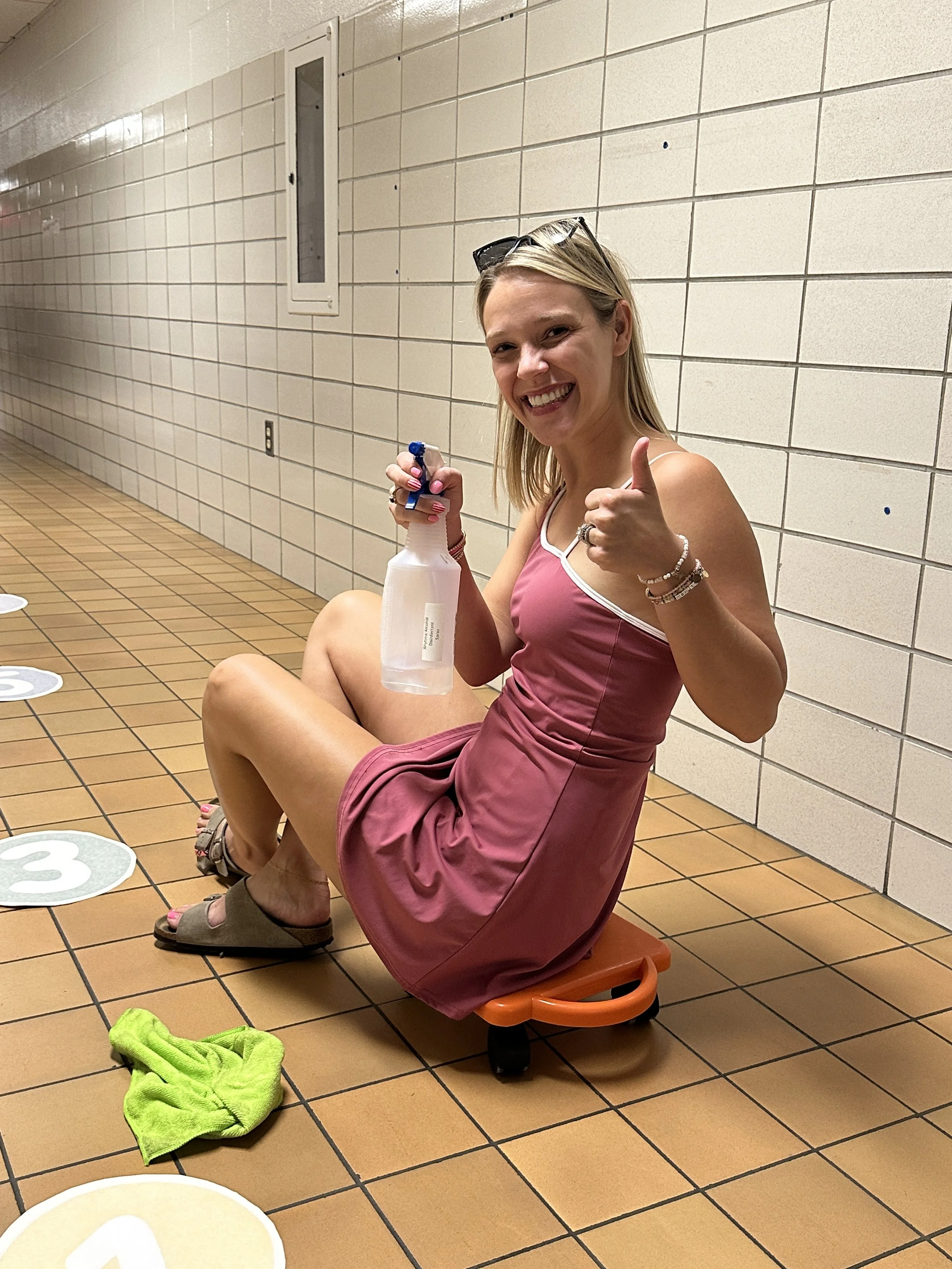
A teacher installing a Sacred Steps sensory path in her school hallway, showing how quick and easy the setup process is — no tools or special skills required.
The school year is winding down — and while most principals are thinking about summer break, the smart ones are thinking about September.
If a sensory path has been on your wish list, summer is hands down the best time to make it happen. Here's why:
1. No Disruption to Students or Staff Installation is quick and easy — but it's even easier when the hallways are empty. Summer gives you the freedom to plan placement, install without interruption, and have everything ready to wow students on the first day back.
2. Time to Plan the Perfect Spot Where should your path go? A main hallway? Outside the lunchroom? Near the resource room? Summer gives you time to walk your building, think strategically, and choose the location that will have the biggest impact.
3. Budget Planning Happens Now Most schools finalize their budgets in spring and summer. If you've been waiting for the right moment to bring a sensory path to your administration or school board, now is the time — before next year's budget is locked in.
4. Grants and Title I Funds Are Available Many schools use Title I funds, special education budgets, or parent organization grants to purchase sensory paths. Summer is a great time to research and apply — so your path is fully funded before fall.
5. Start the Year Strong Imagine your students walking through a beautiful, faith-filled sensory path on the very first day of school. It sets the tone for the entire year — calm, focused, and grounded in faith.
Sacred Steps Sensory Paths install in minutes and require no tools or special skills. Wall-mounted and floor options are available starting at $200. Shop now and be ready for September.
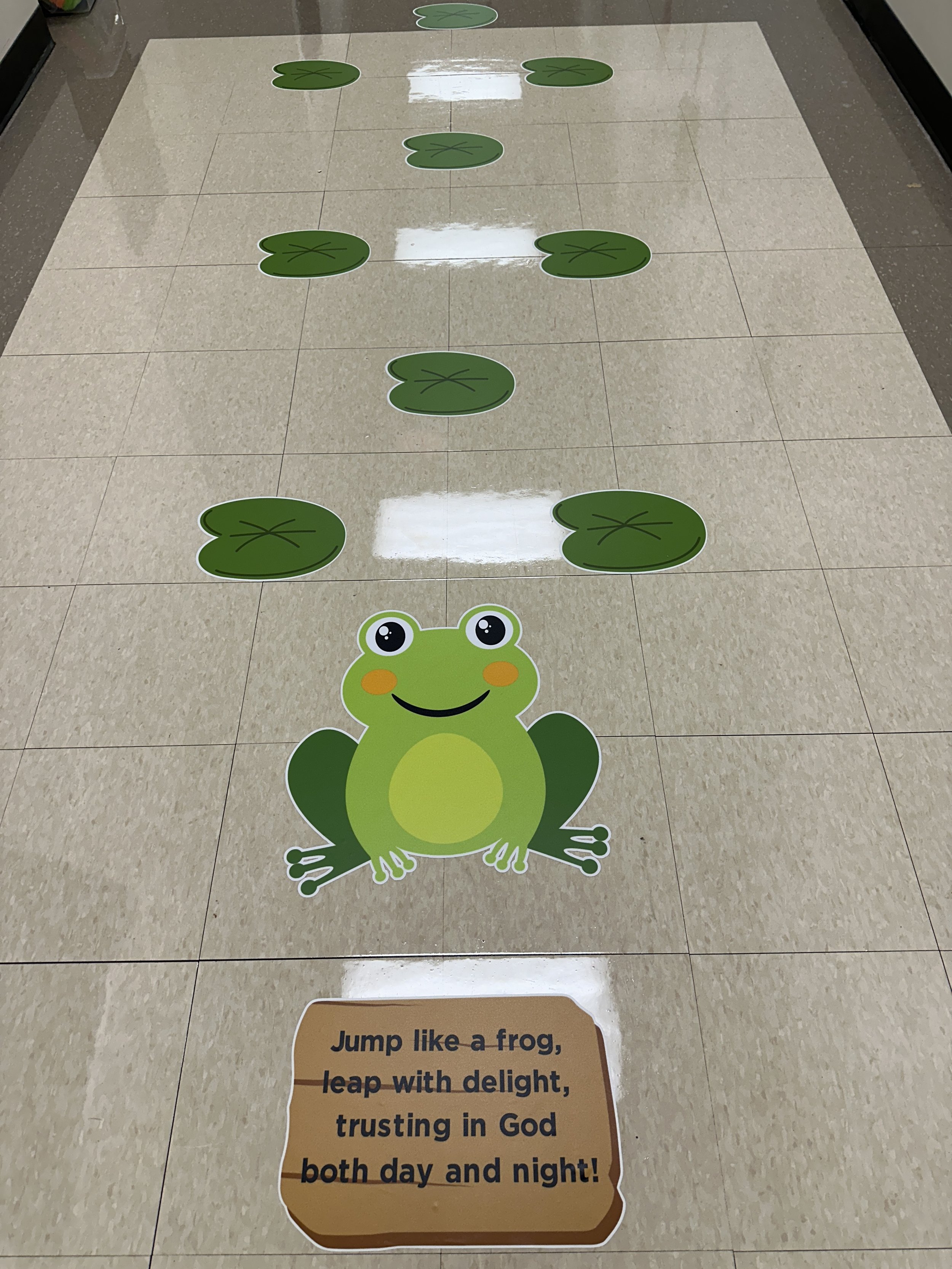
5 Ways a Sensory Path Can Transform Your School Hallway
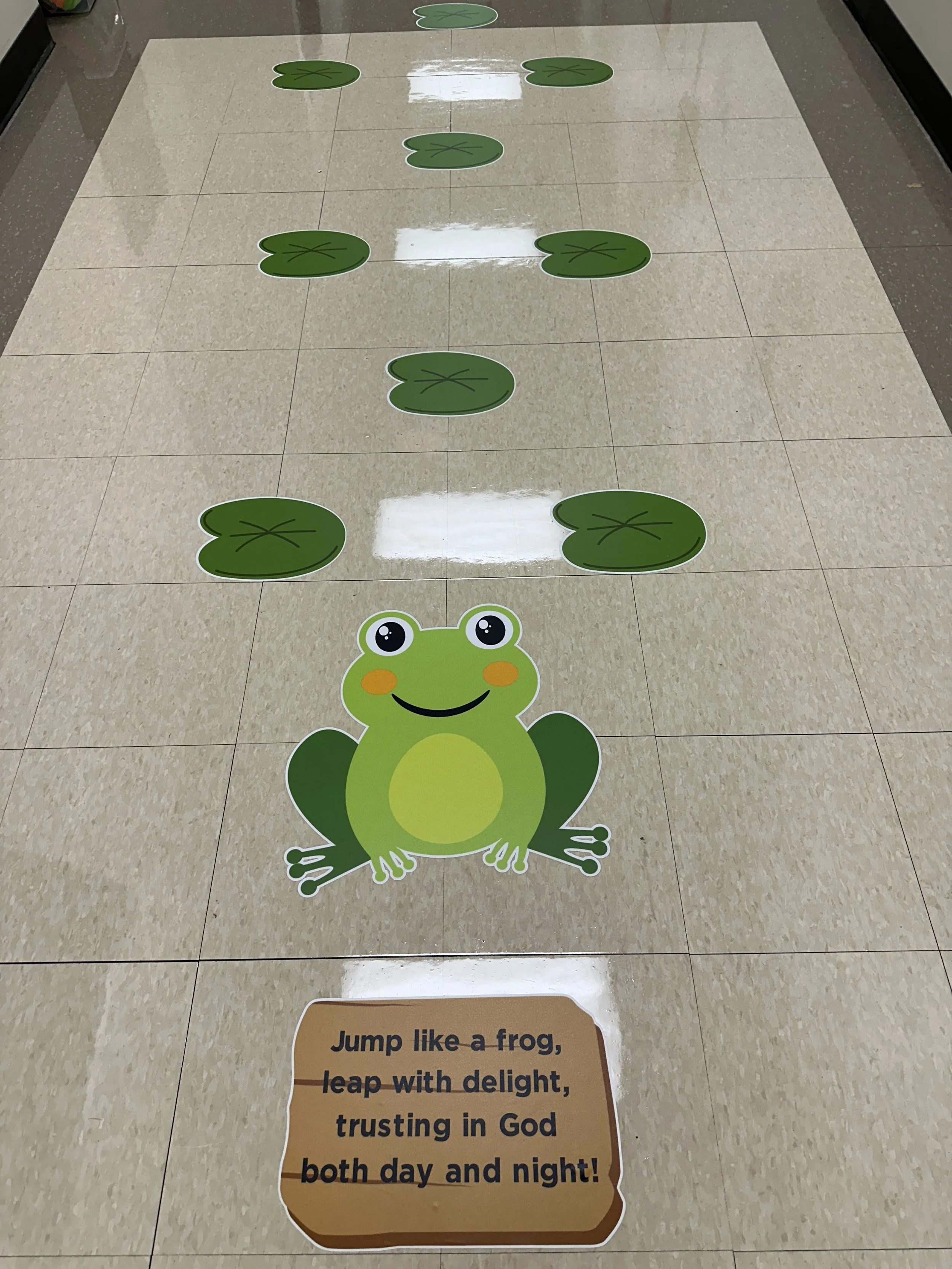
The Noah’s Ark Sacred Steps Sensory Path installed in a school hallway featuring a frog graphic with the Scripture-inspired prompt "Jump like a frog, leap with delight, trusting in God both day and night!
School hallways are often wasted space — just a path from one classroom to the next. But with a sensory path, that same hallway becomes one of the most powerful tools in your school.
Here's how:
1. Reduces Transition Meltdowns Moving between classrooms is hard for many kids, especially those with sensory processing differences. A sensory path gives their bodies something purposeful to do during transitions — so they arrive at their next class regulated and ready to learn.
2. Improves Focus in the Classroom When children get intentional movement breaks, they focus better. Research consistently shows that movement improves attention and academic performance. A two-minute sensory path walk can reset a child's entire afternoon.
3. Builds Motor Skills Without Therapy Time Hopping, balancing, crossing the midline — these are all occupational therapy goals that a well-designed sensory path reinforces naturally, throughout the school day, for every child.
4. Creates a Calmer School Culture When students have a healthy outlet for their energy, behavior improves school-wide. Teachers notice it. Principals notice it. Even parents notice it on pickup.
5. Reinforces Your School's Mission At Sacred Steps, our paths don't just move bodies — they move hearts. Scripture verses, crosses, and faith-based imagery turn every step into a moment of connection with God.
Ready to transform your hallway? Browse Sacred Steps Sensory Paths here.
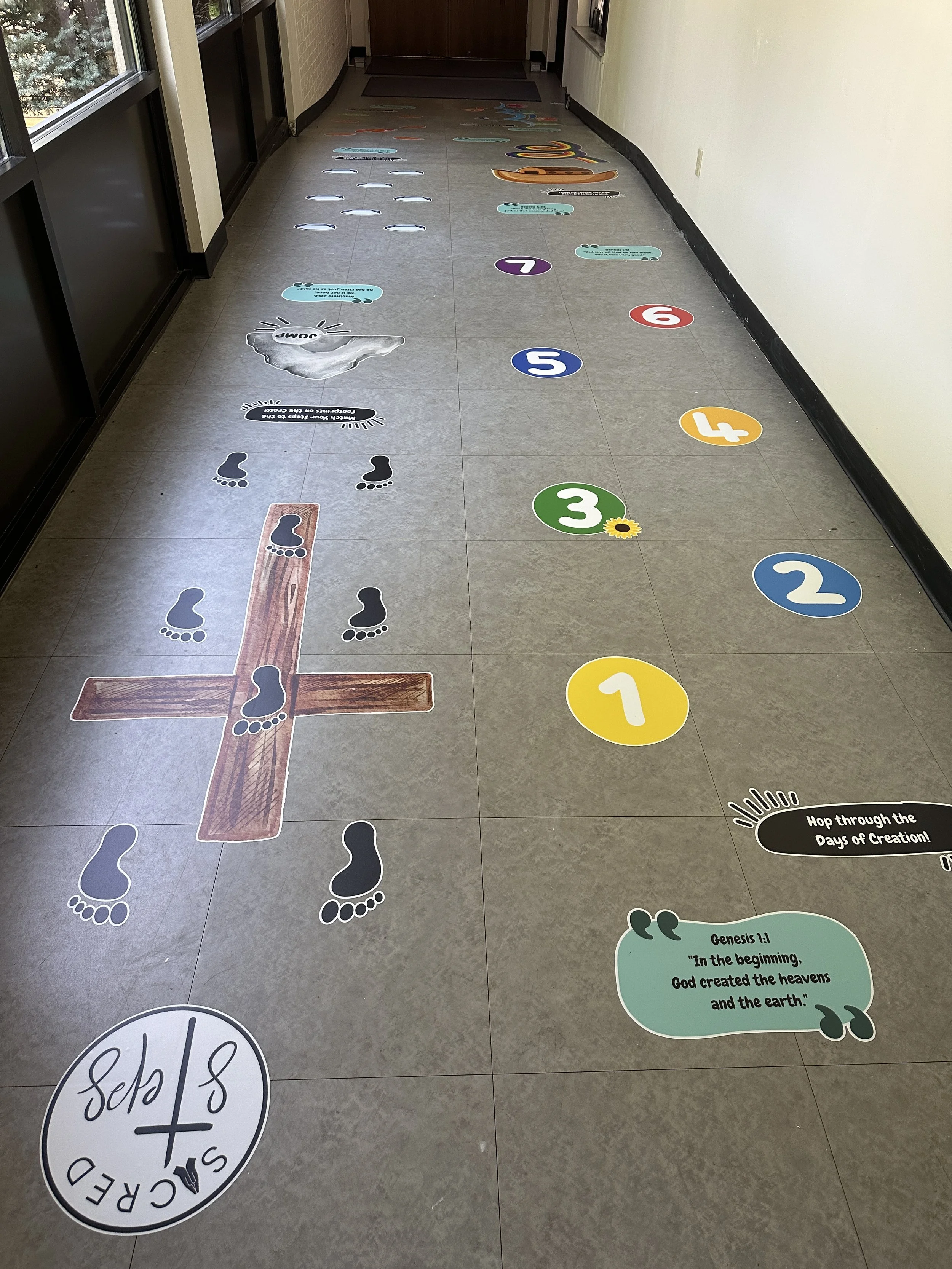
What to Look for in a Sensory Path for Your Catholic School
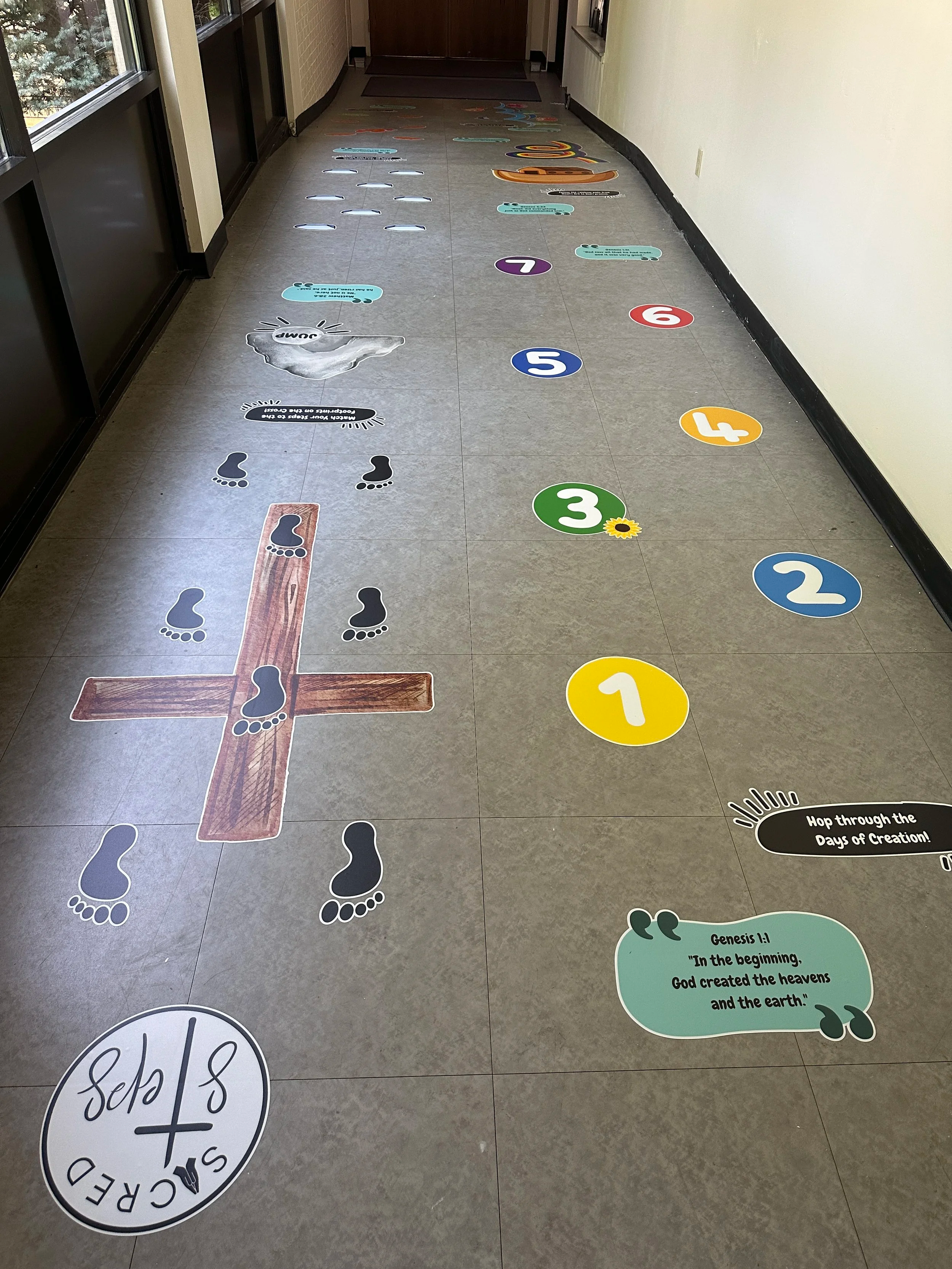
The Bible Stories Sacred Steps Sensory Path installed on a school floor featuring faith-based movement activities for Catholic school hallways.
If you've been searching for a sensory path for your Catholic school, you've probably noticed there aren't many options designed with faith in mind — and that matters more than you might think.
Movement and faith belong together.
Sensory paths help children regulate their bodies, improve focus, and transition more smoothly between activities. But in a Catholic school, why settle for generic shapes and animals when every wall can reinforce what you're already teaching?
Here's what to look for:
1. OT-Informed Design A sensory path should be created with occupational therapy principles in mind — not just fun graphics. Each activity should target specific motor and sensory skills like bilateral coordination, balance, and body awareness.
2. Faith-Based Content Look for paths that incorporate Scripture, crosses, prayer, or saints — elements that reinforce your school's mission while children move.
3. Flexibility Does it work in hallways? Classrooms? Can it be moved if needed? Portable options give you maximum flexibility without a permanent commitment.
4. Proven Results Look for a product used in real Catholic schools, with testimonials from principals, teachers, and OTs.
Sacred Steps Sensory Paths were designed by an occupational therapy professional specifically for Catholic schools — and are now serving students in 24 states. Browse our paths here.